Workflow AI Employees™
You were never supposed to be the whole company. Tell it what you want done, and an organization of forty-one AI roles starts moving, inside the limits you set and with every important decision still yours.
It is 11:40 on a Tuesday night. The kitchen is quiet, the kids are asleep, and you are on your fourth tab.
One tab holds the email tool, where a promotion sits half written. One holds the spreadsheet of people who asked about your service last month and never heard back. One is the payment dashboard, which says a customer paid twice and one did not pay at all. The fourth is a video called "how to connect your calendar to your website," paused at minute nine.
None of this is the work you started the business to do. All of it has to be done anyway, and you are the only one who knows how.
If you keep running the business this way, you will keep losing the hours that should go to customers, to pricing, to the next big move, because every task waits on the one person who can operate every tool. The tools were supposed to save you time. Instead they each asked you to become their operator.
Workflow AI Employees™ is how that changes.
What it feels like when you log in
When you log into your personal DriftFunnels account, you will feel like you have an entire company working for you, even if you are the only person in your business. You will no longer have to figure out which tools to use, which buttons to press, or how to connect everything. You will simply tell DriftFunnels what you want to accomplish, whether by speaking or typing, and it will help turn your goals into executable plans. Your websites, marketing, sales, customers, communications, finances, projects, and AI employees will work together as one intelligent system. You will be able to teach it how you do something once and have it repeat the process with your approval. Instead of spending your days operating software, you will spend your time making decisions, building relationships, and pursuing opportunities. Your account will increasingly feel like a personal operating environment built around your ambitions, your business, and the way you work.
What will make this experience fundamentally different is that your account will not simply generate answers or perform isolated tasks. It will help you operate. It will understand your objectives, track what is happening, identify what is preventing progress, coordinate work across your AI employees, and bring you the decisions that genuinely require your attention. You will be able to see what was accomplished, what it cost, what produced results, and what needs to happen next. As you use it, it will learn from verified outcomes and become increasingly useful without taking away your authority or spending money beyond the limits you establish. Whether your ambition is to earn your first $1,000, build a million-dollar company, or eventually operate a global enterprise, the underlying intelligence will be the same. You will not feel like you purchased another software subscription. You will feel like you have acquired an intelligent organization that you own, direct, and can grow with you.

One sentence in, finished work out
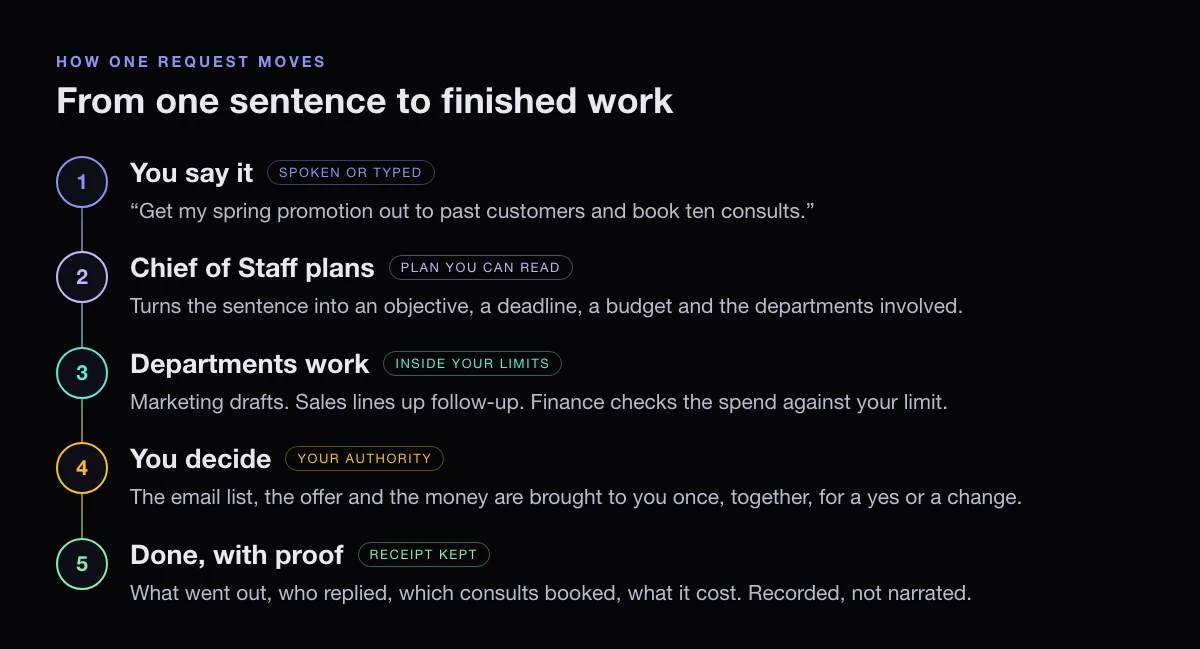
Say you type this, or say it out loud while you drive:
"Get my spring promotion out to everyone who bought last year, and book me ten consultations before the end of the month."
Here is what happens next, in order.
Your AI Chief of Staff reads the sentence and turns it into something a company can run: an objective (ten booked consultations), a deadline (the last day of the month), a budget (whatever you allow), and the departments that need to be involved. You see that plan written in plain words before anything goes out.
The Marketing leader assigns the Content Writing Specialist to draft the email and the Editorial Specialist to check it against how you sound. The Sales leader has the Sales Development Specialist prepare the follow-up for anyone who replies. The Finance leader checks the cost against the spending limit you gave it. The Governance leader confirms that every person on the list agreed to hear from you.
Then it stops and comes to you. The list, the message and the money arrive together, once, for a yes or a change. You do not get pinged nine separate times.
You say yes. It sends. Replies come in. Your calendar fills. At the end you see what went out, who answered, which consultations were booked and what the whole thing cost. That record stays in your account. Nobody has to remember it.
The organization you get
Every company that runs well has the same shape. Somebody sets direction. Somebody coordinates. Departments own their work. Specialists do the detail. Your account is organized the same way.
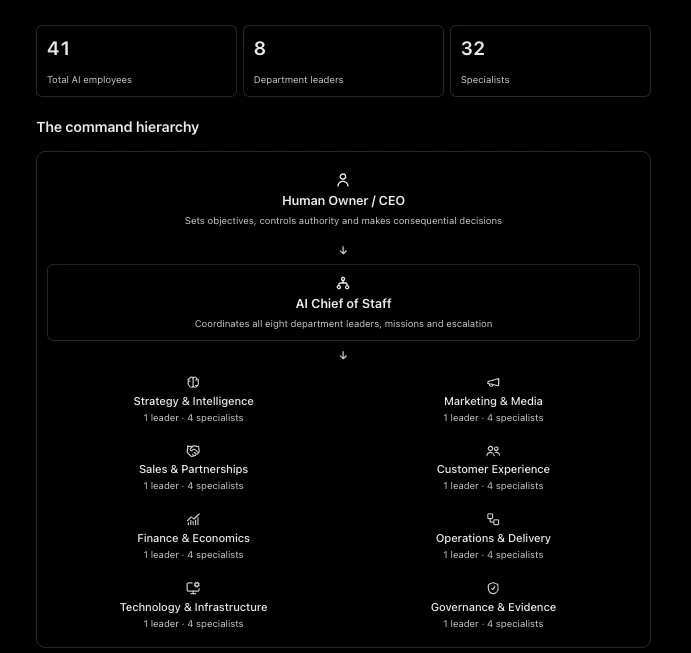
You, the owner and CEO. You set the objectives. You control the authority. You make the decisions that carry consequences. Nothing in this organization outranks you, and nothing in it can grant itself more power than you gave it.
Your AI Chief of Staff. Your one point of contact. It coordinates all eight department leaders, keeps track of every mission in motion, and decides what needs your attention and what does not. It is the role that lets you stop managing software and start running a company. It is also deliberately limited: a Chief of Staff with unrestricted authority would be a liability, so this one works only inside the permissions, budgets and decision rights you set.
Eight department leaders. Each one owns a part of your business, hands bounded assignments to its specialists, manages the handoffs between departments, and brings anything that exceeds its permissions back up the chain.
Thirty-two specialists. The people-sized jobs that make the work real: writing, reconciling, qualifying, testing, checking.
The eight departments, and who works in each
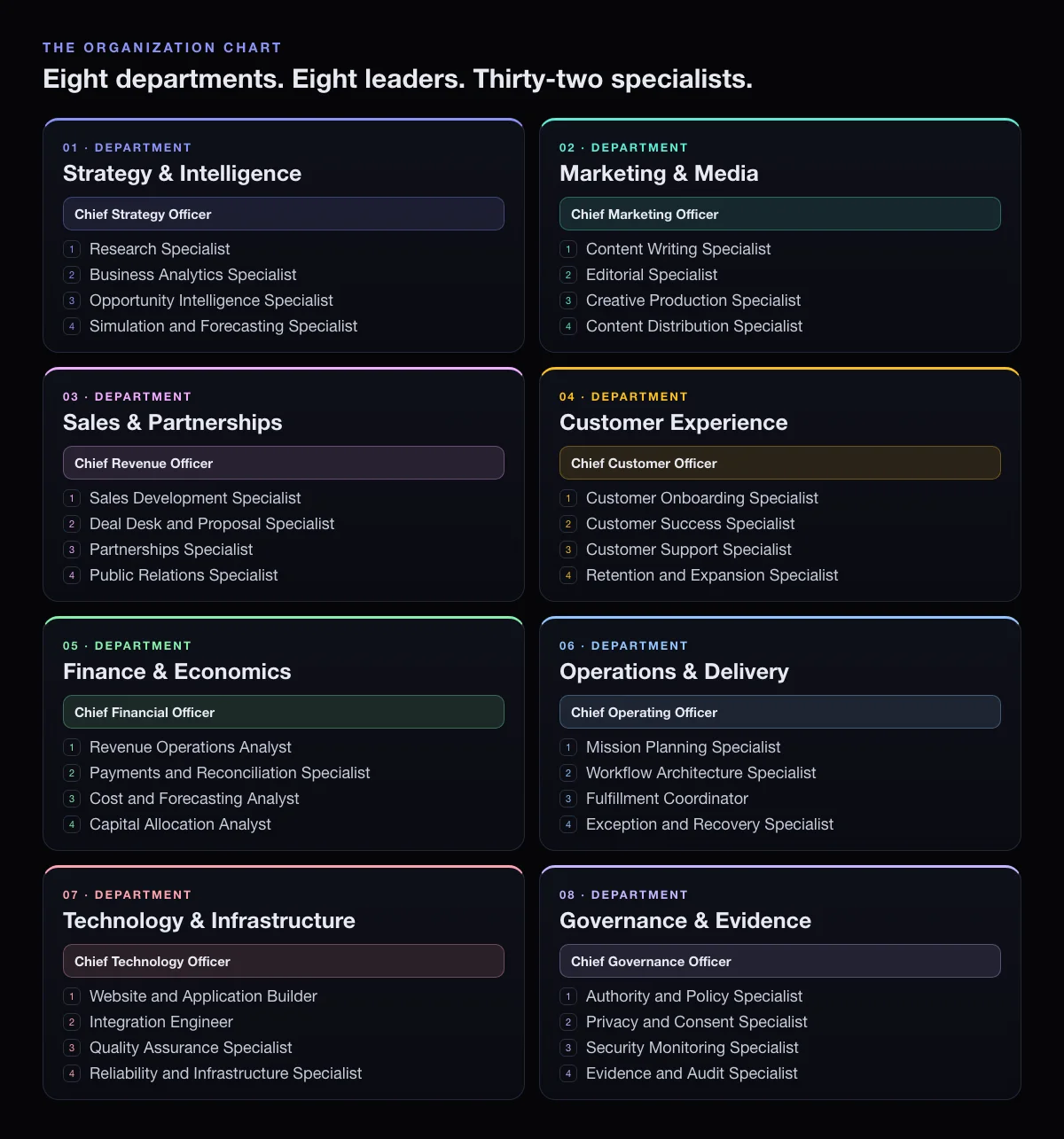
01 · Strategy & Intelligence
Led by the Chief Strategy Officer. Specialists: Research Specialist, Business Analytics Specialist, Opportunity Intelligence Specialist, and Simulation and Forecasting Specialist.
This department answers the questions you lie awake asking. Where is the next customer coming from? Which offer is worth more of your time? What is actually holding the business back this month? It researches your market, finds growth opportunities, runs the numbers on different scenarios and names the single constraint slowing you down, so your effort goes where it moves something.
02 · Marketing & Media
Led by the Chief Marketing Officer. Specialists: Content Writing Specialist, Editorial Specialist, Creative Production Specialist, and Content Distribution Specialist.
Campaigns, messaging, email, social posts, video and creative assets. This team writes in your voice, checks it before it leaves, produces the visuals and puts approved work in front of the right people. Approved is the important word. Your name goes on everything it sends, so you decide what counts as approved.
03 · Sales & Partnerships
Led by the Chief Revenue Officer. Specialists: Sales Development Specialist, Deal Desk and Proposal Specialist, Partnerships Specialist, and Public Relations Specialist.
Every interested person gets followed up. Every qualified lead gets a proposal. Every promising relationship gets nurtured instead of forgotten in an inbox. This is the department that turns attention into appointments and appointments into signed work, and it handles the press and partner conversations that open new doors.
04 · Customer Experience
Led by the Chief Customer Officer. Specialists: Customer Onboarding Specialist, Customer Success Specialist, Customer Support Specialist, and Retention and Expansion Specialist.
The customer who just paid should feel taken care of within the hour. This team gets new customers started, answers their questions, helps them reach the result they bought from you, and notices when someone is ready for more, or quietly slipping away. Customers who feel looked after come back and bring friends.
05 · Finance & Economics
Led by the Chief Financial Officer. Specialists: Revenue Operations Analyst, Payments and Reconciliation Specialist, Cost and Forecasting Analyst, and Capital Allocation Analyst.
What came in. What went out. What each campaign cost and what it returned. Which payments are missing. Whether you can afford the next move. This team keeps the money honest, matches every payment to what it was for, and gives you a clear recommendation before you invest, instead of a surprise after.
06 · Operations & Delivery
Led by the Chief Operating Officer. Specialists: Mission Planning Specialist, Workflow Architecture Specialist, Fulfillment Coordinator, and Exception and Recovery Specialist.
Deadlines, handoffs, delivery and the thousand small steps between a sale and a finished job. When you teach the business how you do something once, this is the team that turns it into a repeatable process. When something breaks halfway through, the Exception and Recovery Specialist picks it back up from where it stopped instead of starting over.
07 · Technology & Infrastructure
Led by the Chief Technology Officer. Specialists: Website and Application Builder, Integration Engineer, Quality Assurance Specialist, and Reliability and Infrastructure Specialist.
Your website, your pages, the tools you already use and how they connect. This team builds, tests before anything goes live, connects the systems you authorize, and keeps everything running. When something needs repair, it proposes the fix, or makes it if you have already allowed that kind of repair.
08 · Governance & Evidence
Led by the Chief Governance Officer. Specialists: Authority and Policy Specialist, Privacy and Consent Specialist, Security Monitoring Specialist, and Evidence and Audit Specialist.
The team that keeps everyone else honest. It checks independently that every action had permission, that every customer contacted had agreed to be contacted, that nothing touched data it should not have, and that every result claimed has evidence behind it. A business that can prove what it did is a business people trust with more.
The count, plainly
| Level | Count |
|---|---|
| AI Chief of Staff | 1 |
| Department leaders | 8 |
| Department specialists | 32 |
| Total | 41 |
Forty-one is the complete blueprint of a well-run company. It is not forty-one things running all at once and billing you for it. A one-person business might begin with the Chief of Staff and three or four specialists. A growing company might turn on full departments. A large organization can run the whole chart and add teams built for its own industry, such as healthcare, retail or manufacturing, when the demand is there to justify them.
You grow into the organization. You never pay for an organization you are not using.
Your authority is written down before anything moves
Here is the fear most owners have about letting anything work on their behalf: it will do something they did not want, spend money they did not have, or send something they cannot take back.
That fear is reasonable, so the answer lives in the structure of the account itself.
Before your AI employees act, the limits are set. What each department may do without asking. How much it may spend, and over what period. Which customers it may contact, and through which channels. Which kinds of decisions always come back to you. These limits are yours to widen or narrow at any time.
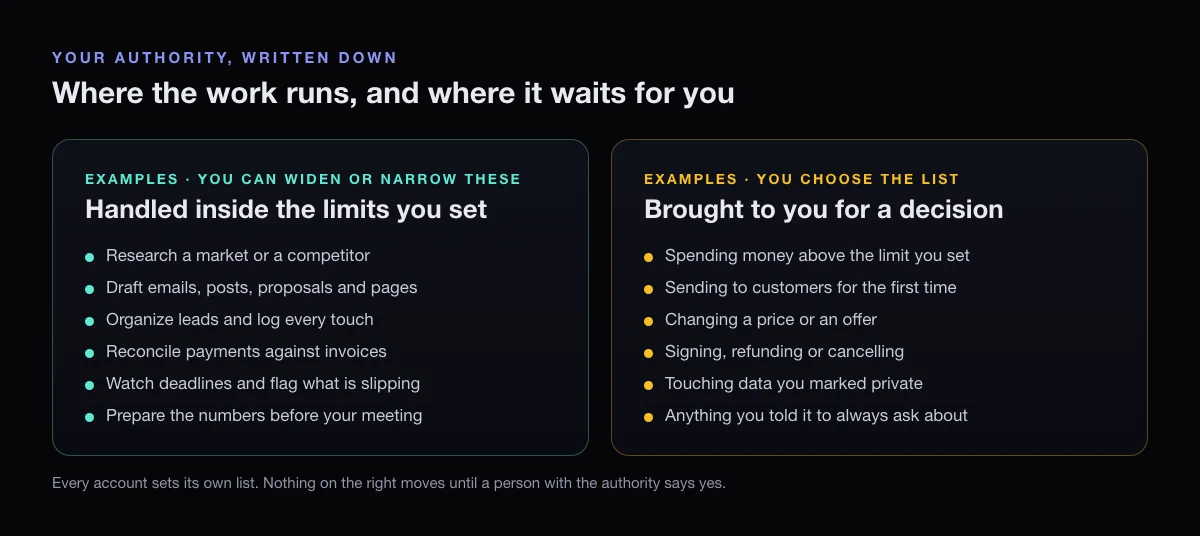
A few promises follow from that.
It cannot give itself more power. No employee, no department and not even the Chief of Staff can raise its own limits. Only you can.
Money it may spend is accounted for before it is spent. Permission to spend a hundred dollars once is never permission to spend it a thousand times. The running total counts against your limit across every mission at once.
If something is uncertain, it stops instead of guessing. Say a payment request times out and nobody can tell whether it went through. The system does not try again and risk charging twice. It holds, checks what actually happened, and only then continues.
A refusal opens another route. When an employee hits a limit, it first looks for another path that stays inside your permissions. Only when there is none does it bring you the smallest possible decision, with what it tried and what blocked it.

Every result comes with a receipt
Most software tells you it did something. A busy dashboard and a green checkmark feel like progress. They are not proof.
Your AI employees keep a record of what they did, who approved it, what it cost and what happened afterward. "Email sent" and "email delivered" are kept as two different facts, because they are. "Consultation booked" is tied to the person, the message that brought them in and the money that followed. When you ask what worked last quarter, the answer comes from what actually happened, not from what somebody hoped happened.

This matters more than it sounds. When results are recorded honestly, the system learns from the truth. It gets better at the things that genuinely worked and stops repeating the things that only looked busy.
Teach it once
You already know how to do the parts of your business that make you good at it. The way you welcome a new client. The questions you ask before you quote a job. The three follow-ups that close most of your deals.
Show your AI employees once. Walk through it, or describe it in your own words. Operations turns it into a repeatable process, Governance checks it respects your rules, and the next time it is needed it runs the way you do it, with your approval at the points you choose. The tenth time is as careful as the first. Your best way of working stops living only in your head.
Four owners, the same account
People run businesses differently. The account meets each of them where they are.
If you think three moves ahead, you will spend your time in Strategy and Intelligence. You will ask what is really limiting growth, compare scenarios before committing money, and watch which bets paid off. The organization gives you a place to think at the level of the whole business, and a team to carry the plan out once you decide.
If you need everything checked, logged and in its place, you will live in the limits and the receipts. Every permission written down. Every action recorded. Every dollar matched to what it was for. Nothing happens that you cannot look up afterward, and nothing important happens without the approval you require.
If your business is about people, you will notice what comes back to you: time. The follow-ups that used to slip, the thank-you notes, the check-in with the customer who went quiet. Your Customer Experience team keeps those relationships warm, so the hours you spend with people are the ones that matter most.
If you want to see something move today, you will type one sentence and watch it become a plan, a draft and a sent campaign before lunch. No setup marathon. No manual. Results you can point to by the end of the day, and a clear next move after that.
Quiet or outgoing, speak or type, morning planner or late-night sprinter, it works the way you work. That is the point of having an organization instead of a tool.
What changes in your week
Monday, you tell your Chief of Staff the one thing that matters most this week. It comes back with a plan and the two decisions it needs from you.
Wednesday, a customer asks a question at 10 p.m. Customer Support answers within your guidelines. You read the summary with your coffee.
Thursday, Finance flags that a campaign is costing more per booked client than it earns. It recommends pausing it and shows you why. You agree with one tap.
Friday, you open a single page and see what moved: new leads answered, consultations booked, payments collected, and what each one cost. You know where you stand without building a single report.

What is true today, and what we are still building
You deserve a straight answer, because the rest of this page asks you to trust us with your business.
Your DriftFunnels account already includes working AI employees, an assistant you can speak or type to, and authority limits that decide what they may do on your behalf. What they do is recorded.
The forty-one-role organization on this page is the complete chart those employees are growing into. We publish the whole blueprint so you can see where your account is going, and because a company you are going to trust should show you its plans. Roles turn on as they are ready and as your business needs them. We will not tell you a role is working before it is.
Why trust it
It works for you alone. Your AI employees work inside your account, for your business. We use the same kinds of roles to run our own company, in a separate account with separate permissions. Using the same technology gives neither side access to the other's private information.
You can leave with your history. Your customers, your records and what your business learned belong to you. Leaving should never mean losing your operating history, so it does not.
It cannot spend what you did not approve. Spending limits are set by you and counted before money moves.
It does not grade its own work. Results are checked against what actually happened, by a department whose only job is checking.
What it costs to start
Start on the Free Gate. It is $0 forever, and no credit card is required. Your AI employees, your assistant and your authority limits are part of the account from the first day. Every capability is available on the free floor; paid plans buy more volume and more room to grow, never the right to use a feature. When you are ready for more, the plans are on the pricing page.
If it does not earn its place in your week, you have lost nothing but an evening.
Frequently asked questions
What is a Workflow AI Employee?
A Workflow AI Employee is a defined role inside your DriftFunnels account, such as a Content Writing Specialist or a Payments and Reconciliation Specialist, that does a specific part of your business's work inside the limits you set. Employees are organized into eight departments under one AI Chief of Staff, and every important decision still comes to you.
How many AI employees do I get?
The complete organization has forty-one roles: one AI Chief of Staff, eight department leaders and thirty-two specialists. You do not need all of them at once. A small business can start with the Chief of Staff and a few specialists, and turn on more as the business grows.
Will it spend money or send messages without asking me?
Only inside the limits you set. You decide what each department may do on its own, how much it may spend and which decisions always come back to you. Spending is counted against your limit before money moves, and nothing in the organization can raise its own limits.
Do I have to learn how to connect all my tools?
No. You tell your account what you want done, by speaking or typing, and your AI employees work out which tools and steps are needed. Connecting a tool you already use is a step you approve, and the Technology department handles it.
How is this different from a chatbot?
A chatbot answers a question and waits for the next one. Your AI employees work toward an objective: they plan, divide the work between departments, track progress, bring you the decisions that matter and record what actually happened, including what it cost.
What happens if something goes wrong halfway through?
The work picks up from where it stopped. If the system cannot tell whether an action went through, such as a payment that timed out, it checks what happened before doing anything else, so nothing is charged or sent twice.
Can I teach it how I do things?
Yes. Show it or describe a process once, and it becomes a repeatable process that runs your way, with your approval at the points you choose.
Can another business see my information?
No. Your private information stays in your account, and two businesses using the same technology gives neither one access to the other's records. Your account, your customers and your records belong to you, and you can leave with your history.
How much does it cost?
You can start on the Free Gate for $0, with no credit card. Paid plans add volume and room to grow. They never lock a capability behind a price.
Is the full forty-one-role organization available today?
Your account includes working AI employees today. The forty-one-role chart is the full organization they are growing into, and roles are turned on as they are ready. We tell you plainly which ones are working rather than claiming the whole chart is finished.
What to do next
The Free Gate tier is free, permanently, and you do not need a credit card to start. The Free Gate is $0 forever. No credit card is required.. Paying for a higher tier buys more volume and more leverage — it never unlocks a capability we were holding back.
- Start Free — No Card Needed
- See what every tier costs
- Check what we have built before you trust any of it
If it turns out not to be for you, you have paid nothing and there is nothing to cancel.