The New Search War: SEO, AEO, and GEO — The Complete Master Class for the AI Search Era
How to make one written article rank in search, answer the question, and become evidence for generative engines
Antonio T Smith Jr, Founder, Density6 · August 26, 2026 · 51 min read
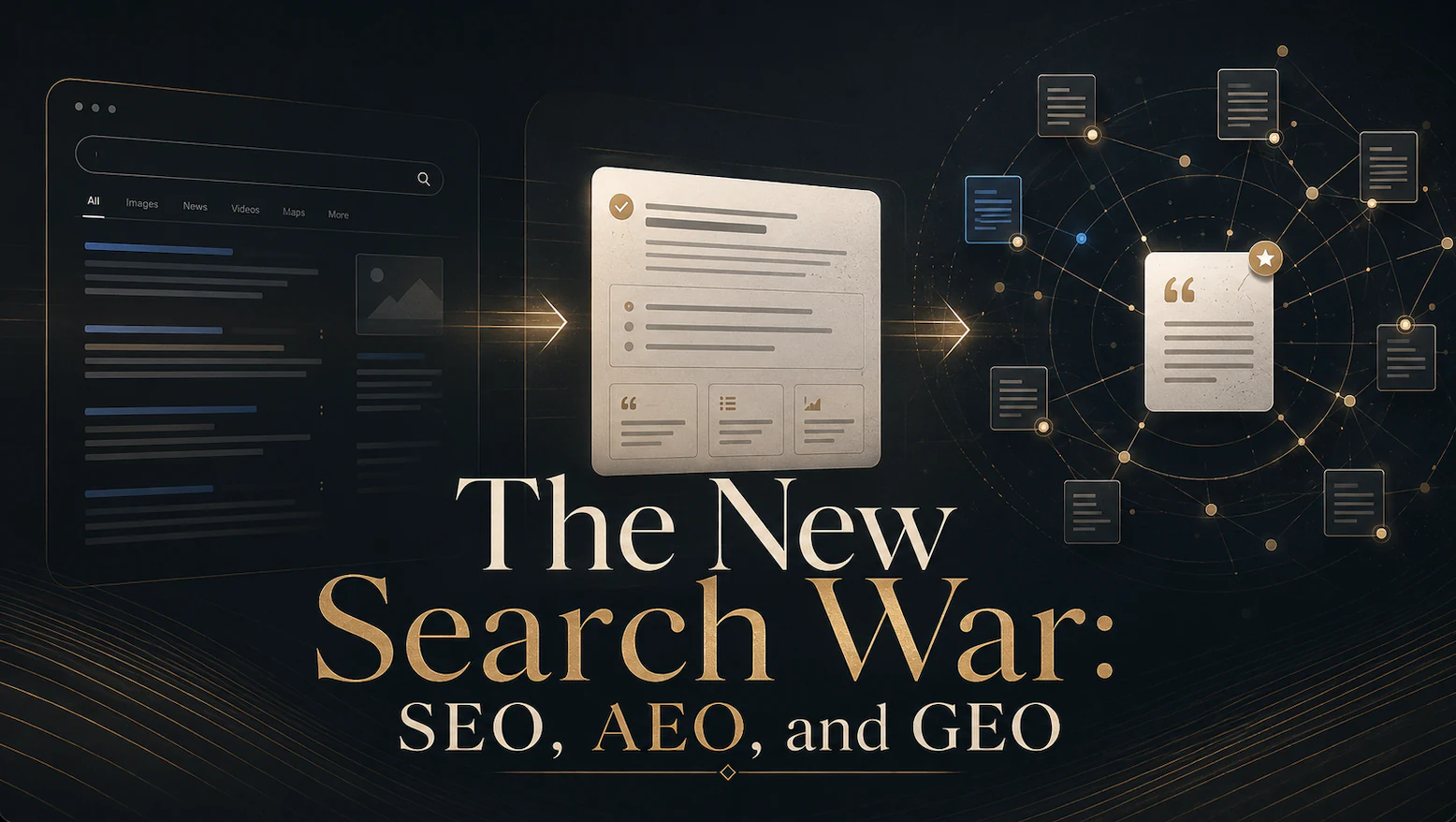
For most of the commercial web's history, publishers obsessed over one question:
How do we rank?
That question is no longer large enough.
A page can rank and still fail to answer the question cleanly. An answer can be perfectly written and still never be discovered. A source can appear nowhere near the top of a familiar list of blue links yet become part of the evidence used inside a generated answer. A publication can also be mentioned by an AI system without receiving a click, cited without receiving the first citation, or retrieved for one phrasing of a question and ignored for another.
The publishing problem has changed because the selection environment has changed.
In 2026, a serious publisher is writing for at least three overlapping systems:
SEO → "Show me the best page." AEO → "Give me the best answer." GEO → "Build me the best answer from trustworthy sources."
That is not a claim that Google runs three separate ranking algorithms with three separate control panels. Google explicitly says the opposite for its own products: its generative Search experiences remain rooted in core Search ranking and quality systems, and it treats optimization for AI Overviews and AI Mode as part of SEO.[^google-ai] But the three terms remain useful as engineering objectives, because they force a publisher to solve three different problems.
SEO makes the work discoverable.
AEO makes the answer extractable.
GEO makes the source worth using.
The strongest publishing asset does all three:
DISCOVERABLE → UNDERSTANDABLE → EXTRACTABLE → CITABLE → TRUSTED → ACTIONABLE
That is the subject of this master class.
This is not a list of tricks for stuffing keywords into prose, manufacturing FAQ schema, or placing llms.txt on a server and hoping an AI model falls in love with the domain. It is a publishing operating system: what each discipline is for, how the systems overlap, which vehicles work best, what changed in 2026, what the research does and does not prove, and how to engineer one written article so that it can compete as a page, an answer, and a source.
The entire framework in one table
Discipline SEO AEO GEO Full name Search Engine Optimization Answer Engine Optimization Generative Engine Optimization Primary objective Earn useful search visibility Win the answer passage Become a useful source for generated answers Main target Search results and discovery systems Direct-answer surfaces Generative retrieval-and-answer systems User behavior "Find me the right page." "Answer this question." "Research, compare, or reason for me." Primary unit Page Passage / answer object Fact / passage / source / entity Typical surfaces Google, Bing, other search results Featured snippets, related questions, direct answers AI Overviews, AI Mode, ChatGPT search, Copilot and other AI search systems Core engineering question "Should this page be retrieved and ranked?" "Can the system isolate the answer?" "Should the system trust, use, or cite this source?" Biggest lever Relevance + authority + technical accessibility Clarity + semantic structure + extractability Evidence + originality + source quality + retrieval accessibility Strong content form Comprehensive, intent-matched page Concise, self-contained answer block Original, evidence-rich, primary or independently authoritative source Technical foundation Crawl, index, canonical, internal architecture Semantic HTML, headings, structured information Crawl access, indexability, retrieval compatibility, stable source identity Business metric Qualified organic discovery and conversion Answer ownership and downstream demand AI citations, accurate mentions, referral traffic and conversion Best outcome The searcher chooses you The system uses your answer The system treats you as evidence
The mistake is choosing one column.
The opportunity is the intersection:
SEO ∩ AEO ∩ GEO
The rest of this article explains how to build for that intersection without confusing the three jobs.
Part I — SEO: Make the Page Worth Finding
What SEO really is
SEO is not "put keywords in articles."
Google's own beginner documentation defines the work much more usefully: SEO is about helping search engines understand content while helping users find a site and decide whether to visit it.[^google-seo]
That immediately gives us a better operating definition:
SEO is the discipline of making it increasingly obvious what a page is about, whom it is for, which problem it solves, how it relates to the rest of the site, and why it deserves to be retrieved instead of competing pages.
A useful SEO model has four gates:
Discovery → Indexing → Ranking → Conversion
A brilliant article that cannot be crawled fails at discovery.
A crawlable article that is not indexed fails at eligibility.
An indexed article that poorly matches intent fails at ranking.
A page that ranks first for the wrong audience can still fail economically.
That produces the first doctrine of modern search publishing:
Traffic is not the objective. Qualified discovery is the objective.
Google's Search Essentials reinforce the point. Meeting technical requirements is necessary for eligibility, but it does not guarantee crawling, indexing, or serving.[^search-essentials] SEO is therefore not a switch. It is a system of probabilities governed by accessibility, relevance, quality, competition, authority, and user need.
SEO Layer 1: Search intent
Before writing a page, determine what the person is actually trying to accomplish.
Take one apparently simple keyword:
CRM
That could represent:
What is CRM? Best CRM Best CRM for plumbers Salesforce alternatives CRM pricing How do I build a CRM? CRM vs ERP CRM for a ten-person construction company CRM that integrates with QuickBooks CRM implementation checklist CRM migration problems Is a CRM worth it for a small business?
Those are not twelve versions of one keyword.
They are twelve different jobs.
A practical intent model looks like this:
Intent What the person is trying to do Informational Understand Navigational Find something specific Commercial investigation Compare possibilities Transactional Buy, book, subscribe, download, install Local Find something in a geographic area Troubleshooting Fix a problem Decision Determine which option is best Validation Verify a claim, belief, price, policy, or fact Research Build a deeper model before acting
This is why a gigantic article cannot automatically rank for every phrase in a market. Search is not merely matching words. It is attempting to satisfy a job.
The practical rule
For every page, write an explicit search-intent contract before drafting:
Primary reader: Who is this for? Primary problem: What are they trying to resolve? Primary query family: What language are they likely to use? Expected answer form: Definition, guide, comparison, tool, product page, local result, research report? Next action: What should a satisfied reader be able to do?
That contract prevents a common failure: a technically optimized page whose actual content answers a different question.
SEO Layer 2: Topic architecture
The weak content strategy says:
"We need more blog posts."
The stronger strategy says:
"We need to become structurally authoritative about a subject."
Imagine your core subject is cybersecurity for small businesses.
A mature architecture might contain a canonical hub:
The Complete Guide to Cybersecurity for Small Businesses
Then supporting clusters:
Cluster Supporting content Risk Cybersecurity risk assessment Access MFA, passwords, identity management Infrastructure Network and endpoint security People Employee security training Compliance SOC 2, HIPAA, PCI DSS Response Incident response planning Vendors Third-party risk Recovery Backup and disaster recovery Insurance Cyber insurance readiness Governance Policies, ownership, escalation
Now the site is not a pile of posts.
It is a knowledge graph represented as a website.
Internal links tell humans and crawlers:
this page is part of this larger subject; this subtopic depends on that topic; this glossary term explains this guide; this research report supports this claim; this product page is the commercial implementation of this problem.
Google explicitly recommends crawlable links and the use of language people actually use in prominent page locations.[^search-essentials]
A useful architecture
For an important topic, think in at least five page types:
Hub — the canonical overview. Spokes — deep pages for subproblems. Definitions — precise entity/concept explanations. Evidence — data, research, case studies, benchmarks. Decision pages — comparisons, pricing, service/product fit.
That architecture makes SEO stronger. It also later makes AEO and GEO stronger because it gives machines cleaner entities, clearer relationships, and better evidence destinations.
SEO Layer 3: On-page relevance
A search system should not have to solve a riddle to determine what a page is about.
The important surfaces still include:
Element Job URL Durable topic identity <title> Search-result identity H1 Human-visible page identity Opening Immediate topic confirmation H2/H3 headings Subtopic architecture Body Topical depth and evidence Internal links Semantic relationships Anchor text Meaning of the destination Image alt text Image context and accessibility Meta description Search-result persuasion Structured data Machine-readable classification Author/publisher data Source identity and trust Canonical Preferred URL identity
Google's Search Essentials recommend using the words people use to look for content in prominent locations such as the title, main heading, alt text, and link text.[^search-essentials]
That does not mean this:
cybersecurity cybersecurity company cybersecurity services best cybersecurity cybersecurity expert
That is not optimization.
It is deterioration.
The better principle is semantic completeness: answer the real subject fully enough that the important vocabulary appears naturally because the important concepts are actually present.
SEO Layer 4: Information gain
Suppose 500 pages already say the same ten things.
Why should the 501st page exist?
This question has become more important as generative systems reduce the cost of producing competent-sounding summaries. Google now explicitly advises publishers not to simply recycle what the rest of the web already says and encourages unique, valuable, non-commodity content.[^google-ai]
A serious page should therefore contribute something.
That contribution might be:
your experiment; your first-party data; your operating method; your dataset; your screenshots; your test; your framework; your failure; your customer observations; your calculator; your benchmark; your case study; your new terminology; your direct experience; your expert analysis; or a synthesis that resolves contradictions other pages leave unresolved.
The question is simple:
After reading this page, what can the reader know or do that the existing pages did not make possible?
If the answer is "nothing, but we rewrote the same information in our brand voice," the page has weak information gain.
SEO Layer 5: Evidence
Good content makes claims proportional to its evidence.
Weak:
"AI increases productivity by 84%."
What AI?
Whose productivity?
Measured how?
Compared with what?
Across what time?
Better:
"In our 2026 analysis of 1,217 support conversations, agents using Workflow A completed qualifying tasks 18.7% faster than the control group."
Now the reader can ask proper questions.
A defensible research claim exposes:
methodology; sample size; dates; population; definitions; treatment/control conditions when applicable; exclusions; uncertainty; limitations; source data when it can responsibly be shared.
The point is not to make the prose sound academic.
The point is to make the claim inspectable.
That creates something another writer can cite.
And something a generative system may have a reason to cite.
The road from SEO to GEO starts here.
SEO Layer 6: Technical SEO
There is no content strategy powerful enough to permanently compensate for a technically broken publishing system.
The ideal path is boring:
URL → HTTP 200 → canonical identity → readable HTML → internal links → structured data → index eligibility
The nightmare path is:
URL → redirect chain → client-side dependency → authentication → bot challenge → partial render → canonical conflict → 404
Google's Search Essentials establish the basic technical floor, while its generative-search guidance says the same core Search accessibility and indexability principles matter for AI Overviews and AI Mode.[^search-essentials][^google-ai]
A publisher should routinely verify:
the important URL returns a successful response; the page is not accidentally noindex; robots rules do not block intended crawlers; the canonical points where intended; content is present in crawlable HTML; important links are real <a href> links; JavaScript does not hide the essential content from crawlers; duplicate URLs are consolidated; XML sitemaps are accurate; lastmod is truthful; structured data matches visible content; status codes reflect reality; stale URLs redirect intentionally or return the right removal status.
IndexNow
For ecosystems that support it, IndexNow provides a useful freshness signal. Its official documentation recommends automating URL submissions as content is added, updated, or deleted.[^indexnow]
A strong publication workflow can therefore be:
Publish → update sitemap → add internal links → submit IndexNow where applicable → verify crawl/index state
The word to notice is automate.
Publishing should not rely on someone remembering five discovery chores after every article goes live.
SEO Layer 7: Authority
Authority has at least two useful dimensions.
Internal authority
Does the publication demonstrate that it understands the subject?
That appears through:
depth; consistency; clear definitions; coherent topic architecture; documented expertise; original evidence; reliable updates; useful related content.
External authority
Does the rest of the web behave as though the publication is worth referencing?
Signals can include:
editorial backlinks; independent citations; brand searches; press coverage; expert interviews; conference appearances; academic or industry references; high-quality community discussion; links from relevant institutions; third-party reviews.
This becomes especially important in GEO because a generative system is not merely looking for language it can copy. It is often trying to justify an answer with sources.
The best vehicles for SEO
Articles matter. They are not the entire strategy.
Vehicle SEO strength Best use Long-form authoritative article 10/10 Broad informational intent Service page 10/10 Commercial intent Product page 10/10 Transactional intent Comparison page 10/10 Decision-stage searches Location page 9/10 Local intent Glossary/definition page 9/10 Entity and definition searches Research report 9/10 Authority, links, statistics Calculator/tool 10/10 Utility, links, repeat visits Case study 8/10 Commercial proof Video + transcript 8/10 Multimedia discovery Original dataset 10/10 Citations and authority News article 8/10 Freshness and topical discovery Category/hub page 10/10 Topic architecture Documentation 9/10 Precise product/technical queries Template/checklist 9/10 Task completion
The mature SEO strategy maps vehicle to intent.
The mistake is assuming "blog post" is the universal shape of knowledge.
Part II — AEO: Make the Answer Impossible to Miss
SEO asks:
Is this page relevant enough to retrieve?
AEO asks:
Where is the answer?
That change in unit matters.
What Answer Engine Optimization means
In this article, Answer Engine Optimization means engineering information so a system can confidently isolate a direct response to a natural-language question.
Historically that included search features such as:
featured snippets; related questions / People Also Ask; voice answers; knowledge-oriented search features; direct-answer surfaces.
Now AEO overlaps heavily with generative AI.
Google's featured-snippet documentation describes those results as answer-oriented boxes that can also appear in related-question groups.[^featured]
The useful writing pattern is:
Question → Immediate answer → Explanation
Not:
Question → 700 words of throat-clearing → history lesson → sales pitch → answer
The answer block
Imagine the question:
What is conversion rate optimization?
Weak opening:
In today's rapidly evolving digital landscape, businesses are constantly searching for innovative ways to maximize their competitive potential.
That paragraph has grammar.
It does not have information.
Better:
Conversion rate optimization (CRO) is the systematic process of increasing the percentage of visitors who complete a desired action, such as buying, booking, subscribing, or requesting a quote. CRO usually involves measuring visitor behavior, identifying friction, testing changes, and comparing the resulting conversion rates.
That passage is:
self-contained; definitional; grammatically complete; extractable; specific; useful without the surrounding article.
That is an answer object.
AEO is partly the practice of building many good answer objects inside a larger page.
Passage-level optimization
A modern article should not function only as one indivisible document.
It should contain independently useful passages.
Consider these headings:
What is CRO?
Immediate definition.
How does CRO work?
Immediate process.
What does CRO cost?
Immediate cost framework.
How long does CRO take?
Immediate time framework.
CRO vs SEO: What is the difference?
Immediate distinction plus comparison table.
What is a good conversion rate?
Immediate answer plus qualification.
When should a company use CRO?
Immediate decision rule.
One page has now become a small database of answers.
That can help a search system isolate a snippet.
It can help a generative system retrieve a passage.
And, more importantly, it helps a human scan the page without being punished for arriving with a specific question.
Answer density
Here is a useful editorial concept:
Answer Density = Useful independently extractable answers ÷ Total content
High answer density does not mean short articles.
A 10,000-word article can have extremely high answer density if the 10,000 words contain many precise, useful, nonredundant answers.
A 600-word article can have terrible answer density if 500 words are filler.
The real goal is:
Every section earns its existence.
Question-first headings
AEO often improves when headings reflect the reader's natural question.
Instead of:
Implementation Considerations
use:
How do you implement CRM automation?
Instead of:
Benefits
use:
What are the benefits of CRM automation?
Instead of:
Costs
use:
How much does CRM automation cost?
Now the relationship is explicit:
Question ↔ Heading ↔ Answer
The machine does less inference.
The reader does less hunting.
Both are improvements.
Tables are answer machines
Tables are dramatically underused.
If the question is:
What is the difference between SEO, AEO, and GEO?
a comparison table can outperform 900 wandering words.
If the question is:
Which CRM should a 50-person business choose?
a table can expose:
product; best use; price; integration fit; advantages; limitations; implementation burden; best customer.
Humans can scan that structure.
Retrieval systems can isolate it.
Generative systems can reason over it.
This is one of the rare optimizations that improves all three disciplines simultaneously.
Structured data helps classification, not truth
Structured data helps machines understand what an object is.
It does not make a weak page authoritative.
Google says Organization structured data can help it understand administrative details and disambiguate an organization.[^org-schema] Its Q&A guidance defines QAPage specifically around a page with one question and its answers.[^qa]
For an article, legitimate structured data may include:
Article or an appropriate article subtype; BreadcrumbList; publisher and author information.
Elsewhere, depending on the page:
Organization; LocalBusiness; Product; VideoObject; QAPage; other types that truthfully match the visible content.
The governing rule is:
Schema describes reality. It does not manufacture reality.
Do not spray every Schema.org type across every page because a plugin offers a checkbox.
Machine-readable lies are still lies.
The FAQ myth changed in 2026
For years, SEO tutorials repeated some version of:
"Add FAQ schema to everything."
That advice is now materially outdated for Google.
Google states that as of May 7, 2026, FAQ rich results are no longer appearing in Google Search.[^faq-change]
That does not make FAQs useless.
It creates an important distinction:
FAQ content ≠ FAQ rich result
Real questions and concise answers can still be excellent content because they:
map to natural language; create answer passages; cover long-tail subqueries; resolve objections; make pages easier to scan; create retrieval-ready sections.
But publishers should stop treating FAQ markup as a magic SERP-decoration strategy.
And QAPage is not a generic substitute. Google's Q&A documentation is explicitly about a page organized around one question followed by its answers.[^qa]
The best vehicles for AEO
Vehicle AEO strength Why Definition article 10/10 Direct extraction How-to article 10/10 Procedural answers FAQ content 10/10 Natural-question matching Comparison article 10/10 Decision answers Glossary 10/10 Entity definitions Troubleshooting guide 10/10 Direct problem solving Calculator 9/10 Exact outputs Specification page 9/10 Factual extraction Research FAQ 9/10 Evidence-backed answers Product documentation 10/10 Precise facts Service page 8/10 Commercial questions Policy page 9/10 "What is your policy on...?" Pricing page 9/10 Commercial fact retrieval
AEO rewards a writer who respects the reader's time.
That is why the discipline matters even if the label eventually disappears.
Part III — GEO: Make the Information Worth Citing
Now the unit changes again.
Traditional search is commonly modeled as:
Retrieve documents → rank documents → show results
Generative search adds another layer:
Retrieve evidence → allocate context → synthesize → generate an answer → sometimes cite sources
That is a different information market.
What Generative Engine Optimization really means
In this article, GEO means:
Increasing the probability that generative systems can discover, retrieve, select, use, accurately represent, and cite your information.
The foundational academic paper that popularized the term described generative engines as systems that synthesize information from multiple sources and reported visibility improvements of up to 40 percent under its experimental setup.[^geo-paper]
That number is real inside the experiment.
It is also one of the easiest GEO numbers to misuse.
A 2026 critical survey of 45 studies makes the limitation explicit: the foundational gains were conditional on the source already being present in a fixed context; they did not establish organic discoverability or durable traffic effects.[^geo-survey]
That is the appropriate way to read the evidence.
The research supports this:
How information is written and positioned can alter whether retrieved material is cited or used.
The research does not yet support this universal promise:
"Use seven GEO tricks and ChatGPT traffic will rise 40 percent."
The field is too young, engines differ, retrieval is stochastic, and repeated prompt runs can produce different source sets.
GEO is not one ranking algorithm
A useful GEO model is a pipeline:
Discovery → Crawl → Index → Retrieve → Rerank → Context allocation → Select → Cite → Absorb → Generate → User action
You can succeed at one stage and fail at another.
A page may be:
crawlable but not indexed; indexed but not retrieved; retrieved but ranked below the context cutoff; in context but not cited; cited but not materially used; used but represented inaccurately; represented accurately but never clicked; clicked but commercially irrelevant.
That is why "AI visibility" needs a more precise vocabulary.
GEO changes the definition of competition
Google openly describes query fan-out in its generative Search systems: the model can issue multiple related queries to gather additional information for a user's original question.[^google-ai]
Suppose a user asks:
"What is the best CRM for a 20-person plumbing company with five salespeople, QuickBooks, and a $1,000 monthly software budget?"
A generative system may need evidence corresponding to multiple subproblems:
best CRM for plumbing; CRM QuickBooks integration; CRM pricing under $1,000; field-service CRM; sales automation; implementation complexity; mobile capabilities; reviews; migration requirements; support quality.
The publisher is therefore competing across a decision space, not merely one exact phrase.
This has a profound content implication:
Do not cover only the keyword. Cover the decision.
GEO is about citation-worthiness
A language model can already generate generic prose such as:
"Customer service matters because satisfied customers are more likely to remain loyal."
It does not need your website to invent that sentence.
External sources become especially valuable for things the model should not fabricate:
current facts; prices; product capabilities; dates; legal and regulatory claims; research findings; statistics; quotations; original arguments; benchmarks; first-party data; direct experience; primary documentation; evidence for contested claims.
That produces one of the most important equations in this article:
Generic information → low citation necessity
while:
Unique, verifiable evidence → high citation utility
That is why GEO cannot be reduced to "write more AI-friendly paragraphs."
The strongest GEO move is often not rewriting.
It is knowing something worth citing.
Become the primary source
Suppose 100 websites say:
"Company X launched Product Y in March."
Company X has an official release containing the launch date and product details.
Which source has the strongest claim to being the canonical source for that fact?
The primary source.
Every company and publication should therefore deliberately create source-of-truth pages.
Information Strong primary vehicle Your pricing Pricing page Product capabilities Product documentation Original research Research report Statistics Data study / statistics page Methodology Methodology page Benchmark Benchmark report Company facts About/company page Policy Policy page API behavior Developer documentation Experiment Experiment report Definition Canonical glossary/reference Announcement Official release / newsroom item Corrections Corrections / update record Security claims Security or trust documentation
A company should own stable canonical URLs for facts that others will repeatedly need to verify.
That is not merely SEO architecture.
It is evidence architecture.
Original research may be the highest-value GEO vehicle
Imagine publishing:
The 2026 Small Business Lead Response Study
You analyze 14,219 leads.
You report:
median response time; appointment rate; time-to-contact differences; industry variation; day-of-week effects; follow-up frequency; conversion curves; methodology; limitations.
Now another article can legitimately say:
"According to the 2026 Small Business Lead Response Study..."
You have created a citation object.
The article is no longer only content.
It is infrastructure for other people's knowledge.
That is one of the strongest defensible positions in the generative era.
Write citable sentences
Important factual conclusions should survive extraction.
Weak:
"As you can see from everything above, this confirms what we have been saying."
Strong:
"Across 14,219 inbound leads, contacting a lead within ten minutes produced a 22.4 percent higher appointment rate than contacting the lead after one hour."
The second sentence contains:
subject; sample; variable; comparison; result.
It can stand alone.
That is what a citable sentence does.
Package evidence
A strong research statement tends to contain:
Claim + Measurement + Context + Source
Example:
"Among 1,204 surveyed U.S. buyers in Q2 2026, 47 percent reported using an AI assistant during at least one stage of product research."
Then disclose the methodology.
The sentence tells a reader or machine:
who; what; when; where; how many; what was measured.
This is much stronger than:
"Almost half of buyers use AI now."
The second sentence may be easier to post.
The first is easier to audit.
GEO rewards auditability.
GEO and third-party authority
What a company says about itself matters.
What independent sources say about it can matter differently.
A 2025 controlled study of AI search reported substantial differences among systems and found a strong preference in its tested AI-search environments for earned media—third-party authoritative sources—over brand-owned and social content.[^earned-media]
That result should not be universalized into "owned media no longer matters." It does not say that.
Owned media remains essential for primary-source facts.
The stronger conclusion is:
GEO needs both source-of-truth ownership and independent corroboration.
That means the broader strategy can include:
digital PR; independent reviews; industry publications; reported interviews; conference appearances; citations; research partnerships; authoritative directories; community discussion; reputable reference sites; independent journalism.
You are building an entity footprint across the public knowledge ecosystem.
The brand as an entity
Machines need to understand that different names refer to the same underlying organization.
For example:
Acme AI AcmeAI Acme AI Inc. Acme acmeai.com
may all refer to one entity.
Consistency reduces ambiguity.
Google's Organization structured-data guidance says the markup can help it understand administrative details and disambiguate organizations.[^org-schema]
The larger principle is:
Entity consistency → entity confidence
A serious brand should be consistent about:
canonical organization name; alternate names; domain; logo; founder/leadership identities when public and relevant; contact details; descriptions; official social profiles; product names; organization identifiers where appropriate.
Do not describe the company as five fundamentally different things on five important pages unless the business itself truly contains those distinctions.
GEO begins with crawler access
A page cannot be used through a retrieval path that cannot access it.
For ChatGPT search specifically, OpenAI says any public website can appear and tells publishers who want summaries and snippets to make sure they are not blocking OAI-SearchBot.[^openai]
OpenAI also distinguishes that search crawler from GPTBot, which is a separate signal for potential training use.[^openai]
That creates an important infrastructure distinction:
Search visibility and training permission are not the same control.
A publisher can make deliberate choices rather than treating every AI user-agent as one category.
The operational checklist includes:
review robots.txt; review CDN/WAF bot rules; review noindex; review authentication walls; verify the rendered page; verify canonical identity; verify that the page can be fetched without broken client-side dependencies.
Do not sabotage discovery accidentally and then blame content quality.
Do you need llms.txt?
Do not build a GEO strategy around it.
Google's 2026 generative-search guidance explicitly says it does not require special AI text files such as llms.txt for participation in its generative Search experiences.[^google-ai]
That does not prove no tool will ever use such a file.
It proves something narrower and more useful:
llms.txt is not a substitute for search fundamentals.
Your foundation remains:
crawlability; indexability; useful content; clear structure; original information; evidence; authority; stable source identity.
Treat optional AI-discovery conventions as compatibility layers, not religion.
The best vehicles for GEO
Vehicle GEO strength Why Original research 10/10 Unique evidence Proprietary dataset 10/10 Unique facts Benchmark report 10/10 Comparison evidence Technical documentation 10/10 Primary source Statistics page 10/10 Citation-rich Definitive reference guide 10/10 Retrieval depth Expert commentary 9/10 Quoteable interpretation Case study 9/10 Real-world evidence Comparison study 10/10 Decision support Public methodology 9/10 Trust and reproducibility Product documentation 10/10 Ground truth Official announcement 10/10 Primary source Independent press coverage 10/10 Third-party validation Industry interview 9/10 Entity association and expertise YouTube + transcript 8/10 Alternate retrieval surface Community discussion 7–9/10 Independent experience signals Public API docs 10/10 Precise machine-readable facts Changelog/release notes 9/10 Freshness and product truth
The defining GEO question is not:
"Can I make this paragraph sound optimized?"
It is:
"Why would an answer system need this source?"
Part IV — The Vehicle Matters More Than "Blogging"
Many publishers confuse the container with the strategy.
They think:
"Articles are the strategy."
No.
Information assets are the strategy.
Articles are one vehicle.
A better model is:
Idea → Evidence → Canonical asset → Multiple vehicles
Suppose you conduct one serious research project.
That single project can become:
Vehicle Job Research report GEO authority Long-form article SEO discovery Direct-answer sections AEO extraction Statistics page GEO citations Infographic Image discovery YouTube video Video discovery Full transcript Searchable evidence Short-form video Attention Podcast episode Authority and distribution Press pitch Earned media LinkedIn/X/social post Distribution News article Freshness Dataset Citations and reuse Calculator Utility and backlinks Executive summary Decision makers Slide deck Internal/external presentation FAQ Objection resolution Documentation Primary-source precision
One intellectual asset becomes a discovery network.
This matters because search is no longer confined to the publisher's website.
In July 2026, Google made Search Console platform properties globally available for Instagram, TikTok, X, and YouTube, allowing publishers to inspect how those social and video assets perform across Google Search, Discover, and Google News.[^platform-properties]
The practical lesson is not "abandon the site for social."
It is the opposite:
Own the canonical source. Distribute the idea through many vehicles. Measure the surfaces separately.
Part V — How One Written Article Does SEO, AEO, and GEO at the Same Time
This is the heart of the system.
You should not normally create:
one SEO article; one AEO article; one GEO article.
Create one canonical authority article that contains all three layers.
ARTICLE = SEO discovery + AEO extraction + GEO evidence
The page must be findable.
Its answers must be isolatable.
Its claims must be worth trusting.
The triple-optimized article architecture
Section Purpose SEO AEO GEO Title Query/topic alignment ✓ ✓ ✓ Subtitle/deck Clarify scope ✓ ✓ ✓ Direct-answer opening Immediate solution ✓ ✓✓✓ ✓✓ Key findings Main conclusions ✓ ✓✓ ✓✓✓ Table of contents Navigation/structure ✓ ✓ ✓ Definition Entity clarification ✓✓ ✓✓✓ ✓✓ Why it matters Intent satisfaction ✓✓ ✓ ✓ How it works Process explanation ✓✓ ✓✓✓ ✓✓ Original framework Differentiation ✓✓ ✓✓ ✓✓✓ Original data Information gain ✓✓ ✓ ✓✓✓ Examples Experience ✓✓ ✓✓ ✓✓ Comparison table Decision support ✓✓✓ ✓✓✓ ✓✓✓ Limitations Trust ✓ ✓ ✓✓✓ Counter-perspective Epistemic discipline ✓ ✓ ✓✓✓ Expert commentary Authority ✓✓ ✓✓ ✓✓✓ Questions Long-tail coverage ✓✓ ✓✓✓ ✓✓ Sources Verification ✓ ✓ ✓✓✓ Author information Trust/entity ✓✓ ✓ ✓✓ Related internal links Topic graph ✓✓✓ ✓ ✓ Structured data Machine classification ✓✓ ✓✓ ✓ Update history Freshness/provenance ✓ ✓ ✓✓
This table contains the entire strategy in miniature.
Your first 100 words matter
Do not hide the thesis.
Imagine the title:
SEO vs AEO vs GEO: How Modern Search Visibility Actually Works
Weak opening:
The internet has changed dramatically over the years. From the early days of web directories to the exciting world of artificial intelligence, businesses have continuously evolved...
Delete it.
A stronger opening:
SEO helps a page appear in search, AEO helps its information become a direct answer, and GEO helps the page become a source used by generative systems. The disciplines overlap: technical SEO makes information discoverable, answer-oriented structure makes it extractable, and original evidence makes it worth citing. Serious publishers should therefore engineer important content for all three rather than treating them as separate channels.
That paragraph can function as:
a human summary; snippet material; a direct-answer passage; an AI retrieval passage; a citation-adjacent explanation.
That is triple optimization.
Build the article in layers
A strong authority article often moves through this order:
Definition → Problem → Mechanism → Evidence → Comparison → Application → Limitations → Questions → Sources
Notice what is missing:
filler.
Every section has a job.
Every H2 should solve a subquery
Take this section:
What is GEO?
First sentence:
Generative Engine Optimization is the practice of making information more likely to be discovered, retrieved, used, and cited by generative answer systems.
Then expand.
Next:
How is GEO different from SEO?
Answer immediately.
Next:
Does GEO replace SEO?
Answer immediately:
No. GEO often depends on the same crawl, index, relevance, authority, and quality foundations that make SEO work, while adding source-selection, context-allocation, synthesis, and citation behavior.
Then support the claim.
Google's current guidance explicitly says its generative Search features remain rooted in core Search ranking and quality systems.[^google-ai]
You have now built passage-level retrieval units inside a coherent page.
Put the answer before the explanation
One of the strongest editorial rules in this entire article is:
Answer → Reason → Evidence → Example → Qualification
Not:
History → background → story → three analogies → answer
There are exceptions in narrative journalism, where a lede earns attention before the nut graf. But even there, the reader should not be forced to wander through a fog before discovering what the story is about.
For explanatory publishing, directness compounds.
Write fact blocks
A strong section can often be reduced to four components:
Claim: What is true? Evidence: What supports it? Meaning: Why does it matter? Action: What should the reader do?
Example:
Claim: SEO remains foundational to Google's AI-search visibility.
Evidence: Google's 2026 guide says AI Overviews and AI Mode remain rooted in core Search ranking and quality systems and use techniques including retrieval-augmented generation and query fan-out.[^google-ai]
Meaning: There is no separate magic AI file that replaces crawlability, indexability, relevance, quality, and authority.
Action: Repair search fundamentals before spending money on GEO gimmicks.
That block is good for humans because it is clear.
It is good for machines because the relationships are explicit.
Create comparison objects
Instead of writing:
"Option A has some advantages while Option B may also be useful depending on your particular situation."
Build the object:
Factor Option A Option B Cost $ $$$ Complexity Low High Best for SMB Enterprise Deployment Hours Months Customization Moderate Extensive Primary tradeoff Less control Higher complexity
A comparison object compresses decision-relevant information without becoming vague.
This is valuable for SEO, AEO, GEO, and humans.
Embed originality inside the article
The strongest article does not merely collect the web.
It adds to the web.
Create a section such as:
Our 2026 Test
Then disclose:
sample; process; time range; control; measurement; results; limitations; data availability.
Now the page contains information older competitors could not have written because it did not exist until you measured it.
That is information gain.
It is also citation supply.
Cite primary sources first
When the claim is about Google's Search rules, cite Google.
When it is about OpenAI crawler controls, cite OpenAI.
When it is about a law, cite the statute or responsible government source.
When it is about academic research, cite the paper.
When it is about company earnings, cite the filing.
Secondary journalism remains crucial for investigation, interpretation, independent verification, and contested stories.
But for a basic factual claim about what an organization officially says or what a published study reports:
Primary source > recycled summary
This article follows that rule.
Make your own page citable
A serious authority article should expose enough provenance for another person—or machine—to understand what it is reading.
Include, when relevant:
publication date; substantive update date; named author; author expertise; publisher identity; methodology; sources; claim boundaries; canonical URL; descriptive title; clean HTML; relevant structured data; stable references; corrections; update history.
Google's people-first guidance asks publishers to consider whether a page provides original reporting or analysis, demonstrates expertise, supplies clear sourcing, and leaves a reader feeling that the goal was achieved.[^helpful]
That is not "SEO copywriting."
It is publishing discipline.
Do not fake freshness
Do not change:
Published January 2025
to:
Updated August 2026
because someone changed a comma.
An update should mean something.
A real update can:
add new data; check sources; repair broken links; refresh prices; retest claims; remove obsolete instructions; add developments; revise conclusions when evidence changes.
Freshness is not a date badge.
Freshness is the state of the information.
The source section is part of the product
For serious explanatory work, citations are not decorative furniture at the bottom of the page.
Build a source hierarchy.
Possible layers:
original research; official documentation; government records; standards bodies; academic literature; primary interviews; reputable independent journalism; industry reports; community evidence when the question is experiential.
Then distinguish three categories clearly:
What we know.
What we infer.
What we predict.
A source-disciplined page is more useful precisely because it does not pretend those categories are interchangeable.
Part VI — The New Content Equation
A useful model for a modern information asset is:
V = D × R × E × O × T × X
Where:
D = Discoverability Can relevant systems find the page?
R = Relevance Does it solve the user's actual question?
E = Extractability Can the useful answer be isolated?
O = Originality Does it contribute something that is not generic?
T = Trustworthiness Can its claims be defended?
X = Experience Does the reader actually benefit?
The multiplication is intentional.
If:
D = 0
nobody finds it.
If:
T = 0
finding it does not make it worth trusting.
If:
O ≈ 0
a generative system may have little reason to use your version instead of dozens of equivalent sources.
The formula is not a Google ranking formula. It is an editorial model.
That distinction matters.
Part VII — Three Different Content Moats
The SEO moat is authority
The SEO moat is created by:
connected useful pages; strong topical architecture; editorial backlinks; brand recognition; historical performance; clean technical foundations; demonstrated expertise; consistent usefulness.
The AEO moat is answer precision
The AEO moat is created when:
your definitions are clearer; your headings map to real questions; your answers arrive quickly; your procedures are executable; your tables are cleaner; your exceptions are explicit; your page wastes less of the reader's time.
The GEO moat is proprietary truth
This may be the most important moat of the three.
You possess information the generic model does not possess independently:
experiments; data; customer observations; benchmarks; research; methods; proprietary systems; primary documentation; direct experience.
A model can rewrite generic prose forever.
It cannot independently reproduce a fact that only you measured.
That is why proprietary truth is such a powerful asset in the generative era.
Part VIII — The Great Paradox of AI Content
AI makes competent text cheaper.
That means the supply of generic text can rise dramatically.
If the supply of generic information rises while the amount of original evidence does not rise at the same rate, then the scarce assets become:
truth; access; experience; measurement; original research; reputation; judgment; first-party information; independent corroboration; trust.
The future publishing advantage therefore does not belong automatically to whoever produces the most words.
It belongs to whoever produces the most defensible information.
Google's current people-first guidance explicitly asks whether a page offers original information, reporting, research, or analysis and warns against simply summarizing what others have already said.[^helpful]
That is the antidote to industrial AI slop.
Part IX — Measuring SEO
SEO already has a mature measurement vocabulary.
Metric What it tells you Indexed pages Search eligibility Impressions Visibility Query position Competitive visibility CTR Search-result attractiveness Organic sessions Traffic Engagement Visitor usefulness Conversion Business outcome Assisted conversion Influence Backlinks/referring domains External authority Branded search Brand demand Non-branded search New discovery Crawl/index errors Technical friction Revenue / lead value Economic performance
The mistake is using rankings as the final score.
A ranking is an intermediate state.
A business outcome is the outcome.
Part X — Measuring AEO
AEO is less clean because many answer surfaces do not produce a traditional click.
Possible measurements include:
featured-snippet ownership; related-question visibility; snippet text; question-query visibility; answer accuracy; query-to-passage alignment; direct-answer testing; brand search lift; downstream conversions; citations/mentions when AEO overlaps with generative surfaces.
Do not measure AEO only by traffic.
A direct answer can satisfy a user without a click.
Whether that is good or bad depends on the objective.
If the goal is brand authority, a zero-click answer may still create value.
If the goal requires a signup, a citation with no click may be insufficient.
Measurement follows mission.
Part XI — Measuring GEO
Do not merely ask:
"Does ChatGPT know us?"
That question is too vague.
Measure the pipeline.
GEO metric Question Citation frequency How often are we cited? Citation share What percentage of relevant answers cite us? Source diversity Which URLs are selected? Prompt coverage Which question classes trigger us? Citation position How prominently are we presented? Citation absorption Did our evidence actually shape the answer? Brand mention Are we named without a citation? Representation accuracy Are we described correctly? Referral traffic Do people click? Conversion Do those visitors become customers/readers? Competitor share Who is used instead? Engine variance Do results differ by platform? Prompt variance Do paraphrases change the source set? Temporal stability Does visibility persist over time? Freshness lag How quickly do changed facts appear? Source fidelity Does the generated claim match the cited source?
The 2026 critical survey of GEO research is especially important here. It characterizes GEO as a stochastic, partially observable pipeline and recommends repeated measurement, paraphrases, controls, human validation, and separation of discovery, citation, absorption, and economic outcomes.[^geo-survey]
That is a much stronger measurement doctrine than screenshotting one favorable AI answer and declaring victory.
Part XII — GEO Is Becoming Measurable Infrastructure
This is one of the most important 2026 developments.
Google now has a dedicated Generative AI performance report in Search Console for a subset of site owners. It reports organic impressions from supported generative Search features, including AI Overviews and AI Mode, and can break visibility down by page, country, date, and device.[^gsc-genai]
Microsoft introduced AI Performance in Bing Webmaster Tools as a public preview in February 2026. Its dashboard includes total citations, average cited pages, grounding-query information, page-level citation activity, and trends across supported Microsoft AI experiences.[^bing-ai]
OpenAI says ChatGPT referral links automatically include:
utm_source=chatgpt.com
so publishers can identify referral traffic in analytics.[^openai]
This does not make GEO deterministic.
It does make GEO less mystical.
The industry is moving from:
"I think AI mentioned us."
toward:
"We can measure which source URLs are used, where they appear, what queries retrieve them, and what those referrals do."
That is the beginning of an actual operating discipline.
Part XIII — Two 2026 Publisher Changes You Should Not Ignore
Google Preferred Sources
Google now lets users select publications as preferred sources. For users who select a site, that site's content can be more likely to appear in Top Stories and can receive a preferred-source treatment in AI Mode and AI Overviews.[^preferred-sources]
For publishers, this matters because it introduces a new layer between search optimization and audience loyalty:
Discovery → trust → preference → increased chance of resurfacing
A publication should therefore think about a Preferred Sources call to action the way it already thinks about:
email subscription; RSS; app install; social follow; browser notification.
The strategic shift is subtle.
For years, publishers rented the search result one query at a time.
Preferred Sources gives the reader a mechanism to express a durable preference for a publication.
That is worth earning.
Social and video are now measurable Search properties
Google's July 2026 rollout of Search Console platform properties means publishers can inspect how content on Instagram, TikTok, X, and YouTube performs across Google Search, Discover, and Google News.[^platform-properties]
That changes the vehicle conversation.
A YouTube video is not merely "social."
A TikTok clip is not necessarily trapped inside TikTok.
A publisher can now think of content as a portfolio of indexable/discoverable surfaces and compare which format wins which query.
The canonical article can remain the evidence base while:
video demonstrates; short-form earns attention; social distributes; the article preserves the full argument; research supplies the evidence; Search and AI systems connect the surfaces.
Part XIV — The 30-Step Triple-Optimization Article Standard
For every major authority article, use a publishing standard at least this rigorous:
Order Component 1 Define the search intent 2 Define the primary reader 3 Write a precise, useful H1 4 Put a 40–100 word definitive answer near the top 5 State key findings 6 Add a table of contents for long work 7 Define important terms 8 Explain why the subject matters 9 Explain the mechanism 10 Add an original framework 11 Add original evidence/data where possible 12 Add concrete examples 13 Build a comparison object/table 14 Give implementation instructions 15 Name mistakes and failure modes 16 State limitations and exceptions 17 Include a counter-perspective where evidence is contested 18 Answer real questions people ask 19 Write a conclusion that changes what the reader can do 20 Provide primary sources 21 Provide author/expertise information 22 Add related canonical articles 23 Use truthful article/breadcrumb structured data 24 Set the correct canonical 25 Include the page in the sitemap 26 Trigger IndexNow where applicable 27 Verify Search Console/index state 28 Verify intended AI crawler access 29 Test repeated AI retrieval/citation behavior 30 Substantively refresh when dependencies change
That is no longer:
"Write a blog."
It is:
Build a knowledge publication pipeline.
Part XV — The Three Most Important Writing Rules
Rule 1: Every section must create usable knowledge
Ask:
What new usable information does the reader possess after this section?
If the answer is:
"Nothing, but it sounds professional,"
delete it.
This one rule removes an extraordinary amount of machine-flavored filler.
Rule 2: Never make the machine infer what you can state explicitly
Weak:
"It can sometimes have substantial benefits in situations like these."
Better:
"AEO is most useful when users ask explicit questions that can be answered with definitions, procedures, facts, comparisons, or calculations."
Name the thing.
Define the thing.
State the relationship.
State the evidence.
Rule 3: Do not optimize for word count
Google explicitly says it does not have a preferred word count.[^helpful]
The correct length is:
As long as necessary + no longer than necessary
If 1,800 words solve the problem completely, stop.
If mastery genuinely requires 12,000 words, write 12,000.
Length should be the consequence of completeness.
It should not be the objective.
Part XVI — A Hierarchy of Content Quality
A useful way to think about modern publishing:
Level Content 1 Generic AI-generated summary 2 Human rewrite of generic information 3 Good synthesis of existing sources 4 Expert explanation 5 Expert explanation + evidence 6 Original framework 7 Original case study 8 Original data 9 Repeatable research 10 Canonical primary source used by others
Most publishers are fighting over Levels 1–3.
AI makes those levels easier to produce.
The durable moat begins when the publication creates facts, frameworks, evidence, and primary-source material that did not previously exist.
Part XVII — SEO, AEO, and GEO Should Not Fight Each Other
There is a bad mental model that says:
SEO writing is robotic.
AEO writing is short.
GEO writing is written for machines.
None of those need to be true.
A human likes:
clear headings.
Machines benefit too.
A human likes:
direct answers.
Machines benefit too.
A human likes:
credible evidence.
Machines need it too.
A human likes:
comparison tables.
Machines can parse them too.
A human likes:
original research.
Machines have a reason to retrieve it too.
A human likes:
honest limitations.
Responsible synthesis improves when the sources state them.
The incentives increasingly converge around a better thing:
high-quality information architecture
The best SEO/AEO/GEO writing does not feel engineered for robots.
It feels unusually clear, unusually useful, unusually well sourced, and unusually difficult to replace.
Part XVIII — The Modern Publishing Flywheel
The mature system looks like this:
Research → Publish → Index → Rank → Answer → Citation → Discovery → Links → Authority → More ranking
Then:
Authority → Media → Mentions → Entity strength → More AI discovery
Then:
Visitors → Customers/readers → Data → Research → Better content
And then the loop repeats.
At that point, content is no longer merely a recurring publishing expense.
It becomes a compounding information asset.
Part XIX — The Final Doctrine
The entire master class can be compressed without losing the system.
SEO
Make the page worth finding.
AEO
Make the answer impossible to miss.
GEO
Make the information worth citing.
The ultimate article should satisfy five commands:
Find me. Understand me. Extract me. Trust me. Cite me.
Or, in the shortest useful form:
SEO = DISCOVERY AEO = ANSWER GEO = AUTHORITY
But the final point is larger than three acronyms.
The strongest publisher in the next phase of the web will not merely ask:
"How do I rank number one?"
The better question is:
"How do I become part of the evidence layer from which the internet constructs answers?"
Once you see the problem that way, the written article stops being a blog post.
It becomes a machine-readable, human-useful, independently defensible unit of knowledge.
A page that can rank.
A passage that can answer.
A source that can be cited.
An entity that can be understood.
Evidence that can survive extraction.
A publication a reader can choose again.
And information strong enough that, when machines become better at writing, the value of the work does not disappear—because the value was never merely the words.
The value was the truth the words carried.
Editorial Source Integrity Note
This article uses a strict evidence posture.
Official platform claims are sourced to first-party documentation from Google, Microsoft/Bing, IndexNow, and OpenAI. Research claims are attributed to the specific papers that report them. The foundational GEO "up to 40%" result is presented with the later research caveat that it was measured in a controlled setting with sources already in context. No research result is represented as a guaranteed traffic outcome. All source URLs in the source notes below were opened and resolved successfully on August 26, 2026. Tracking parameters were removed where a stable canonical source URL was available. Short quotations below are included so a reader can see what each cited source actually says without relying only on this article's paraphrase.
Source Notes: What the Sources Actually Say
Google — Generative AI features in Search
Google's official guide says its generative Search experiences remain grounded in core Search systems and explicitly discusses both AEO and GEO.
"The best practices for SEO continue to be relevant."
Source: Google Search Central, "Optimizing your website for generative AI features on Google Search." https://developers.google.com/search/docs/fundamentals/ai-optimization-guide
Google — SEO Starter Guide
Google's basic definition keeps the human and machine sides of SEO together.
"SEO... is about helping search engines understand your content."
Source: Google Search Central, "Search Engine Optimization (SEO) Starter Guide." https://developers.google.com/search/docs/fundamentals/seo-starter-guide
Google — Search Essentials
Google explicitly warns that meeting the requirements does not guarantee inclusion.
"doesn't mean that Google will crawl, index, or serve its content."
Source: Google Search Central, "Google Search Essentials." https://developers.google.com/search/docs/essentials
Google — Featured Snippets
Google describes featured snippets as answer-forward search-result formats.
"Featured snippets are special boxes where the format of a regular search result is reversed"
Source: Google Search Central, "Featured snippets and your website." https://developers.google.com/search/docs/appearance/featured-snippets
Google — Organization structured data
Google frames Organization markup as a way to improve understanding and disambiguation.
"can help Google better understand your organization's administrative details and disambiguate your organization"
Source: Google Search Central, "Organization (Organization) structured data." https://developers.google.com/search/docs/appearance/structured-data/organization
Google — Q&A structured data
Google defines a Q&A page narrowly.
"one question followed by its answers"
Source: Google Search Central, "Q&A (QAPage) structured data." https://developers.google.com/search/docs/appearance/structured-data/qapage
Google — FAQ rich-results change
This is the 2026 change that makes much older FAQ-schema advice obsolete.
"As of May 7, 2026, FAQ rich results are no longer appearing in Google Search."
Source: Google Search Console Help, "Data anomalies in Search Console." https://support.google.com/webmasters/answer/6211453?hl=en
Google — People-first content
Google explicitly rejects the mythology of a preferred article length.
"No, we don't."
That sentence answers Google's own question about whether it has a preferred word count.
Source: Google Search Central, "Creating helpful, reliable, people-first content." https://developers.google.com/search/docs/fundamentals/creating-helpful-content
Google Search Console — Generative AI performance
The reporting layer is now becoming visible to publishers.
"The generative AI performance report shows data about how your site performs in generative AI features"
Source: Google Search Console Help, "Generative AI performance report (Search)." https://support.google.com/webmasters/answer/16984139?hl=en
Google — Preferred Sources
Google now allows readers to explicitly prefer publications.
"your content is more likely to appear in 'Top Stories'"
Source: Google Search Central, "Help your readers find your site through preferred sources in Google Search." https://developers.google.com/search/docs/appearance/preferred-sources
Google — Social and video platform properties
Google expanded Search Console measurement beyond the publisher's own domain.
"platform properties are globally available to everyone."
Source: Google Search Central Blog, Daniel Waisberg and Lizzi Sassman, "Platform properties roll out globally, plus a new social and video performance guide," July 29, 2026. https://developers.google.com/search/blog/2026/07/platform-properties-social-video-guide
Microsoft Bing — AI Performance
Microsoft now treats AI citation visibility as a first-class webmaster measurement problem.
"visibility is not only about blue links."
Source: Microsoft Bing Blogs, "Introducing AI Performance in Bing Webmaster Tools Public Preview," February 10, 2026. https://blogs.bing.com/webmaster/February-2026/Introducing-AI-Performance-in-Bing-Webmaster-Tools-Public-Preview
IndexNow — URL submission
IndexNow recommends event-driven submission rather than manual submission rituals.
"automate submission of URLs as soon as the content is added, updated, or deleted"
Source: IndexNow, "Documentation." https://www.indexnow.org/documentation
OpenAI — Publisher discovery and OAI-SearchBot
OpenAI gives publishers a specific control for ChatGPT search discovery.
"make sure you aren't blocking OAI-SearchBot."
Source: OpenAI Help Center, "Publishers and Developers — FAQ." https://help.openai.com/en/articles/12627856-publishers-and-developers-faq
Aggarwal et al. — Foundational GEO paper
The foundational GEO paper reported a substantial controlled visibility result.
"GEO can boost visibility by up to 40% in generative engine responses."
Source: Pranjal Aggarwal et al., "GEO: Generative Engine Optimization," arXiv:2311.09735, submitted November 16, 2023; revised June 28, 2024. https://arxiv.org/abs/2311.09735
Martinez — 2026 critical GEO survey
The later survey gives the necessary limit on how the foundational result should be interpreted.
"they establish neither organic discoverability nor durable traffic effects."
Source: Olivier Martinez, "Optimizing Visibility in Generative Engines: A Critical Survey of Generative Engine Optimization (2023–2026)," arXiv:2607.14035, July 15, 2026. https://arxiv.org/abs/2607.14035
Chen et al. — Earned media and AI search
This 2025 study found a strong source-type preference in the AI-search systems it tested.
"bias towards Earned media... over Brand-owned and Social content"
Source: Mahe Chen, Xiaoxuan Wang, Kaiwen Chen, and Nick Koudas, "Generative Engine Optimization: How to Dominate AI Search," arXiv:2509.08919, September 10, 2025. https://arxiv.org/abs/2509.08919
[^google-ai]: Google Search Central, "Optimizing your website for generative AI features on Google Search," accessed August 26, 2026, https://developers.google.com/search/docs/fundamentals/ai-optimization-guide .
[^google-seo]: Google Search Central, "Search Engine Optimization (SEO) Starter Guide," accessed August 26, 2026, https://developers.google.com/search/docs/fundamentals/seo-starter-guide .
[^search-essentials]: Google Search Central, "Google Search Essentials," accessed August 26, 2026, https://developers.google.com/search/docs/essentials .
[^featured]: Google Search Central, "Featured snippets and your website," accessed August 26, 2026, https://developers.google.com/search/docs/appearance/featured-snippets .
[^org-schema]: Google Search Central, "Organization (Organization) structured data," accessed August 26, 2026, https://developers.google.com/search/docs/appearance/structured-data/organization .
[^qa]: Google Search Central, "Q&A (QAPage) structured data," accessed August 26, 2026, https://developers.google.com/search/docs/appearance/structured-data/qapage .
[^faq-change]: Google Search Console Help, "Data anomalies in Search Console," accessed August 26, 2026, https://support.google.com/webmasters/answer/6211453?hl=en .
[^helpful]: Google Search Central, "Creating helpful, reliable, people-first content," accessed August 26, 2026, https://developers.google.com/search/docs/fundamentals/creating-helpful-content .
[^indexnow]: IndexNow, "Documentation," accessed August 26, 2026, https://www.indexnow.org/documentation .
[^geo-paper]: Pranjal Aggarwal, Vishvak Murahari, Tanmay Rajpurohit, Ashwin Kalyan, Karthik Narasimhan, and Ameet Deshpande, "GEO: Generative Engine Optimization," arXiv:2311.09735, submitted November 16, 2023, revised June 28, 2024, https://arxiv.org/abs/2311.09735 .
[^geo-survey]: Olivier Martinez, "Optimizing Visibility in Generative Engines: A Critical Survey of Generative Engine Optimization (2023–2026)," arXiv:2607.14035, July 15, 2026, https://arxiv.org/abs/2607.14035 .
[^earned-media]: Mahe Chen, Xiaoxuan Wang, Kaiwen Chen, and Nick Koudas, "Generative Engine Optimization: How to Dominate AI Search," arXiv:2509.08919, September 10, 2025, https://arxiv.org/abs/2509.08919 .
[^openai]: OpenAI Help Center, "Publishers and Developers — FAQ," accessed August 26, 2026, https://help.openai.com/en/articles/12627856-publishers-and-developers-faq .
[^platform-properties]: Daniel Waisberg and Lizzi Sassman, "Platform properties roll out globally, plus a new social and video performance guide," Google Search Central Blog, July 29, 2026, https://developers.google.com/search/blog/2026/07/platform-properties-social-video-guide .
[^gsc-genai]: Google Search Console Help, "Generative AI performance report (Search)," accessed August 26, 2026, https://support.google.com/webmasters/answer/16984139?hl=en .
[^bing-ai]: Microsoft Bing Blogs, "Introducing AI Performance in Bing Webmaster Tools Public Preview," February 10, 2026, https://blogs.bing.com/webmaster/February-2026/Introducing-AI-Performance-in-Bing-Webmaster-Tools-Public-Preview .
[^preferred-sources]: Google Search Central, "Help your readers find your site through preferred sources in Google Search," accessed August 26, 2026, https://developers.google.com/search/docs/appearance/preferred-sources .
Selected Bibliography
Aggarwal, Pranjal, Vishvak Murahari, Tanmay Rajpurohit, Ashwin Kalyan, Karthik Narasimhan, and Ameet Deshpande. "GEO: Generative Engine Optimization." arXiv:2311.09735. Submitted November 16, 2023; revised June 28, 2024. https://arxiv.org/abs/2311.09735 .
Chen, Mahe, Xiaoxuan Wang, Kaiwen Chen, and Nick Koudas. "Generative Engine Optimization: How to Dominate AI Search." arXiv:2509.08919. September 10, 2025. https://arxiv.org/abs/2509.08919 .
Google Search Central. "Creating helpful, reliable, people-first content." Accessed August 26, 2026. https://developers.google.com/search/docs/fundamentals/creating-helpful-content .
Google Search Central. "Featured snippets and your website." Accessed August 26, 2026. https://developers.google.com/search/docs/appearance/featured-snippets .
Google Search Central. "Google Search Essentials." Accessed August 26, 2026. https://developers.google.com/search/docs/essentials .
Google Search Central. "Help your readers find your site through preferred sources in Google Search." Accessed August 26, 2026. https://developers.google.com/search/docs/appearance/preferred-sources .
Google Search Central. "Optimizing your website for generative AI features on Google Search." Accessed August 26, 2026. https://developers.google.com/search/docs/fundamentals/ai-optimization-guide .
Google Search Central. "Organization (Organization) structured data." Accessed August 26, 2026. https://developers.google.com/search/docs/appearance/structured-data/organization .
Google Search Central. "Q&A (QAPage) structured data." Accessed August 26, 2026. https://developers.google.com/search/docs/appearance/structured-data/qapage .
Google Search Central. "Search Engine Optimization (SEO) Starter Guide." Accessed August 26, 2026. https://developers.google.com/search/docs/fundamentals/seo-starter-guide .
Google Search Console Help. "Data anomalies in Search Console." Accessed August 26, 2026. https://support.google.com/webmasters/answer/6211453?hl=en .
Google Search Console Help. "Generative AI performance report (Search)." Accessed August 26, 2026. https://support.google.com/webmasters/answer/16984139?hl=en .
IndexNow. "Documentation." Accessed August 26, 2026. https://www.indexnow.org/documentation .
Martinez, Olivier. "Optimizing Visibility in Generative Engines: A Critical Survey of Generative Engine Optimization (2023–2026)." arXiv:2607.14035. July 15, 2026. https://arxiv.org/abs/2607.14035 .
Microsoft Bing Blogs. "Introducing AI Performance in Bing Webmaster Tools Public Preview." February 10, 2026. https://blogs.bing.com/webmaster/February-2026/Introducing-AI-Performance-in-Bing-Webmaster-Tools-Public-Preview .
OpenAI Help Center. "Publishers and Developers — FAQ." Accessed August 26, 2026. https://help.openai.com/en/articles/12627856-publishers-and-developers-faq .
Waisberg, Daniel, and Lizzi Sassman. "Platform properties roll out globally, plus a new social and video performance guide." Google Search Central Blog. July 29, 2026. https://developers.google.com/search/blog/2026/07/platform-properties-social-video-guide .
Where this came from
- GEO: Generative Engine Optimization — arxiv.org
- Optimizing Visibility in Generative Engines: A Critical Survey of Generative Engine Optimization (2023–2026) — arxiv.org
- Generative Engine Optimization: How to Dominate AI Search — arxiv.org
- Platform properties roll out globally, plus a new social and video performance guide — developers.google.com
- Introducing AI Performance in Bing Webmaster Tools Public Preview — blogs.bing.com
- Optimizing your website for generative AI features on Google Search — developers.google.com
- Search Engine Optimization (SEO) Starter Guide — developers.google.com
- Google Search Essentials — developers.google.com
- Featured snippets and your website — developers.google.com
- Organization (`Organization`) structured data — developers.google.com
- Q&A (`QAPage`) structured data — developers.google.com
- Data anomalies in Search Console — support.google.com
- Creating helpful, reliable, people-first content — developers.google.com
- Documentation — indexnow.org
- Publishers and Developers — FAQ — help.openai.com
- Generative AI performance report (Search) — support.google.com
- Help your readers find your site through preferred sources in Google Search — developers.google.com
Corrections
- Removed a duplicate, empty 'Notes' heading that appeared above the bibliography. No wording, figures or sources changed.
General financial education, not advice about your situation.
This is the plain-text version of the story. Read it with the pictures and formatting.