How to Turn Attention Into Revenue
A practical operating system for small entrepreneurs: entertain the masses, educate the interested, sell to the committed, overdeliver to the converted.
Antonio T Smith Jr, Founder, Density6 · August 23, 2026 · 46 min read
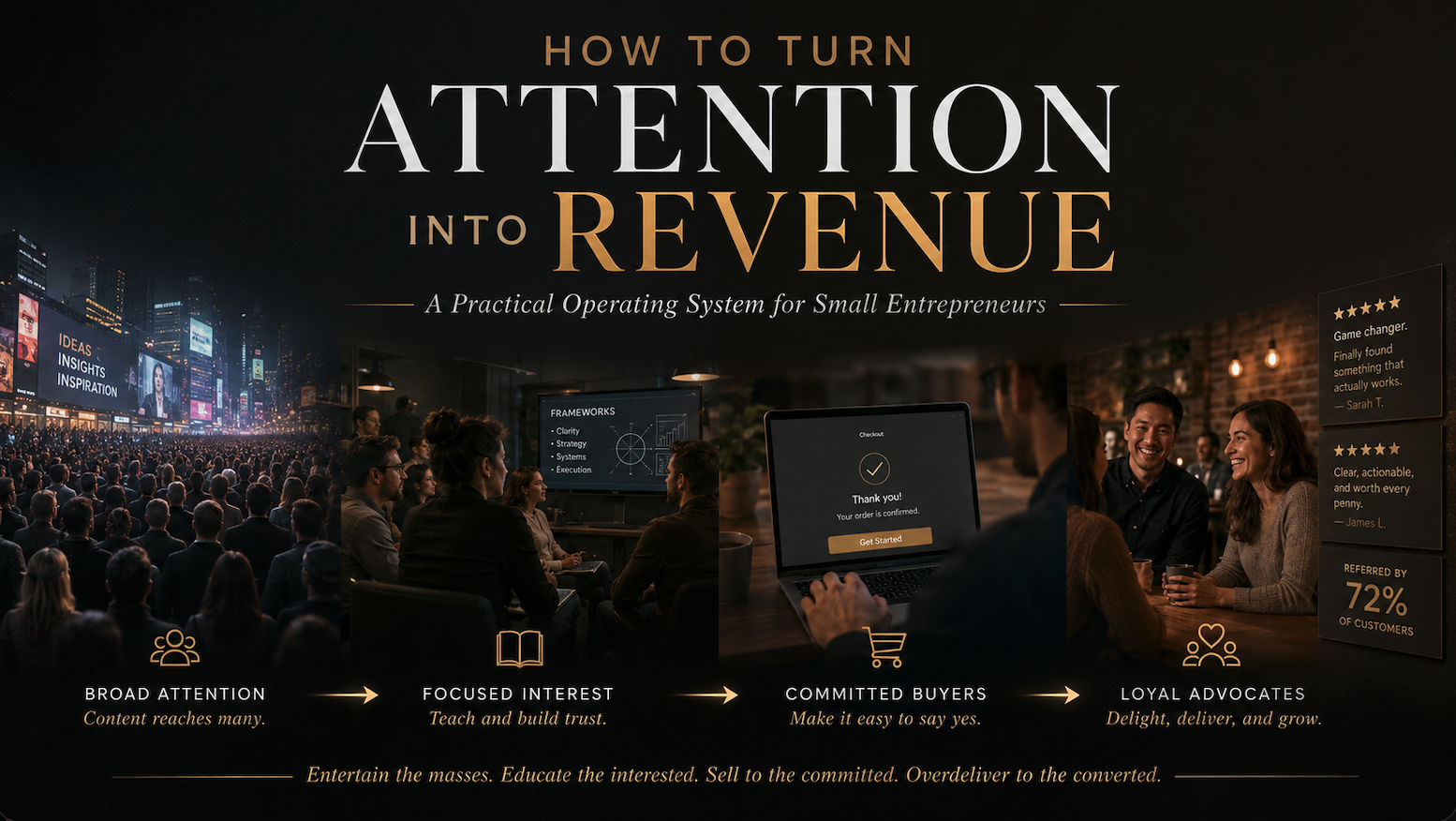
Entertain the masses. Educate the interested. Sell to the committed. Overdeliver to the converted.
A landscaper posts a picture of a lawn and writes, “Spring packages available. Call today.”
Nothing is wrong with the offer. The price may be fair. The work may be excellent. The problem is that the message assumes the reader has already decided to care.
Now imagine the same landscaper posts a close-up of two patches of grass and writes, “These two brown spots look the same. One needs water. Fertilizing the other can make it worse.”
A homeowner who was not shopping for lawn service may stop long enough to compare the pictures. Another homeowner may save the post. A third may ask, “Mine looks like the one on the right. What is it?”
No sale has occurred. Something more basic has happened: attention has turned into voluntary interest.
That distinction is the foundation of this operating system. Most small businesses do not have one audience. They have several audiences occupying different states at the same time. A stranger may need a reason to notice. An interested person may need enough information to understand the problem. An evaluator may need proof. A committed buyer may need a price and an open calendar. A customer who already paid should be receiving the result, not another sales pitch. Treating all of them alike creates waste.
The working doctrine is simple:
Entertain the masses. Educate the interested. Sell to the committed. Overdeliver to the converted.
It should not be mistaken for a universal law of psychology or a rigid funnel. It is a routing rule for deciding what kind of communication is appropriate next. Research on consumer decision-making supports the caution against rigid sequencing. Google’s Decoding Decisions describes an “infinitely looping relationship between explore and evaluate,” while McKinsey describes a post-purchase “feedback loop” in which customers continue evaluating what they bought.[^1][^2]
The practical consequence is useful for a one-person company: stop asking every piece of content to make a sale. Give each piece one job, then measure whether it did that job.
The Business Has More Than One Audience at Once
A small-business owner often sees one list:
followers
or one database:
leads
or one crowd:
people who might buy.
Those labels hide the information that matters. A person who watched one video is different from a person who visited your pricing page three times. A person who downloaded a beginner checklist is different from a person who asked whether Tuesday at 2:00 p.m. is available. A previous customer who refers two friends is different from both.
A more useful model looks like this:
State What the person is doing Your primary job Stranger Has little or no demonstrated interest Earn attention Attentive Stops, watches, clicks, visits Establish relevance Interested Returns, saves, follows, asks Educate Evaluating Compares, checks reviews, studies price Reduce uncertainty Committed Requests quote, booking, availability, terms Make buying clear Customer Has paid Deliver the promised result Advocate Reviews, refers, returns, shares Make proof easy to preserve
The movement is not always downward through the table. A customer can return to evaluation before renewing. A stranger referred by a trusted friend may enter at evaluation. An emergency-service buyer may skip almost everything and search “24-hour plumber near me” with a credit card in hand.
That is why the doctrine works better as state-based routing than as a chronological funnel. If you know the state, the next move gets easier.
PART I: ENTERTAIN THE MASSES
Entertainment Is an Attention Job
“Entertain” causes trouble because people hear comedy, dancing, stunts, or whatever happened to go viral this week. That definition is too narrow for business.
For a working entrepreneur, entertainment means presenting something with enough curiosity, tension, recognition, surprise, usefulness, emotion, beauty, contrast, or participation that a relevant stranger chooses to keep paying attention. A tax preparer can do that. So can a roofer, barber, funeral director, photographer, bookkeeper, pastor, mechanic, dentist, contractor, baker, realtor, consultant, and house cleaner.
The work does not have to become silly. It has to become legible.
Curiosity offers one reason this works. Amanda Markey and George Loewenstein summarize the information-gap account by writing that “curiosity develops when people become aware of a gap between what they know and what they don’t know.”[^3] A useful hook can make that gap visible without turning the content into clickbait.
Consider the difference:
Weak: We provide professional bookkeeping services for small businesses.
Stronger: Your bank balance can rise while your business gets less able to pay its bills. These four numbers tell you whether that is happening.
The second line does not prove the bookkeeper is competent. It does not close the sale. It opens a specific gap that the right owner may want closed.
Research on sharing adds another caution. Jonah Berger and Katherine Milkman analyzed New York Times articles and found that emotion and arousal were associated with transmission. Their abstract also notes that “surprising, interesting, or practically useful content” was positively linked to virality in their analysis.[^4] That does not mean every small business should chase virality. It means dry information is not the only way to be useful, and useful information does not have to be emotionally flat. For the operator, the target is relevant attention, not fame.
Six Attention Formats a Small Business Can Reuse
These formats are operating patterns, not scientific laws. Their value is that they give an entrepreneur something repeatable to make from real work.
Format 1: The Reveal
A reveal gives the audience a visible change or hidden fact. A contractor can show what was behind a wall. A detailer can show half a seat cleaned and half untouched. A baker can reveal a custom cake built from a strange customer request. A realtor can open a basement door after showing a polished first floor. The content promise is simple: you are about to see something you could not see at the beginning.
A pressure-washing operator might film:
the driveway before work. one dirty section close up. a single cleaning pass. half cleaned, half untouched. the completed driveway. the customer’s reaction, if the customer agrees to be filmed.
One paid job can produce multiple attention assets without inventing a story.
Format 2: The Mistake
A mistake format works when the operator can name a real, bounded error and explain its consequence.
A painter:
“This is why paint peels around this bathroom window even when the paint itself is expensive.”
A bookkeeper:
“Three expenses owners accidentally count twice when they estimate how much cash they can spend.”
A barber:
“If your hairline grows this way, pushing this corner back can make the cut look clean today and worse next week.”
The ethical boundary matters. Do not fabricate danger. Do not make a normal choice sound catastrophic. Show the actual error, the actual consequence, and the conditions under which it matters.
Format 3: The Comparison
Comparison gives the audience a decision structure. A realtor can show three homes at the same asking price. A photographer can show the same subject under two lighting setups. A baker can compare buttercream and fondant for two different event conditions. A contractor can compare repair, partial replacement, and full replacement. The strongest comparisons disclose the criteria.
Instead of:
Cheap roof versus good roof.
Use:
Repair versus replacement: cost today, expected remaining life, warranty, disruption, and what each option does not fix.
The comparison becomes education while still being easy to enter.
Format 4: The Transformation
Transformation makes movement visible.
The obvious versions are visual: dirty to clean, empty to full, damaged to repaired. Service businesses can use nonvisual transformations too:
confused books → monthly close. missed leads → organized follow-up. scattered files → searchable client records. empty appointment book → scheduled work. ten-step intake → three-step intake.
Do not claim a transformation you cannot document. If the result is illustrative, say so. If it is a customer result, preserve the evidence and permission.
Format 5: The Story
Story gives expertise a human sequence.
A heating-and-air company could say:
“A homeowner called expecting a full system replacement. The technician tested the system before discussing replacement and found a failed component that could be repaired. This is the test we run before recommending a new unit.”
That is stronger than “We believe in honesty” because the principle is attached to an observable process. For public use, a true customer story needs permission or sufficient anonymization. A hypothetical teaching story needs a label. Do not combine several customers into one and present the composite as real.
Format 6: The Challenge
A challenge invites the audience to participate.
Which roof has hail damage? Which of these three invoices is hurting cash flow? Which kitchen layout would you keep? Which photograph used natural window light? What would you repair first in this inspection photo?
The answer should teach something. Otherwise the challenge is empty engagement bait.
The Accountant Does Not Need to Become an Influencer
Consider a solo accountant who wants more owner-led service businesses.
The default content often looks like this:
Tax preparation. Bookkeeping. Payroll. Advisory. Contact us.
That content has a place on the website. It is weak as a constant attention strategy because it asks a stranger to start with the service menu.
A better media sequence might look like this:
Attention
“A company can report a profit and still run out of cash. The difference is hiding in timing.”
Interest
“These are the five dates I would put on one page before deciding how much cash the owner can safely take out.”
Education
“Bookkeeper, tax preparer, accountant, controller, CFO: what each role does and where the boundaries overlap.”
Evaluation
“If your books are thirty days behind, this is what I would want cleaned up before promising you a monthly close date.”
Commitment
“Our monthly close service includes A, B, C, and D. It costs $X for this scope. Here is what is not included. Here is the first available onboarding date.”
The accountant has not become an entertainer in the celebrity sense. The accountant has learned to package expertise according to customer state.
The Realtor Can Stop Posting Only Inventory
Inventory matters. Inventory alone makes a realtor easy to compare with every other person who can access the same listings. A realtor can build an information world around the decision.
Attention
“Three houses. Same $400,000 asking price. Which tradeoff would you take?”
Education
“The cheapest monthly mortgage payment is not always attached to the cheapest house. Here are the costs I would compare.”
Local knowledge
“These three neighborhoods put the same purchase budget into very different combinations of lot size, commute, taxes, age, and walkability.”
Evaluation
“Seven questions I would ask an inspector before waiving any contingency.”
Commitment
“Buying within ninety days? This is my buyer process from preapproval through closing.”
The serious buyer eventually stops comparing realtors only by friendliness or availability. The buyer can compare the quality of the realtor’s decision system. That is a better competitive position.
The Purpose of Entertainment Is Not Maximum Reach
Virality can be commercially weak. A plumber with 4,000 relevant local followers may own more usable demand than a creator with 400,000 viewers scattered across markets the plumber cannot serve. A divorce attorney does not need a global teenage audience. A local barber does not need five million viewers who live several flights away.
This distinction can be written as two separate quantities:
\[ \text{Reach} \neq \text{Relevant Reach} \]
and
\[ \text{Relevant Reach} \neq \text{Purchase Intent} \]
A piece of content can perform well at one and poorly at the others.
The operator should ask:
Did the right geography see it? Did the right kind of customer respond? Did people ask questions related to the paid problem? Did profile visits become site visits? Did site visits become deeper consumption? Did any of those people later evaluate the offer?
A viral post that fills the business with irrelevant traffic can consume time without creating useful demand. The aim is not to make the largest crowd possible. The aim is to keep discovering people for whom the work can become relevant.
PART II: EDUCATE THE INTERESTED
Interest Changes the Contract
A person who keeps watching has given you something valuable: permission to go deeper. The content can now carry more detail.
Someone who saves a roofing explainer, visits the contractor’s website, reads a second article, and asks what a shingle rating means is behaving differently from the stranger who saw one thirty-second video. The operator’s job changes from earn attention to increase decision quality.
Useful education should help the prospect answer:
What is happening? Why might it be happening? What would tell me which version of the problem I have? What happens if I ignore it? What can I solve myself? When does professional help make sense? What options exist? What tradeoffs separate those options? How should I evaluate a provider? What does competent implementation look like?
A business that teaches those questions is doing more than “giving value.” It is shaping the customer’s evaluation criteria. If the business actually meets the criteria it teaches, education becomes differentiation without needing to declare superiority.
Build a Knowledge Ladder
Do not hand every prospect the entire library. Organize education by depth.
Level 1: Recognition
Purpose: help someone name the situation.
“These three symptoms usually mean your website has a follow-up problem, not a traffic problem.”
Level 2: Explanation
Purpose: show the mechanism.
“A lead can disappear at five handoffs: form submission, notification, first response, qualification, and scheduling.”
Level 3: Diagnosis
Purpose: help the person inspect their own case.
“Pull the last fifty inbound leads. Mark response time, contact attempts, booked, showed, bought.”
Level 4: Options
Purpose: show available solution classes.
“You can fix this with manual process, automation, staffing, or a mix. Each has a different cost and failure mode.”
Level 5: Selection
Purpose: give decision criteria.
“Choose based on volume, response-time target, exception rate, staff availability, and how much authority you are willing to automate.”
Level 6: Implementation
Purpose: show what professional execution involves.
“A real implementation needs routing, permissions, message logic, failure handling, reporting, and a way to stop automation when the goal is reached.”
Level 7: Offer
Purpose: make the commercial path concrete.
“This is the scope we implement, the price, the timeline, what we need from you, and what we do not include.”
The person reading Level 7 material has revealed a different kind of interest from the person who paused on Level 1. Do not route them to the same message.
Build a Small-Business University
A useful test is to imagine a serious prospect consuming your best material for thirty days. Would that person become meaningfully better at understanding the problem you solve?
A barber’s curriculum might cover:
taper versus fade. how growth pattern affects a cut. why some lines should not be pushed backward. how often different styles need maintenance. beard shape and face shape. product categories and what they actually do. how to communicate a desired cut. what can be maintained safely at home.
A house cleaner might teach:
daily cleaning versus deep cleaning. a room-by-room rotation. what needs dwell time. which surfaces require different products. how to prepare a home before a cleaner arrives. what a standard clean does not include.
A photographer might teach:
why light direction changes a portrait. what scouting a venue accomplishes. why backup equipment matters. how delivery timelines work. why editing style is part of the product. how to compare photographers beyond camera brand.
The business is not trying to turn every prospect into a do-it-yourself replacement. It is helping the prospect understand enough to recognize the value and limitations of professional work.
Some people will learn and do it themselves. They were not necessarily lost customers. Others will learn enough to conclude, with greater certainty, that they want help.
Education Should Make the Customer Harder to Fool
This is one of the best tests of trustworthy marketing. After reading your material, is the customer better able to reject a bad provider, including you?
A roofer who teaches customers to ask for license information, warranty terms, scope exclusions, material specification, cleanup procedure, and change-order rules is increasing the buyer’s standards. That can feel dangerous. It is only dangerous if the roofer cannot meet those standards.
Education that increases the customer’s discernment does three things:
it raises the quality of the sales conversation. it reduces dependence on vague adjectives. it makes proof more valuable.
“High quality” becomes less persuasive than an exact material, an exact process, a named warranty, a documented inspection, and a clear exclusion. That is how an operator competes without shouting.
PART III: THE BUYER DOES NOT MOVE IN A STRAIGHT LINE
Replace the Funnel in Your Head With a Routing Map
The old funnel is useful for reporting. It is dangerous when treated as a literal map of human behavior.
Google’s research frames the space between trigger and purchase as a loop in which consumers explore and evaluate. The report says the goal is to provide people with what they need to feel comfortable making a decision, rather than forcing them out of that process.[^1] McKinsey likewise describes shoppers adding and removing choices over time, then continuing evaluation after purchase.[^2]
For the small operator, this means:
A person may see a video in January, receive a referral in March, read reviews in April, request a quote in May, delay the purchase, return in July, and buy after a new trigger appears. A different person may search for an emergency service and buy in ten minutes.
Do not make “time since first contact” your only definition of lead temperature. Behavior is more informative.
A useful routing rule is:
The exact thresholds will differ by business. The logic travels well.
Build an Intent Ladder
A simple intent ladder can live in a spreadsheet before it lives in software.
Level State Observable examples Best next move 0 Unknown Impression only Earn another second 1 Attentive Watch, click, profile visit Establish relevance 2 Interested Save, follow, repeat visit, question Teach 3 Learning Guide, long video, webinar, email reply Give deeper diagnosis 4 Evaluating Reviews, pricing, comparison, case study Give proof and criteria 5 Committed Quote, booking, availability, terms Make transaction simple 6 Purchasing Contract, checkout, deposit Remove friction 7 Customer Active delivery Produce result 8 Advocate Review, referral, repeat purchase Preserve and distribute proof
Do not pretend that a “like” means purchase intent. Do not pretend a price-page visit means a sale.
Use behavior as evidence of movement, not certainty about the person’s mind. That distinction matters. You are classifying observable state, not diagnosing someone’s private psychology.
Let the Customer Self-Identify
You can learn more by asking.
A contractor can ask:
What are you trying to do?
emergency repair. normal repair. replacement. preventative maintenance. not sure yet.
A consultant can ask:
Where is growth breaking?
not enough qualified arrivals. slow follow-up. poor qualification. weak closing. retention. fulfillment capacity. I do not know yet.
A realtor can ask:
Where are you in the process?
browsing. need financing. selling first. buying in ninety days. actively touring.
Self-selection has two benefits. The customer gets information that fits the situation, and the business stops pretending everybody needs the same sequence.
PART IV: SELL TO THE COMMITTED
A Committed Buyer Needs Less Theater and More Certainty
The communication should become more concrete as purchase intent rises.
A committed buyer wants answers:
What exactly do I get? What does it cost? How is price determined? What happens after I pay? How long does it usually take? Who does the work? What do you need from me? What is excluded? What could change the price? What proof exists? What are the risks or limitations? What is the next available date? How do I start?
This is where some value-first businesses fail. They teach for months, build trust, create a ready customer, then hide the transaction behind vague language such as “reach out to learn more.” If the buyer is ready, clarity is service.
Never Hide the Cash Register
The committed prospect should not need detective skills.
Make the buying path visible:
price or price logic when appropriate. packages. quote request. booking calendar. phone number. application form. financing information where lawful and relevant. deposit. checkout. service area. availability. expected response time.
The exact design depends on the business. A complex commercial construction project may require a scoped estimate. A haircut should not require a seven-step consultation form.
Fogg’s Behavior Model offers a useful diagnostic. Stanford’s Behavior Design Lab summarizes the model with three elements: “Motivation, Ability, and a Prompt.”[^5] If a ready prospect fails to act, the problem may not be a lack of desire. The action may be too difficult, or the prompt may be missing.
Audit the bottom of the journey for:
forms that ask for information you do not need yet. broken calendars. slow mobile pages. unclear service areas. hidden phone numbers. unclear deposits. unanswered messages. checkout errors. surprise fees. five competing calls to action.
A motivated person can still abandon a bad buying system.
Example: The Roofer
A roofing company can serve four states with four different messages.
Stranger
“Can you spot the damaged shingle in this photo?”
Interested homeowner
“What hail damage can look like, what it can be confused with, and when an inspection makes sense.”
Evaluator
“Repair versus replacement: scope, expected life, warranty, cost drivers, and what each option does not solve.”
Committed buyer
“Inspection process, written scope, material specification, estimate, warranty, scheduling window, payment terms, and next available date.”
The progression becomes less theatrical because the customer’s question changes. At the top: Should I care? Near the bottom: Can I trust this specific transaction?
The Sales Page for a High-Intent Prospect
A strong high-intent page can be built from eleven blocks:
Problem
Name the exact situation.
Customer
Say who this is for.
Outcome
State what the service is designed to accomplish without guaranteeing what you cannot guarantee.
Scope
List what is included.
Exclusions
List what is not included.
Process
Show what happens from payment through completion.
Timeline
Give the normal range and what can change it.
Price
Give the number, range, or calculation method.
Proof
Show real results, reviews, credentials, process evidence, or work samples.
Risk
Explain warranties, refund rules, dependencies, or limitations honestly.
Action
Give one primary next step. This is the point where clever copy should surrender to usable information.
PART V: OVERDELIVER TO THE CONVERTED
The Sale Is Where the Claim Meets Reality
Before purchase, the company makes promises. After purchase, the customer acquires evidence.
That is why “overdeliver to the converted” matters. It does not mean donating unlimited labor or destroying margin. It means exceeding the expectations that matter most to the result and the experience.
A contractor may overdeliver through:
arriving when promised. protecting the customer’s property. sending a short status update before the customer has to ask. documenting change orders. cleaning the job site. explaining the final work. leaving warranty information organized.
A consultant may overdeliver through:
faster diagnosis. clearer decisions. documented assumptions. a handoff the client can operate without the consultant. measured results. explicit next steps.
A photographer may overdeliver through:
preparation guidance. backup planning. clear delivery dates. organized galleries. file formats the customer can actually use.
Overdelivery should improve the result, reduce uncertainty, or make the experience easier. Random extras can increase cost without increasing value.
Delivery Creates the Strongest Raw Material for Future Marketing
Advertising says the business can do something. A completed result can show what happened.
That evidence can become:
before-and-after material. a documented case. a customer quote. a review. a work sample. a process demonstration. a repeat-purchase record. a referral story.
Social proof is especially useful when buyers are uncertain. Robert Cialdini’s Influence at Work page summarizes the principle this way: “people will look to the actions and behaviors of others” when they are uncertain.[^6]
Local-business research illustrates how heavily reviews can enter that evaluation. BrightLocal’s 2026 Local Consumer Review Survey, based on a representative panel of 1,002 U.S. adults, reports that “97% of consumers read reviews for local businesses.” It also reports that after positive reviews, 66 percent of respondents said they do further research while 34 percent were ready to buy or book.[^7]
That second number is useful because it prevents an overclaim. A positive review is not always a closing device. Often it sends the person deeper into evaluation.
The proof needs integrity. The Federal Trade Commission tells review platforms to ensure reviews “truly reflect the feedback received from genuine customers,” and its guidance addresses fake and false reviews and testimonials.[^8]
For a small entrepreneur, the rule is uncomplicated:
Earn the proof. Preserve the proof. Do not manufacture the proof.
Turn Delivery Into a Proof Record
After a successful job, capture five things.
Before
What was true before the work?
Intervention
What did you actually do?
After
What changed?
Evidence
What shows that change?
Customer voice
How does the customer describe it, and do you have permission to use that statement?
A proof record can be as simple as:
That is far more valuable than a folder named testimonials filled with screenshots whose origin no one remembers.
Example: The Mobile Detailer
One real appointment can generate a week of communication.
Attention asset
The initial interior condition, with customer permission and no identifying personal material in frame.
Attention asset
Half-clean comparison.
Education asset
Why the detailer chose extraction for that material.
Education asset
What customers should remove from a vehicle before a deep detail.
Evaluation asset
Basic interior clean versus deep interior restoration.
Proof asset
Final result.
Proof asset
Customer review.
Commercial asset
Exact package price and what it includes.
Local asset
“We will be working in this neighborhood Thursday. These are the remaining appointment windows.”
Retention asset
A care guide sent to the customer after service. One transaction can create material for every stage because the business is documenting reality instead of inventing content from scratch.
The One-Job, Ten-Asset Rule
After each meaningful job, ask whether the work can produce ten useful assets without violating privacy or manufacturing claims.
A hairstylist completing a real color correction, with permission, might capture:
before image. consultation goal. product or process explanation. mid-process detail. final reveal. maintenance instructions. time required. factors that affected price. customer reaction. approved review.
A kitchen remodel might produce:
pre-project walkthrough. design constraint. demolition discovery. electrical explanation. cabinet comparison. material selection. schedule update. final reveal. cost drivers. owner interview.
The rule is a content-extraction target, not a quota. If the job only yields four truthful assets, publish four.
PART VI: THE LOCAL ENTREPRENEUR ADVANTAGE
Proximity Is a Real Asset
Large companies can buy reach. Small companies often know the street.
They know:
what homes in the neighborhood were built with. which weather event just hit. when the local event lets out. what parking is like. which questions customers keep asking. what local buyers call the problem. which seasonal patterns recur. which neighborhoods have different constraints.
That specificity can make content more useful than generic national advice.
A contractor:
“Homes from this subdivision’s first phase tend to have this vent configuration. If yours does, inspect this area before replacing anything.”
A restaurant:
“What the kitchen looks like at 6:00 a.m. before Saturday service.”
A barber:
“Three cuts customers in this shop are asking for this month, and what maintenance each one needs.”
An accountant:
“The records I ask local contractors to gather before we begin a quarterly review.”
A realtor:
“Same purchase budget, three neighborhoods, four tradeoffs.”
Local relevance also has a search and reputation component. BrightLocal’s 2026 findings show that review reading is widespread and that positive reviews frequently lead consumers to more research rather than immediate purchase.[^7] Your website, review profiles, social pages, hours, service area, and contact path need to agree with one another. The person who saw a reel yesterday may search the business name tomorrow.
Create Shows Instead of Inventing Posts Every Morning
A recurring format reduces the cost of deciding what to make.
A mechanic can run:
What’s That Noise?
An accountant:
Can I Deduct That? With appropriate tax disclaimers and fact-specific boundaries.
A realtor:
What $400K Buys Here
A barber:
Fix This Cut
A restaurant:
Before We Open
A consultant:
Find the Constraint
A landscaper:
What’s Killing This Lawn?
A photographer:
Same Camera, Different Light
The audience learns the format. The operator learns the production process. The business accumulates a library around one recognizable problem.
A show is not valuable because television did it first. It is valuable because recurrence lowers creative overhead.
PART VII: BUILD CONTENT FOR THE STATE
A Seven-Day Publishing Architecture
A small operator can use a weekly structure without posting seven days if that pace is unrealistic. The point is coverage across states.
Monday: Attention
A reveal, mistake, comparison, story, or question with a real answer.
Tuesday: Education
Explain one problem.
Wednesday: Evidence
Show a documented case, process, work sample, or properly labeled example.
Thursday: Evaluation
Help a serious prospect compare options.
Friday: Offer
State what you sell, scope, price logic, availability, and next step.
Saturday: Proof
Publish an approved review, result, or before-and-after record.
Sunday: Human context
Show the work, team, values through behavior, community, or a lesson learned. Do not force “humanity” into fake vulnerability. Show something true that helps the reader understand who is doing the work.
Email Should Change When Intent Changes
Suppose a restaurant consultant offers a free checklist titled:
10 Places Restaurant Profit Leaks Before Month-End
A new subscriber gets:
Email 1: how to use the checklist. Email 2: one leak explained.
Email 3: a documented example or clearly labeled illustration. Email 4: how to measure the leak. Email 5: when the owner can fix it internally and when outside help may be useful.
Now the subscriber clicks a page called:
How Our Restaurant Audit Works
That click does not prove purchase intent. It is a stronger evaluation signal than opening the checklist email.
A reasonable next message can become more commercial:
“You looked at the audit process. If you are comparing options, this page has the scope, price, timeline, and what we need from you.”
The person’s behavior changed. The communication changed with it.
Do Not Confuse Followers With Customers
A person can follow for three years and never buy. A different person can discover the business Tuesday and book Thursday. Chronology is weak evidence by itself.
Suppose a new visitor:
watches one video. visits the website. reads three case studies. opens the price page twice. checks reviews. requests a consultation.
That person may have compressed exploration and evaluation into one afternoon. Do not force a beginner email sequence onto a person who is already trying to buy.
The opposite also matters. A longtime follower who enjoys your content may never have a relevant problem. Familiarity is not intent.
PART VIII: SMALL AUDIENCES CAN SUPPORT SERIOUS BUSINESSES
Celebrity Economics and Business Economics Are Different
A high-value service does not require a celebrity-sized audience. Suppose, purely as arithmetic, a service sells for $5,000.
Four sales:
\[ 4 \times \$5{,}000 = \$20{,}000 \]
Twenty sales:
\[ 20 \times \$5{,}000 = \$100{,}000 \]
Those figures are not a forecast. They make one point: audience size and required customer count are different variables.
A hypothetical monthly flow could be:
Nothing in this example guarantees those conversion rates. A real business must measure its own.
The strategic implication survives without assuming the percentages:
a business selling a valuable service may need a reliable stream of qualified conversations more than it needs mass fame.
That changes what “good content” means.
Example: The Eighteen-Year-Old Pressure-Washing Operator
An eighteen-year-old with a phone, basic equipment, insurance required for the work, and no meaningful media budget can still build the system from documented jobs.
Attention
Film the driveway before work and the first clean pass.
Education
Explain why surfaces require different pressure and methods. Only claim what the operator is trained and qualified to explain.
Evaluation
Show what changes the price: area, material, access, staining, add-ons.
Commitment
Publish the service area, available times, price or estimate logic, and booking method.
Proof
Capture the final result and approved customer review. The useful asset is not youth, virality, or cinematic production. It is the ability to turn work into evidence and evidence into discoverable communication.
Example: The Pastor With a Separate Leadership Service
Suppose a pastor also runs a paid leadership-training business. The ethical problem is obvious: the ministry audience should not be treated as a captive sales list. The commercial service needs a separate, clear lane.
Public attention
A leadership observation:
“The most dependable person in a small organization often becomes the place every decision waits.”
Education
Teach delegation, role clarity, decision rights, meeting structure, or succession.
Self-selection
Offer a leadership-capacity assessment.
Evaluation
Explain what a paid intensive does and does not include.
Sale
State scope, price, duration, and fit. The sermon does not have to become an advertisement. The business can earn its own demand.
Example: The Pharmacist Building a Nonclinical Service
Suppose a pharmacist wants to offer a lawful administrative service helping caregivers organize medication lists and prepare questions for licensed clinicians. The boundaries have to be explicit.
Attention
“Five bottles, three prescribers, two pharmacies: the paperwork problem can become hard to track before anyone notices.”
Education
Teach how to maintain an accurate medication list, what information to bring to an appointment, and how caregivers can organize records.
Boundary
State what the service does not do: no diagnosis, no changing prescriptions, no substitute for the prescriber or dispensing pharmacist.
Offer
Describe the administrative review, price, privacy practices, and referral boundaries. The business value comes from making existing expertise understandable without pretending an administrative service is medical treatment. Any entrepreneur working in a regulated field should add the applicable professional, legal, privacy, and advertising requirements before using this playbook.
PART IX: USE AI WITHOUT BECOMING GENERIC
Cheap Generation Raises the Value of Reality
AI can make drafting, repurposing, summarization, and variation faster. Adoption is no longer niche. Stanford’s 2026 AI Index reports: “Generative AI is now used in at least one business function at 70% of organizations.”[^9]
That fact does not prove that all generic information has become worthless. It supports a narrower inference: when more organizations can produce competent-looking text and media quickly, merely producing more generic content becomes a weaker differentiator. The small entrepreneur should use AI to process reality, not replace it.
Good uses include:
transcribing a customer-approved interview. turning one long explanation into platform-specific drafts. organizing repeated questions. clustering objections from sales notes. drafting headline variants. indexing a proof library. finding recurring themes in reviews. turning a job log into a first case-study draft. checking whether a page answers common questions. adapting education to different levels of intent.
The raw material should increasingly come from things competitors cannot prompt into existence:
your actual jobs. your local observations. your prices. your process. your measurements. your mistakes. your customer questions. your documented results. your point of view. your accumulated proof.
AI can help package those assets. It should not manufacture the underlying receipt.
PART X: BUILD THE PROOF LIBRARY
Proof Should Be Searchable, Permissioned, and Reusable
Create a proof library with enough structure that six months later you can tell what each asset means.
For each asset, record:
date. customer or anonymized identifier. product or service. claim supported by the asset. source file. customer permission. allowed channels. expiration or withdrawal if applicable. context and limitations.
A screenshot without context can become dangerous. Was it a test environment? Was the customer paid for the statement? Was the result typical? Did the customer approve public use? Does the number still mean what the caption says?
Proof should become stronger as the library grows, not less traceable. The FTC’s review and endorsement guidance is one reason to take that seriously.[^8]
A Competitor Can Copy the Headline Faster Than the History
A competitor can imitate:
“Three mistakes killing your lawn.”
The competitor cannot instantly duplicate:
five years of before-and-after jobs. 300 properly permissioned reviews. a library of local problem patterns. customer language collected from real calls. your response history. your work samples. your documented fixes. your referral network.
That accumulated history can improve education. Better education can improve fit.
Better fit can improve delivery. Better delivery can create stronger proof.
The compounding asset is not the post. It is the evidence-producing operating history behind the post.
PART XI: MEASURE MOVEMENT, NOT NOISE
Give Each Stage Its Own Question
A content system becomes diagnosable when each stage has a purpose.
Attention
Possible measures:
relevant impressions. watch time. retention. shares. profile visits. local reach.
Question:
Did the right people stop?
Interest
Possible measures:
repeat visits. saves. follows. downloads. email subscriptions. questions. direct replies.
Question:
Did attention become voluntary depth?
Education
Possible measures:
article completion. long-video completion. webinar attendance. tool use. checklist completion. assessment completion.
Question:
Did the prospect learn enough to evaluate the problem better?
Evaluation
Possible measures:
pricing visits. case-study views. review-page visits. comparison-page views. proposal starts. consultation starts.
Question:
Did understanding become active comparison?
Commitment
Possible measures:
booked calls. quote requests. applications. carts. trial starts. deposits initiated.
Question:
Did evaluation become concrete intent?
Sale
Possible measures:
purchases. close rate. average transaction. gross profit. variable cost. contribution.
Question:
Did intent become economic action?
Delivery
Possible measures:
completion. time to result. defects. rework. support burden. repeat purchase.
Question:
Did the promise become reality?
Advocacy
Possible measures:
reviews. referrals. repeat business. approved testimonials. customer-created content.
Question:
Did the result create evidence or distribution?
No single metric tells the whole story.
Find the Broken Transition
Suppose a business gets strong relevant reach and almost no deeper visits.
The likely problem sits near:
Attention → Interest
Possible causes:
entertaining but unrelated content. weak profile. no next resource. unclear problem. wrong audience.
Suppose subscribers read education but never investigate the service.
Look near:
Education → Evaluation
Possible causes:
the education solves trivia rather than a valuable problem. no clear differentiation. no evidence. no bridge to the paid work.
Suppose consultation volume is healthy but closing is weak.
Look near:
Commitment → Sale
Possible causes:
price/value mismatch. poor fit. slow follow-up. weak proof. unclear scope. friction. wrong prospects entering the call.
Suppose customers buy but reviews and referrals remain weak.
Look near:
Delivery → Advocacy
Possible causes:
ordinary delivery. inconsistent result. no proof-capture process. no review request. no easy referral method. expectations set too high during marketing.
Once the broken transition is visible, “post more” stops being the default answer.
PART XII: BUILD THE MINIMUM SYSTEM
The Seven-Part Small-Business Stack
A solo operator can begin with seven parts.
One Primary Attention Channel
Choose the place where relevant customers already spend attention or search. Do not select a platform because another entrepreneur went viral there.
One Owned Destination
A website, landing page, email list, or other destination you control well enough to continue the relationship.
One Useful Resource
A checklist, guide, calculator, assessment, template, demonstration, or tool that helps an interested person go deeper.
One Education Sequence
Five to ten messages or pieces that move from recognition toward evaluation.
One Primary Offer
A clear commercial next step.
One Proof System
Capture outcome, permission, evidence, and customer voice.
One Referral Loop
Give successful customers a simple, ethical way to review, refer, or return. That is enough for a first operating system. Do not wait for the complete media empire.
The One-Page Routing Sheet
Keep this beside the content calendar.
Signal Likely state Send/show next First view Stranger Relevant attention content Repeated view/save Interested Beginner education Guide download Learning Deeper diagnosis Multiple case studies Evaluating Proof + criteria Pricing visit Evaluating Scope + objections Quote request Committed Exact process + offer Booking started Purchasing Friction removal Paid Customer Onboarding + delivery Result verified Customer Proof request Review/referral Advocate Thank, preserve, continue relationship
Do not let the sheet become a mind-reading machine. It is a decision aid.
PART XIII: THE 90-DAY BUILD
Days 1–30: Learn What Earns Relevant Attention
Document real work.
Create:
five reveals. five mistakes. five comparisons. five stories. five challenges.
You do not need to publish all twenty-five immediately. Build inventory.
Track:
which topics stop relevant people. which questions repeat. which posts produce local profile visits. which posts attract irrelevant crowds. what language customers use in comments and calls.
The output of month one is not merely “content.” It is a better map of what the market notices.
Days 31–60: Build the Education Layer
Take the ten questions you hear most often.
For each one, create:
a short answer. a deeper explanation. a diagnostic step. a comparison. the conditions under which your paid service becomes relevant.
Then build:
one checklist. one FAQ. one comparison page. one case-study template. one email sequence.
The output of month two is a path from curiosity to informed evaluation.
Days 61–90: Repair the Buying Path
Study the people who got close to buying. Write down every question asked before purchase.
Audit:
pricing. scope. response time. consultation. proposal. contract. deposit. scheduling. checkout. onboarding. proof.
Use the Fogg model as one diagnostic lens: was the desired action sufficiently easy, sufficiently prompted, and attached to enough motivation?[^5] The output of month three is not “more sales copy.” It is a lower-friction decision and transaction system.
PART XIV: ONE YEAR OF COMPOUNDING WORK
The Library Becomes the Asset
Assume a business chooses a manageable weekly cadence:
three attention pieces. two educational pieces. one commercial piece. one proof piece.
Over fifty-two weeks, the arithmetic is:
156 attention pieces. 104 educational pieces. 52 commercial pieces. 52 proof pieces.
Those numbers do not predict performance. They show inventory.
Now add the information generated by actual customers:
questions. objections. requests. before-and-after records. reviews. mistakes. process changes. local patterns. referrals.
By the end of a year, a disciplined operator can possess a body of market-specific knowledge that did not exist at the beginning. That knowledge can improve the next year’s work.
PART XV: WHERE THE DOCTRINE CAN FAIL
Entertainment Can Attract the Wrong Crowd
A baker can become famous for comedy while nobody remembers the cakes. A contractor can get millions of views from demolition clips outside the service area.
A financial professional can attract people who love arguments but will never become qualified clients. Fix: connect attention to the actual problem, geography, product, or point of view. The entertaining element should carry the business with it.
Education Can Become an Endless Free Library With No Offer
Some entrepreneurs become excellent teachers and invisible merchants. Every post teaches. Every email teaches. The website teaches.
The customer still cannot tell what is for sale. Fix: when evaluation signals appear, show the offer without apology. Education and commerce can coexist as long as the state is respected.
Selling Can Arrive Too Early
A stranger watches one video and immediately receives:
Book a $5,000 package.
That may work for a person already in market. It can repel someone who was only beginning to recognize the problem. Fix: let behavior determine how commercial the next message becomes.
“Overdelivery” Can Destroy Margin
Giving away twice the contracted labor is not automatically good service.
Fix: overdeliver on the dimensions customers value and the business can sustain:
certainty. communication. cleanliness. preparation. documentation. speed where feasible. craftsmanship. handoff.
Do not confuse generosity with unmanaged scope.
Proof Can Become Manipulation
The temptation grows as reviews become commercially important.
Do not:
write fake reviews. hide material relationships. invent testimonials. merge several customers into one. publish unverified results. crop context until a claim changes meaning.
FTC guidance exists because review and endorsement systems can be abused.[^8] Fix: maintain a proof ledger with source, permission, claim, context, and limitations.
PART XVI: FOUR PRACTICAL BUSINESS EXAMPLES
The Baker
Mass
“A customer asked for a cake shaped like the first car her husband ever owned.”
Show the process and reveal.
Interested
Teach:
serving size. frosting options. outdoor-temperature considerations. delivery constraints. design complexity.
Evaluator
Publish:
what changes price. booking lead time. deposit. delivery area. cancellation terms.
Committed
Give the exact quote and order process.
Converted
Deliver the cake, capture approved photographs and customer response, then add those assets to the proof library.
The House Cleaner
Mass
“The kitchen surface most people forget until grease makes it obvious.”
Interested
Offer a room-rotation cleaning checklist.
Evaluator
Explain:
standard clean. deep clean. move-out clean. what each excludes. add-ons. time estimates.
Committed
Show price logic, service area, available dates, access requirements, pet policy, and cancellation policy.
Converted
Send a care note, request an honest review, and preserve approved before-and-after images. The owner does not need to claim that education psychologically “creates trust.” The owner can observe whether people who consume the education are more likely to evaluate or buy. Measure it.
The Consultant
Consulting work is hard to photograph, so the consultant has to make thinking visible.
Mass
“This company did not have a lead problem. It had 612 leads and no reliable second contact.”
If this is a real client, document permission and numbers. If it is an illustration, label it.
Interested
Teach the five places a lead can disappear.
Evaluator
Offer a diagnostic that classifies the constraint:
acquisition. response. qualification. closing. retention. fulfillment.
Committed
Present one clear paid audit or implementation package with scope, price, timeline, and evidence.
Converted
Document the starting state, intervention, measured outcome, limitations, and customer statement. The consultant’s advantage grows when the claim can be traced to a receipt.
The Candle Company
Product businesses often post the product over and over. A candle brand can build a decision world.
Mass
“Two candles use the same fragrance family. One fills this room much faster. Watch the burn.”
Only make the comparison if you actually test it.
Interested
Teach wax, wick, vessel, burn care, fragrance families, and room-size considerations.
Evaluation
Create a scent finder, sample set, or comparison chart.
Committed
Give clear product pages, shipping, return rules, burn time claims only when measured, and checkout.
Converted
Invite customers to share where they use the product and ask for honest reviews without scripting a positive opinion. The product now has a story, an education layer, a buying path, and a proof loop.
PART XVII: THE RECURSIVE BUSINESS
What Changes After the First Cycle
The first cycle begins with limited evidence.
The business says:
We can help with this problem.
After successful delivery, the next cycle can begin with more.
Now the business can show:
what the problem looked like. what the business did. what changed. how long it took. what the customer said. what limitations remained.
Google’s messy-middle model explicitly notes that post-purchase experience feeds back into future exposure, and McKinsey likewise includes post-purchase evaluation in the journey.[^1][^2] That makes “overdeliver to the converted” more than a customer-service slogan. It closes the economic loop.
The sequence becomes:
The second cycle can be stronger because it contains evidence the first cycle did not have.
PART XVIII: THE OPERATING FORMULA
A Diagnostic Equation
The following is a conceptual model, not a validated forecasting equation:
\[ R = A \times I \times E \times P \times C \times B \times D \times Q \]
Where:
\(A\) = relevant attention. \(I\) = movement from attention to interest. \(E\) = education that improves evaluation. \(P\) = proof. \(C\) = committed intent. \(B\) = buying ease. \(D\) = delivery quality. \(Q\) = proof and referral capture.
If any term approaches zero, the system can underperform even when another term is large. A business can have massive attention and weak buying intent.
It can have strong intent and a broken checkout. It can have strong sales and poor delivery.
It can have excellent delivery and no proof-capture system. The equation forces the operator to ask where movement is failing. That is more useful than saying, “We need more marketing.”
PART XIX: THE DOCTRINE AS A DAILY DECISION SYSTEM
Before You Publish Anything, Ask Five Questions
Who is this for?
Not “everyone.” Name the likely state.
What job does this piece perform?
Attention, education, evaluation, sale, delivery, proof, or advocacy.
What claim am I making?
Separate sourced facts, customer results, personal observation, and illustrative examples.
What is the next reasonable action?
Do not ask a stranger for a commitment the message has not prepared them to make. Do not hide the purchase from a person trying to buy.
What evidence will tell me whether it worked?
Choose the stage metric before publishing. These five questions can replace a great deal of random content production.
PART XX: THE FINAL PRINCIPLE
Stop Trying to Force the Sale Upstream
A stranger should not have to trust you before they understand why you matter. An interested person should not have to buy before they understand the problem.
A committed person should not have to search for the transaction. A customer should not have to survive continued selling while waiting for the promised result.
An advocate should not have to invent a way to tell other people what happened. Give each state the next useful thing.
That produces the complete doctrine:
ENTERTAIN THE MASSES.
Earn relevant attention without pretending attention is revenue.
EDUCATE THE INTERESTED.
Help people understand the problem, the options, and how to judge quality.
SELL TO THE COMMITTED.
When the evidence of intent rises, make scope, price, proof, risk, and action clear.
OVERDELIVER TO THE CONVERTED.
Produce the result, make the experience strong enough to remember, and preserve the evidence honestly. Then the customer’s result can return to the market as proof.
The business no longer treats marketing as a series of isolated posts. It becomes a system in which work produces evidence, evidence produces useful communication, useful communication finds relevant people, and relevant people can move toward a transaction at the pace their behavior supports.
Entertain. Educate. Sell. Deliver. Prove. Repeat.
That is how attention becomes revenue without trying to turn every human interaction into a pitch.
Implementation Appendix
A. One-Job Content Extraction Sheet
Use this after a completed job.
Field Record Customer permission Yes / No / Limited Problem before work What was visible What was not visible Work performed Result Measured evidence Limitations Customer quotation Before asset Process asset After asset Educational lesson Comparison lesson Price factor Timeline factor Referral/review request sent
Possible outputs:
reveal. mistake. process. comparison. FAQ. case study. review. offer. local availability post. customer-care follow-up.
B. High-Intent Page Checklist
A committed prospect should be able to find:
what the offer is. who it is for. who it is not for. exact scope. exclusions. price or pricing method. expected timeline. dependencies. proof. credentials where relevant. warranty/refund terms where relevant. next available action. one primary call to action. working mobile form or phone link. service area. response expectation.
C. Proof Integrity Checklist
Before publishing a customer claim:
Is the result real? Is the source preserved? Is the number correct? Is the date known? Is customer permission documented? Is compensation or another material relationship disclosed where required? Does the caption preserve the original context? Is the result presented as typical only if you can support that claim? Are limitations visible? Would the customer recognize the published statement as what actually happened?
D. Weekly State Coverage Audit
At the end of each week, count how many useful assets served each state:
State Count What worked What needs repair Stranger / Attention Interested / Education Evaluating / Proof Committed / Offer Customer / Delivery Advocate / Referral
A zero is not automatically a problem. It tells you where the week’s communication was concentrated.
Evidence and Scope Note
This article uses strict evidence discipline for external factual claims. The small-business scenarios, sample lines, funnels, price examples, schedules, formulas, and conversion flows are illustrative operating examples, not reported case studies and not promises of financial performance.
The four-line doctrine is an original business operating heuristic presented here as a routing system. None of the cited researchers or institutions is claimed to have authored or endorsed that doctrine.
All source links listed below were checked during preparation on August 23, 2026. None returned a 404 in that verification pass. Some sources are PDFs or publisher pages and may behave differently depending on browser, geography, subscription status, or automated-access controls.
Notes
[^1]: Alistair Rennie, Jonny Protheroe, Claire Charron, and Gerald Breatnach, Decoding Decisions: Making Sense of the Messy Middle (Google, 2020), especially the discussion of non-linear exploration and evaluation and the post-purchase experience loop, Google PDF.
[^2]: McKinsey & Company, “The New Consumer Decision Journey,” October 1, 2015, McKinsey.
[^3]: Amanda Markey and George Loewenstein, “Curiosity,” in International Handbook of Emotions in Education, ed. Reinhard Pekrun and Lisa Linnenbrink-Garcia (New York: Routledge, 2014), 228–245, Carnegie Mellon University PDF.
[^4]: Jonah Berger and Katherine L. Milkman, “What Makes Online Content Viral?,” Journal of Marketing Research 49, no. 2 (2012): 192–205, SAGE Journals.
[^5]: Stanford Behavior Design Lab, “Fogg Behavior Model,” Stanford University, Stanford.
[^6]: Influence at Work, “Dr. Robert Cialdini’s Seven Principles of Persuasion,” Influence at Work.
[^7]: BrightLocal, “Local Consumer Review Survey 2026,” based on a representative panel of 1,002 U.S. adult consumers, BrightLocal.
[^8]: Federal Trade Commission, “Endorsements, Influencers, and Reviews,” FTC.
[^9]: Stanford Institute for Human-Centered Artificial Intelligence, “AI Index Report 2026: Economy,” Stanford HAI.
Selected Bibliography
Berger, Jonah, and Katherine L. Milkman. “What Makes Online Content Viral?” Journal of Marketing Research 49, no. 2 (2012): 192–205. https://journals.sagepub.com/doi/abs/10.1509/jmr.10.0353.
BrightLocal. “Local Consumer Review Survey 2026.” 2026. https://www.brightlocal.com/research/local-consumer-review-survey/.
Federal Trade Commission. “Endorsements, Influencers, and Reviews.” https://www.ftc.gov/business-guidance/advertising-marketing/endorsements-influencers-reviews.
Influence at Work. “Dr. Robert Cialdini’s Seven Principles of Persuasion.” https://www.influenceatwork.com/7-principles-of-persuasion/.
Markey, Amanda, and George Loewenstein. “Curiosity.” In International Handbook of Emotions in Education, edited by Reinhard Pekrun and Lisa Linnenbrink-Garcia, 228–245. New York: Routledge, 2014. https://www.cmu.edu/dietrich/sds/docs/loewenstein/Curiosity_IntlHandbookEmotEduc.pdf.
McKinsey & Company. “The New Consumer Decision Journey.” October 1, 2015. https://www.mckinsey.com/capabilities/growth-marketing-and-sales/our-insights/the-new-consumer-decision-journey.
Rennie, Alistair, Jonny Protheroe, Claire Charron, and Gerald Breatnach. Decoding Decisions: Making Sense of the Messy Middle. Google, 2020. https://www.thinkwithgoogle.com/qs/documents/10221/DecodingDecisionsTheMessyMiddleofPurchaseBehavior_1.pdf.
Stanford Behavior Design Lab. “Fogg Behavior Model.” Stanford University. https://behaviordesign.stanford.edu/resources/fogg-behavior-model.
Stanford Institute for Human-Centered Artificial Intelligence. “AI Index Report 2026: Economy.” 2026. https://hai.stanford.edu/ai-index/2026-ai-index-report/economy.
Where this came from
- Decoding Decisions: Making Sense of the Messy Middle — Think with Google
- The New Consumer Decision Journey — McKinsey & Company
- Curiosity — Routledge
- What Makes Online Content Viral? — Journal of Marketing Research
- Fogg Behavior Model — Stanford Behavior Design Lab
- Dr. Robert Cialdini’s Seven Principles of Persuasion — Influence at Work
- Local Consumer Review Survey 2026 — BrightLocal
- Endorsements, Influencers, and Reviews — Federal Trade Commission
- AI Index Report 2026: Economy — Stanford Institute for Human-Centered Artificial Intelligence
General financial education, not advice about your situation.
This is the plain-text version of the story. Read it with the pictures and formatting.