AI Is Making Expert-Looking Work Cheap. Trust Is the New Scarcity.
Antonio T Smith Jr, Founder, Density6 · August 21, 2026 · 45 min read
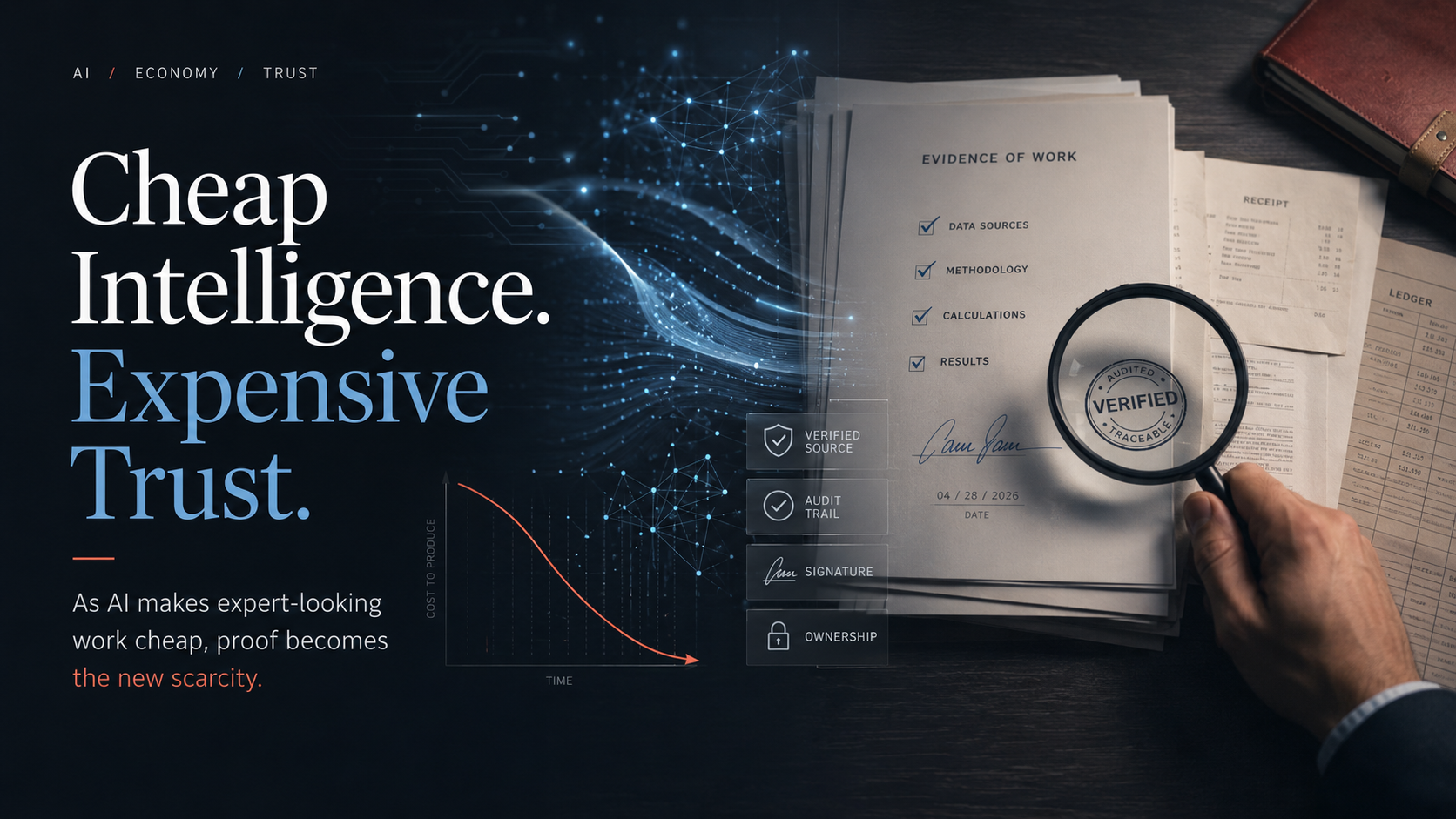
AI Is Making Expert-Looking Work Cheap. Trust Is the New Scarcity.
A practical guide to turning cheaper intelligence into measurable leverage, credible proof, and things you actually own
Published: August 21, 2026
A viral graphic has been circulating with a seductive claim: open AI models can deliver nearly 90 percent of the capability of closed models at roughly 1 percent of the cost.
The first half has real research behind it. The second half, as a universal claim, does not.
MIT Sloan's January 2026 summary of research by Frank Nagle and Daniel Yue reported that open models in their dataset averaged 89.6 percent of closed-model performance. The same research found that open-model inference was about 87 percent less expensive, not 99 percent less expensive, and that closed models cost roughly six times as much on average in the studied market.[^1][^2] The OpenRouter dataset used in the research represented an estimated roughly 1 percent of global inference spending; that 1 percent figure is about the sample's market coverage, not a universal open-model price ratio.[^1]
That correction matters. If we are going to make decisions about our work, our families, our businesses, and our future, we cannot build them on a meme.
But the corrected story is more important than the meme.
The price of useful machine intelligence is falling. The performance gap between leading open-weight and proprietary systems has repeatedly narrowed. In some specific workloads, researchers and companies really have reported cost differences near or below 1 percent. And increasingly capable systems are becoming available to people who do not own data centers, do not have research laboratories, and do not have the budget to hire a room full of specialists.
That changes what one person can attempt.
It does not make everybody wealthy. It does not erase the advantages of capital, distribution, proprietary data, credentials, relationships, or experience. It does not make every AI answer correct. It does not even guarantee higher wages: a large Danish labor-market study found substantial task reorganization around generative AI but no detectable effects on earnings or recorded hours larger than 2 percent over the first two years.[^18]
The useful conclusion is narrower:
One of the historically expensive inputs to economic activity—access to competent cognitive work—is becoming much cheaper.
And that creates a second-order effect that may matter even more.
When almost anyone can produce polished analysis, a professional-looking proposal, competent code, a plausible marketing plan, a clean résumé, a sophisticated article, or a confident explanation, looking like an expert becomes cheaper too.
That means the scarce thing begins to move.
The new scarcity is not merely information.
It is trust.
This article is a how-to manual for operating in that environment.
Start With the Fact That the Meme Is Wrong—and the Trend Is Real
Before turning research into a strategy, separate four claims that are routinely blended together.
Claim 1: Open-weight models have become much more competitive with closed models.
This is well supported.
Nagle and Yue's working paper found that frontier open models were closing the performance gap with frontier closed systems in a matter of months. MIT Sloan summarized the average open-model performance in the studied data at 89.6 percent of closed-model performance, with the typical frontier catch-up interval shrinking from 27 weeks to 13 weeks.[^1][^2]
Stanford's 2025 AI Index independently documented the same direction. On Chatbot Arena, the gap between the leading closed-weight and open-weight models narrowed from 8.04 percent in January 2024 to 1.70 percent by February 2025.[^4]
Stanford's 2026 AI Index shows why this should not be turned into a simplistic "open has caught up forever" headline. The gap moves. Proprietary systems advance, open systems close in, a new proprietary release moves the frontier, and the cycle repeats. In March 2026, Stanford reported a roughly 3.4 percent gap between the leading closed and open-weight systems on the relevant Arena measure.[^5]
That pattern is the story:
closed frontier advances → gap opens → open frontier catches up → new frontier advances → repeat.
Claim 2: Open models can be dramatically cheaper.
Also true, but the number depends on the model, provider, workload, token mix, deployment method, and date.
MIT Sloan reported an example average of $0.23 per million tokens for open models versus $1.86 for closed models in the underlying market analysis.[^1] That makes the open price about 12.4 percent of the closed price in that example—not 1 percent.
Yet extreme price gaps are real in particular comparisons. OpenRouter reported DeepSeek V4 Flash at $0.09 per million input tokens and $0.18 per million output tokens, compared with $5 input and $30 output for GPT-5.5 at the time of that comparison.[^8] On those list prices, the DeepSeek input price was 1.8 percent of the GPT-5.5 price and the output price was 0.6 percent.
That is a genuine sub-1-percent output-token price comparison.
It is not proof of "99 percent cheaper at equal universal intelligence."
Claim 3: Specific jobs have achieved roughly 1-percent cost results.
Yes.
A 2023 report in The Information described Atlassian replacing a customized GPT-3.5 implementation with Llama 2 for a text-to-JQL task and reportedly obtaining similar results "at 1% of the cost."[^13]
Researchers behind SIEVE, a system for filtering pretraining data, reported that their approach "matches GPT-4o accuracy at less than 1% of the cost."[^12]
A 2024 industry white paper modeling a document-analysis workflow reported that "90% performance can come at 0.4% of the cost," while explicitly acknowledging exclusions and limitations in the calculation.[^15]
These examples matter because they demonstrate that large cost collapses are technically possible in particular applications.
They do not establish a law of nature called "90 percent for 1 percent."
Claim 4: Cheaper models automatically mean cheaper businesses.
No.
"Cost" can mean at least five different things:
API price: what the provider charges per token. Realized inference cost: the actual input, output, reasoning, caching, retries, and tool calls your workflow consumes. Self-hosting cost: hardware, memory, utilization, networking, storage, inference software, and engineering. Total cost of ownership: deployment, monitoring, security, compliance, reliability, upgrades, and people. Training cost: the cost of creating the model in the first place.
Those are not interchangeable.
DeepSeek's V3 technical report, for example, reported 2.788 million H800 GPU-hours for full training.[^11] That is a training-compute fact. It is not an API price, and it is not the company's full research-and-development budget.
If you remember only one rule from this section, use this one:
Never compare two AI cost numbers until you know exactly what each number measures.
What Is Actually Becoming Cheap
For most people, the important thing is not whether a particular model is open weight, proprietary, Chinese, American, local, hosted, or routed through an aggregator.
The important thing is what the falling cost curve lets you do.
For decades, many forms of competent cognitive labor required one of three things:
you already possessed the skill; you could hire somebody who possessed it; or you could wait long enough to learn it.
AI does not eliminate those constraints. It changes their severity.
A person can now ask a capable system to help:
explain a contract in plain language before sending it to a professional for review; turn meeting notes into a structured operating procedure; write and debug ordinary code; compare several possible business processes; draft a customer follow-up sequence; analyze a spreadsheet; summarize a body of research; create a study plan; role-play a difficult sales conversation; generate twenty variations of a message; translate material; produce a first-draft budget narrative; turn a rough idea into a project specification; prepare questions for an accountant, lawyer, doctor, lender, vendor, or employer; classify incoming requests; draft responses; search a knowledge base; help a new worker perform a process that previously required months of accumulated tacit knowledge.
That last point has empirical support.
In a study of 5,179 customer-support agents, Erik Brynjolfsson, Danielle Li, and Lindsey Raymond found that access to a generative-AI assistant increased productivity by 14 percent on average, with a 34 percent improvement for novice and lower-skilled workers and much smaller effects for experienced, highly skilled workers.[^16]
A separate 2026 randomized experiment with 1,174 adults ages 25–45 found that AI improved performance on a workplace-style business problem-solving task for all education groups, but the gains were larger for participants with less formal education. The performance gap in the experiment fell from 0.548 standard deviations without AI to 0.139 with AI, closing about three-quarters of the initial gap during AI-assisted task execution.[^17]
Do not turn either study into "AI makes everyone equal."
The second study explicitly found that underlying human-capital differences remained. When AI was removed, a sizable gap re-emerged.[^17]
The more useful interpretation is:
AI can reduce the price of reaching competent execution on some tasks. It does not eliminate the value of knowing what good execution is.
That distinction is the doorway to everything that follows.
Stop "Learning AI." Start Buying Outcomes With It.
A lot of people are being taught the wrong goal.
They are told to "learn AI."
That is too vague to be economically useful.
Learning 200 prompts is not an outcome.
Knowing the names of thirty models is not an outcome.
Being able to argue about context windows is not an outcome.
The better question is:
What can I now accomplish—faster, cheaper, or at higher quality—that someone values?
Start there.
The Outcome Inventory
Take one sheet of paper and create four columns:
Area Friction today Valuable outcome How you would verify it Work Weekly reports take 3 hours Report ready in 45 minutes Time log + manager acceptance Local business Leads wait until evening Every lead answered within 5 minutes CRM timestamps Freelance work Proposals take 90 minutes Qualified proposal in 20 minutes Time + close rate Household learning Child gets stuck on algebra Guided practice every night Quiz scores + explanation aloud Community organization Volunteer scheduling is manual Schedule produced in 15 minutes Fewer conflicts / coordinator approval Job search Applications are generic Tailored application package Interviews per 10 qualified applications
Notice what is not in the table:
"Use AI more."
The machine is not the objective.
The result is the objective.
Your first rule
Use AI first where delay, repetition, information handling, or drafting is expensive—but where a human can still cheaply verify the result.
That is the sweet spot.
Good early targets often include:
summarization; classification; first drafts; follow-up; scheduling assistance; research organization; FAQ generation from approved sources; spreadsheet explanation; standard customer communications; document formatting; repetitive code; testing; documentation; training materials; meeting preparation; idea generation; comparison matrices.
Bad early targets are high-consequence decisions where errors are difficult to detect before harm occurs.
The point is not maximum automation.
It is maximum verified leverage.
The Biggest Change May Be That Expertise Is Now Easy to Imitate
Here is the uncomfortable part.
AI makes useful work cheaper.
It also makes the appearance of useful work cheaper.
A person who has never run a business can generate a polished business plan.
Someone who has never practiced medicine can generate prose that sounds clinical.
Someone who has never built software can generate a technical architecture.
Someone who has never closed a sale can publish a twenty-part sales framework.
Someone who has never performed an audit can produce an audit-shaped document.
Someone who has never studied an academic field can produce academic-looking prose.
That does not mean the output is wrong.
It means surface sophistication is losing value as a signal of underlying competence.
Research on AI-text detection illustrates the problem. In a 2025 experiment involving 63 university lecturers, human evaluators identified AI-generated text correctly only 57 percent of the time; professional-level AI text was especially difficult to identify.[^19] In a 2026 study of 89 peer reviewers, reviewers misclassified LLM-generated abstracts as human-authored in roughly 62 percent of cases while remaining highly confident in their judgments.[^20]
Those studies are narrow. They concern academic text, not every form of expertise.
But they demonstrate a larger information problem:
Polish is becoming less trustworthy as evidence of authorship, experience, or competence.
For years, people used signals such as:
polished language; professional formatting; technical vocabulary; a sophisticated website; a long article; confident explanations; rapid content production;
as rough proxies for expertise.
AI weakens those proxies.
That means a new operating rule is required:
Do not ask people to trust how professional you look. Make it easy for them to verify why you deserve trust.
That is the Trust Economy.
What I Mean by the "Trust Economy"
I am using Trust Economy here as a strategic description, not as a formally measured sector in national economic statistics.
It describes a market condition in which:
credible-looking output becomes abundant; the cost of producing that output falls; it becomes harder to infer competence from presentation alone; buyers, employers, readers, partners, and communities therefore place greater value on proof; people who can create verifiable trust gain an advantage over people who merely create more content.
The internet lowered the cost of publishing.
Social media lowered the cost of distribution.
Generative AI lowers the cost of producing plausible expertise.
Each time supply explodes, scarcity moves.
In an AI-saturated environment, the scarce assets increasingly include:
verified identity; reputation; accountable human relationships; first-party data; real customer history; real work history; verifiable results; trusted distribution; proprietary workflows; guarantees; corrections; references; durable communities; domain judgment; the ability to determine whether an AI output is actually right.
MIT researchers studying competition in generative AI make a related point about firms: open models alone do not erase incumbent power because commercial advantage can remain in complementary assets such as compute, infrastructure, nonpublic data, evaluation capability, safety systems, and network effects.[^14]
The same logic applies at human scale.
If intelligence becomes cheaper, do not spend all your energy trying to own the intelligence. Own the complementary assets around it.
Build a Proof Stack, Not an Expert Costume
Suppose two businesses use the same AI model.
Both can generate a beautiful website.
Both can generate 100 social posts.
Both can write a convincing proposal.
Both can create an FAQ.
Both can make a polished PDF.
What separates them?
The one that can prove what it says.
I recommend a seven-layer Proof Stack.
Layer 1: Identity
A real person or accountable organization should stand behind the work.
For a local operator, this may include:
real name; real photo; business address or service area where appropriate; direct contact channel; license or certification when relevant; ownership or team information.
AI can generate a persona.
It cannot retroactively create ten years of accountable service in a community.
Layer 2: Specificity
Replace adjectives with facts.
Weak:
We provide exceptional, industry-leading service.
Stronger:
We completed 412 service calls last year. Our median emergency response time was 47 minutes.
Weak:
Trusted by businesses everywhere.
Stronger:
68 customers renewed in the last twelve months; 51 have given permission to be named.
Specificity is expensive to fake consistently because specifics create things that can be checked.
Layer 3: Receipts
Every important claim should have evidence proportional to its importance.
Receipts can include:
invoices; timestamps; screenshots; source documents; before-and-after measurements; test results; customer references; public records; case studies; code tests; signed approvals; published methodology; original data; photographs; version history.
AI can write the sentence "we reduced response time by 43 percent."
Trust comes from showing the measurement.
Layer 4: Provenance
Show where important information came from.
For an article, link the study.
For financial analysis, identify the data source and date.
For a proposal, identify assumptions.
For a code change, preserve tests and commit history.
For AI-assisted work, disclose AI involvement when the context, policy, client agreement, or risk makes that material.
Stanford's 2026 AI Index reports strong public demand for AI transparency and fragmented trust in institutions managing AI.[^6] That is a signal: as synthetic output grows, provenance becomes more valuable.
Layer 5: Verification
Do not merely publish a claim. Tell the other person how to check it.
Examples:
"Here is the public license database." "Here are the raw before-and-after times." "Here is the source spreadsheet." "Here is the test suite." "Here are the three cited papers." "Here is the customer you may call." "Here is the method we used."
The strongest form of authority is not "believe me."
It is:
You do not have to believe me. Here is how to verify me.
Layer 6: Accountability
Tell people what happens when you are wrong.
This is one of the most underused trust signals in business.
Create:
a correction policy; a rework policy; a refund condition; an escalation contact; a revision history; a service guarantee that you can actually honor.
Nobody is error-free.
A person who has an observable error-correction process can be more trustworthy than a person who pretends never to make errors.
Layer 7: Consistency
Trust compounds.
One accurate article does not create a trusted publication.
One completed project does not create an operating reputation.
One good customer experience does not create a durable brand.
The advantage compounds when the same identity repeatedly makes a promise, produces evidence, delivers, corrects mistakes, and does it again.
That creates a trust loop:
Promise → Deliver → Measure → Prove → Correct → Repeat
AI can accelerate every stage.
It cannot skip one.
The Practical Rule: Proof Before Polish
AI reverses an old temptation.
Because polished material is now extremely cheap, people are producing the polish first.
Do the opposite.
Use this sequence:
Step 1: Write the claim before the copy
What exactly are you saying?
Not:
Our system dramatically improves follow-up.
Write:
For the pilot group, median lead-response time fell from 4 hours 18 minutes to 6 minutes over 30 days.
Now you know what needs proof.
Step 2: Identify the evidence
Where does each number come from?
Who owns the data?
What period does it cover?
What exclusions exist?
What would falsify the claim?
Step 3: Mark fact, inference, and recommendation separately
These are not the same.
Fact: Response time fell from X to Y.
Inference: Faster response probably contributed to the booking increase.
Recommendation: We should extend the system to the rest of the team.
Do not let AI turn the first sentence into certainty about the second.
Step 4: Let AI draft around the evidence
Now use the machine.
Give it the facts.
Give it the sources.
Give it the audience.
Give it the objective.
Tell it what it may not claim.
The writing will usually improve because the source material is concrete.
Step 5: Human-check the consequential claims
Check:
names; numbers; dates; quotes; legal assertions; medical assertions; financial assertions; promises; prices; guarantees; technical requirements; customer claims.
The more costly an error would be, the more expensive verification should be.
Step 6: Publish the receipts when appropriate
A footnote beats "research shows."
A case study beats "proven."
A number beats "dramatic."
A customer reference beats "trusted."
A correction log beats pretending the first version was perfect.
That is how you become more believable precisely when everybody else becomes more polished.
Do Not Sell "AI." Sell the Result.
This applies whether you have a job, a side business, a local company, a professional practice, or a new idea.
Customers generally do not wake up wanting:
artificial intelligence; agents; automation; prompts; an LLM; a vector database.
They wake up wanting:
the phone answered; the appointment booked; the invoice paid; the proposal finished; the roof repaired; the tax documents organized; the customer retained; the shipment located; the report ready; the child to understand the lesson; the grant submitted; the problem solved.
AI is infrastructure.
The economic question is what the infrastructure enables.
A plumber
Do not sell "AI plumbing."
Use AI to:
classify incoming messages; draft an immediate response; ask the customer for the right photos; create a job summary; prepare a draft estimate from approved price data; remind the customer of the appointment; follow up after the job; request a review; reactivate customers whose maintenance is due.
Then build trust with:
license number; actual service area; named technicians; exact pricing policy; photographs; invoices; arrival-time tracking; a real guarantee.
The AI is invisible.
The customer experiences responsiveness and certainty.
A barber, stylist, or salon owner
Use AI to:
convert consultation notes into service recommendations; draft after-care instructions from an approved knowledge base; remind customers when it is time to rebook; segment customers by service history; draft win-back messages; answer routine questions; turn before-and-after records into case studies with permission.
Your moat is not the generated caption.
It is the relationship, the skill, the customer history, the permission to contact them, and the proof of results.
A real-estate professional
Use AI to:
summarize listing documents; build neighborhood research packs; prepare buyer-question checklists; draft follow-ups; compare property features; create viewing notes; turn client requirements into search criteria.
Do not let it fabricate school, crime, tax, zoning, property-condition, or legal facts.
Trust comes from sourced information, accurate disclosures, responsiveness, and a transaction history—not from having prettier listing copy.
A church or community organization
Use AI to:
organize volunteer schedules; create first drafts of announcements; summarize meeting notes; prepare study guides from approved source texts; produce donor or member communications; create grant-draft scaffolds; organize community-resource information.
Do not outsource pastoral judgment, confidential counseling, safeguarding decisions, or factual claims about people to a model.
Use AI to reduce administrative friction so human attention can move toward the parts that require human presence.
A freelancer or consultant
Do not sell prompts.
Sell:
a researched decision memo; a tested workflow; a finished campaign; a cleaned dataset; a verified analysis; a production-ready implementation; a documented operating procedure.
Then attach your proof:
methodology; sources; test cases; before-and-after results; client references; limitations.
The commodity is the draft.
The premium is the accountable outcome.
If You Have a Job, Become the Person Who Can Redesign the Work
There is a defensive and an offensive way to respond to AI at work.
The defensive response is:
How do I make sure AI cannot do my task?
That may be impossible for some tasks.
The stronger question is:
How do I become the person who knows how this work should be done when AI is part of the system?
That means moving upward from task ownership to workflow ownership.
A five-step workplace play
Choose one repetitive workflow
Examples:
weekly report; customer ticket; meeting follow-up; scheduling; document review; project status update; quality checklist.
Measure the baseline
Before using AI, record:
minutes per task; error rate; rework; response time; backlog; customer satisfaction if available.
Without a baseline, "AI made me faster" is a story, not evidence.
Build a controlled version
Give the system approved inputs.
Define what it may draft.
Define what still requires human approval.
Keep confidential data inside tools your employer authorizes.
Test on historical cases
Do not begin with your most important live customer.
Run the workflow against old work where you already know what good looks like.
Track failures.
Present the result as an operating improvement
Do not tell your manager:
I know AI.
Tell them:
I reduced the average preparation time for this report from 126 minutes to 38, with the same required fields and no increase in correction rate across 20 test cases. Here is the workflow and the audit sheet.
That is not "AI expertise."
That is organizational value.
A 2025 field experiment across 66 firms and 7,137 knowledge workers found that workers who used an integrated generative-AI tool spent less time on email, though the study did not detect broad changes in the overall quantity or composition of tasks from individual-level access alone.[^21]
That is another reminder:
Having AI does not redesign an organization. Someone still has to redesign the work.
Become that person.
If You Run a Business, Build an AI Ladder Instead of Buying Every Model
One of the easiest ways to waste money is to assume the most expensive model should handle everything.
Do not do that.
Build a model ladder.
Tier 1: Cheap and fast
Use for low-risk, easy-to-check work:
classification; formatting; tagging; summarization; FAQ drafting; extraction; simple rewrites; routine customer-response drafts.
Tier 2: Strong general model
Use when the task needs:
multi-step reasoning; longer context; code; more difficult analysis; synthesis across many documents; nuanced drafting.
Tier 3: Frontier model or specialist
Reserve for work where the incremental capability matters:
difficult debugging; complex planning; high-value analysis; challenging research; agentic work; tasks where a weaker model repeatedly fails your acceptance tests.
Tier 4: Human authority
Some decisions should end here no matter what model helped upstream.
Examples include:
binding legal commitments; medical decisions; material financial decisions; firing or disciplinary actions; safety-critical approvals; public accusations; irreversible high-cost actions.
The operating rule is:
Use the cheapest system that reliably clears the acceptance test for the task. Escalate based on evidence, not prestige.
That is how declining model costs become actual business economics instead of another subscription bill.
Turn Saved Time Into an Asset—or AI Just Makes You Busier Faster
Suppose AI saves you five hours this week.
What happens to the five hours?
This is where the economic outcome splits.
You can spend the five hours producing five more disposable outputs.
Or you can convert the five hours into something that survives the week.
Use an Ownership Ladder.
Level 1: Save the time
You complete the task faster.
Useful, but temporary.
Level 2: Document the process
You create a checklist or SOP so the improvement can be repeated.
Now you own a process.
Level 3: Create reusable components
Templates, source packs, scripts, prompts, test cases, checklists.
Now each future task starts further ahead.
Level 4: Automate the workflow
Connect the pieces so routine work moves with less manual intervention.
Now you own an operating system for the task.
Level 5: Capture first-party relationships and data
With permission and lawful handling, build:
customer history; preference data; service records; opt-in audience; transaction history; outcome data.
Now your system learns from things a generic model does not automatically possess.
Level 6: Build recurring value
Turn the workflow into:
a recurring service; membership; maintenance program; subscription; managed process; retained relationship.
Level 7: Build durable ownership
Depending on the work, this may include:
a business; software; proprietary datasets; contracts; trademarks; copyrightable human-authored materials; methods and know-how; a customer network; a trusted publication; a brand with real reputation.
Do not assume every AI-generated artifact creates protectable intellectual property. Legal treatment varies by jurisdiction and by the amount and nature of human authorship. The point is broader:
Use cheap intelligence to build assets around the output, not merely more output.
Your Customer List Just Became More Valuable Than Your Content Calendar
When AI can generate endless content, content itself becomes easier to flood.
Direct relationships become more important.
Own the ability to reach people who have chosen to hear from you.
That may mean:
email list; SMS opt-ins; membership; customer accounts; referral network; local community; subscriber base; professional relationships; private group; repeat-customer database.
Do not spam.
Do not scrape people into a list they did not consent to join.
The point is not "collect data."
The point is:
Build a lawful, permissioned relationship that a platform algorithm cannot erase overnight.
Then use AI to serve that relationship better:
answer faster; personalize from approved customer information; notice patterns; send useful reminders; identify unresolved issues; produce better educational material; follow up consistently.
Distribution plus trust is a much stronger asset than unlimited content generation.
Your Reputation Needs Receipts Now
There was a time when publishing a thoughtful 2,000-word article was itself a signal.
It took time.
Research took time.
Writing took time.
Editing took time.
Today, a person can generate 2,000 polished words before breakfast.
That does not make long-form writing worthless.
It changes what makes it valuable.
A strong article now needs:
primary sources; named studies; precise dates; transparent limitations; original reporting; real experience; original data; testable claims; correction history; a recognizable human point of view.
The same is true for professional reputation.
Do not say:
I am an expert in customer acquisition.
Say:
Here are the last twelve experiments I ran, the assumptions, the spend, the results, the failures, and what changed because of them.
Do not say:
I am an AI consultant.
Say:
Here are three workflows I changed, the baseline, the new cycle time, the error rate, the cost, and the customer willing to verify the work.
Do not say:
I am a thought leader.
Publish thoughts that survive checking.
In the Trust Economy, authority becomes a byproduct of accumulated evidence.
Build a Public Proof Ledger
A simple proof ledger can become a powerful competitive advantage.
For every meaningful public claim, record:
Field Example Claim Median response time fell to 6 minutes Source CRM event export Period July 1–31, 2026 Population 487 qualified inbound leads Exclusions Test accounts, duplicates Method First human/approved automated response minus lead creation Verified by Operations manager Last checked Aug. 3, 2026 Caveat Does not prove response time caused conversion increase Public evidence Redacted methodology + aggregate table
You do not need to publish confidential data.
You do need to know what supports what.
This is especially important because AI systems are fluent enough to silently strengthen claims.
"Associated with" becomes "caused."
"Some" becomes "most."
"A pilot" becomes "our customers."
"Up to 40 percent" becomes "40 percent."
A proof ledger prevents language from outrunning evidence.
It also makes AI more useful because the model has clean, structured facts to work from.
Create a Correction Advantage
Most brands treat corrections as humiliation.
That is increasingly backwards.
In a world of synthetic content, hidden automation, and untraceable claims, a visible correction mechanism is a trust signal.
Create a page or section that says:
what changed; when it changed; why; what the previous version said; which downstream conclusions were affected.
For a service business, the equivalent may be:
complaint logged; responsible person assigned; remedy promised; remedy completed; customer confirmed closure.
For software:
issue; reproduction; fix; tests; release; rollback path.
For research:
claim; source; correction; revised conclusion.
The goal is not to advertise mistakes.
It is to make accountability observable.
AI can generate confident falsehoods.
A person or company that can say "we were wrong here, this is the evidence, and this is what we changed" has something a polished hallucination does not have:
a history of responsibility.
Do Not Automate the Moment Where Trust Is Actually Being Created
This is a subtle mistake.
People find a process that can be automated and automate all of it.
But some parts of a process are not merely labor.
They are the place where the relationship is formed.
A customer may appreciate an automatic appointment reminder.
They may not appreciate an automated response to a death in the family.
A prospect may appreciate an immediate acknowledgment.
They may want a human when negotiating a $100,000 agreement.
A patient may appreciate help organizing questions.
Diagnosis and treatment require qualified medical judgment.
A church member may appreciate a summarized schedule.
Pastoral care is not a scheduling problem.
An employee may appreciate automated documentation.
A disciplinary conversation should not be outsourced to a chatbot.
Ask this question before automating:
Is this step expensive because it is repetitive, or valuable because another human is present?
Automate the first aggressively.
Protect the second.
A 30-Day AI Leverage Plan
You do not need to transform your life in a weekend.
You need one verified win.
Week 1: Find the constraint
Day 1: Track your work
For one day, write down everything you do in 15- or 30-minute blocks.
Mark:
repetitive; writing; searching; organizing; deciding; communicating; waiting; correcting.
Day 2: Find expensive repetition
Circle the tasks that happen repeatedly and consume meaningful time or delay money, customers, or decisions.
Day 3: Pick one outcome
Examples:
answer qualified inquiries faster; create proposals faster; reduce report preparation time; reduce missed follow-up; help a student practice more consistently; reduce volunteer scheduling conflicts.
Day 4: Measure the baseline
Collect at least a small sample of how long or how well the current process performs.
Day 5: Write the acceptance test
Example:
A generated proposal is acceptable only if every customer name, requested service, price, delivery date, and contractual term matches the approved source data.
Now you have a standard.
Week 2: Build the smallest working system
Give the AI:
approved source material; clear task; output format; prohibited claims; examples of good work; acceptance criteria.
Test it on old cases.
Record every failure.
Do not fix failures by merely saying "be more accurate."
Change the system:
improve source data; narrow the task; add a validation rule; change the model; add a human approval; add a deterministic check.
Week 3: Add the Trust Layer
For every output that reaches another person, ask:
Who is accountable? What facts does this rely on? Can the recipient verify them? What has been automated? What requires human approval? What happens if it is wrong? What data was used? Is the use of that data authorized?
Add proof, not adjectives.
Week 4: Measure economic reality
Compare the new system with the baseline.
Track:
time per task; cost per task; error rate; rework rate; response time; conversion where relevant; revenue collected where relevant; customer complaints; employee/customer satisfaction where measurable.
Then choose one of three decisions:
KEEP: measurable improvement, acceptable risk.
REPAIR: promising, but failures remain.
KILL: no meaningful improvement.
That last option matters.
Not every AI workflow deserves to exist.
The $100 Rule: Prove Value Before Buying Infrastructure
For many individuals and small operators, the first AI investment should not be a GPU.
It should not be an expensive course.
It should not be five overlapping subscriptions.
It should be a small experiment.
A useful rule:
Do not buy expensive AI infrastructure to solve a problem you have not yet proved is valuable.
Start with inexpensive access.
Measure.
If the cheap system fails because of a real constraint—privacy, latency, cost at scale, reliability, customization, data control, or capability—then upgrade.
This sequence protects cash:
Need → Test → Measure → Bottleneck → Upgrade
Not:
Hype → Purchase → Search for a use case
The falling price of inference makes this discipline more rational, not less.
Open Weight Does Not Mean "Free," and It Does Not Always Mean "Open Source"
Language matters here.
A model whose weights can be downloaded is not automatically open source in the full software-freedom sense.
The Open Source Initiative's Open Source AI Definition requires freedoms to use, study, modify, and share the system, along with sufficient information and materials to exercise those freedoms.[^10]
Many widely discussed "open-source models" are better described as open-weight models because licenses, training-data disclosure, code availability, or other conditions do not satisfy every open-source criterion.
This matters practically.
Before building a business around a model, check:
commercial-use rights; redistribution rights; attribution requirements; acceptable-use restrictions; hosting terms; data terms; model-specific license; whether the provider can change price or access; whether you can move the workflow elsewhere.
The model is cheap only if you can legally and operationally use it for what you intend.
Benchmark Scores Are Not Your Business
A leaderboard is useful.
It is not your acceptance test.
Artificial Analysis' August 2026 index placed Claude Opus 5 at 63 and Kimi K3 max at 60, illustrating how close leading open-weight systems can appear on a composite benchmark.[^6][^7]
But you cannot divide 60 by 63 and announce that Kimi has "95.2 percent of Claude's intelligence."
The index combines multiple evaluations. Intelligence is not being measured on a simple ratio scale.[^7]
More importantly, your customer does not buy benchmark points.
Your customer buys a result.
Build your own test set.
If your business sends estimates, create 50 representative historical estimates and score:
correct customer; correct service; correct price; correct exclusions; correct tone; no invented promise.
If you write research, create a test set for:
correct quote; correct source; correct date; no invented citation; proper qualification; counterargument represented fairly.
If you use AI for support:
correct policy; correct account context; correct escalation; no unsupported refund; no privacy leak.
Then test models on your work.
The cheapest model that passes your test is more valuable to you than the model that wins an unrelated leaderboard.
Use AI to Create Apprenticeship at Scale
One of the most promising uses of AI is not replacing experts.
It is helping more people learn expert patterns faster.
That interpretation is consistent with the customer-support study, where the largest measured gains accrued to newer and lower-performing workers and the researchers found suggestive evidence that AI helped disseminate the practices of more capable workers.[^16]
You can apply that deliberately.
At work
Give a new employee:
approved procedures; examples of excellent work; common failure cases; an AI tutor constrained to those sources; a checklist requiring the employee to verify the answer.
In a family
Instead of using AI to give a child the answer, ask it to:
generate practice problems; give one hint at a time; ask the child to explain each step; challenge an answer; produce a second problem testing the same concept.
In a business
Turn the knowledge of the best operator into:
SOPs; annotated examples; decision trees; training simulations; retrieval systems; coaching prompts.
But preserve the final step:
the learner must be able to perform and explain the work without pretending the machine's output is their knowledge.
AI can compress the path to competent practice.
It cannot eliminate the need to know when the machine is wrong.
Teach Children to Defend Their Work, Not Merely Submit It
The education problem is changing.
When a polished essay can be generated in seconds, "turn in five paragraphs" measures something different than it used to.
A more durable skill set is:
State the objective. Find the evidence. Separate fact from inference. Explain the reasoning. Identify what could be wrong. Use tools to improve the work. Verify the output. Defend the result aloud.
A child should be able to answer:
Where did this fact come from? What part did the AI do? What did you change? What evidence would change your conclusion? What mistake did the AI make? Can you solve a related problem without it?
That is education for a world where access to answers is cheap.
The advantage moves toward judgment.
The Trust Economy Changes Marketing
Traditional marketing often tries to increase confidence through claims.
AI can generate claims without limit.
So marketing needs to move from claim generation to proof compression.
Instead of creating fifty generic posts, create one powerful artifact:
a case study with actual numbers; a teardown showing your process; a customer interview; a source-backed guide; a public benchmark; a calculator using transparent assumptions; a before-and-after workflow; a public failure analysis; an audited guarantee.
Then use AI to distribute that proof in fifty forms.
This reverses the machine:
Old pattern: Generate content → hope it creates trust.
Better pattern: Generate proof → use AI to distribute the proof.
That distinction may be one of the highest-value marketing ideas in the AI era.
The Trust Flywheel
A durable AI-enabled business can be built around six repeated moves.
Make a narrow promise
Not:
We grow businesses.
Better:
We answer every qualified inbound inquiry within five minutes during operating hours.
Instrument the promise
Collect the timestamps.
Deliver
Use AI, automation, people, software—whatever works.
Verify
Did the promised event occur?
Publish appropriate proof
Aggregate results, case study, customer reference, dashboard, report.
Improve the system
Find the bottleneck and run the loop again.
That creates:
Promise → Instrument → Deliver → Verify → Prove → Improve
Most people will stop at "generate."
That is why proof can remain scarce even while intelligence gets cheap.
Nine Things Not to Do
Do not fabricate expertise.
Never invent clients, credentials, case studies, citations, licenses, or experience.
AI makes fabrication easy.
That makes discovery more damaging, not less.
Do not let AI strengthen a claim beyond the evidence.
"May help" is not "causes."
"One pilot" is not "our customers."
"Up to" is not "average."
Do not leak confidential information.
Do not paste employer, customer, patient, legal, financial, or proprietary data into an unauthorized system.
Cheap intelligence is not worth an expensive breach.
Do not automate irreversible decisions casually.
Escalate high-risk decisions to qualified humans.
Do not worship the model.
Models change.
Prices change.
Benchmarks change.
Build workflows that can swap models.
Do not confuse activity with economics.
One million generated words may produce zero dollars and zero saved hours.
Measure outcomes.
Do not borrow heavily to chase the trend.
Prove the use case first.
Do not call everything open source.
Check the license and the actual openness of the system.
Do not hide behind "AI said."
The person deploying the output remains responsible for deciding whether it should be used.
The Reality Check: AI Can Raise Productivity Without Raising Your Income
This article would be irresponsible if it implied a straight line:
AI → productivity → wealth.
The evidence does not justify that.
In the Danish study by Anders Humlum and Emilie Vestergaard, AI adoption and AI-related tasks spread rapidly, yet the researchers found no detectable earnings or recorded-hours effects greater than 2 percent in the first two years.[^18]
Technology can:
increase output; reorganize tasks; lower costs; shift bargaining power; create new firms; destroy old roles; create new roles; reward owners differently than workers; distribute gains unevenly.
So a person needs two strategies at once.
Strategy A: Become more productive
Use the tool.
Learn the workflows.
Improve judgment.
Reduce wasted time.
Strategy B: Capture part of the value you create
Where possible, build:
measurable accomplishments; negotiated compensation; ownership; customer relationships; recurring revenue; portable skills; reputation; reusable processes; lawful first-party data; equity or business assets when appropriate.
Productivity is capacity.
Value capture is economics.
Do not confuse them.
The New Career Moat Is a Stack
Do not bet your future on one skill remaining scarce forever.
Build a stack.
A strong human stack in the AI era may look like:
Domain knowledge AI fluency verification skill communication relationships reputation ownership of workflows/data/distribution accountability
AI can make you faster at several layers.
It cannot cheaply hand you the full stack.
That is good news.
It means the future does not belong only to the person with the largest model.
It belongs partly to the people who know where to apply models, how to verify them, and how to create trust around the result.
What the Research Does—and Does Not—Allow Us to Say
Here is the fact base worth carrying forward.
We can say:
Open models in Nagle and Yue's studied data averaged 89.6 percent of closed-model performance.[^1][^2] Their analysis found a frontier catch-up interval of roughly 13 weeks, down from 27 weeks previously.[^1] Their market analysis found large price differences; MIT described open inference as about 87 percent less expensive in the examined data.[^1] Stanford documented a sharply narrowing open/closed benchmark gap in 2024–25, followed by continued leapfrogging rather than permanent parity.[^4][^5] Specific production and research workloads have achieved costs around or below 1 percent of certain proprietary alternatives.[^12][^13][^15] Generative AI has produced measurable productivity gains in some controlled and field settings, with particularly large gains for less experienced workers in some studies.[^16][^17] Human observers can struggle to distinguish high-quality AI-generated text from human text in studied academic settings.[^19][^20] Early labor-market evidence does not show that productivity or adoption automatically becomes higher earnings.[^18]
We should not say:
Every open model is 90 percent as capable as every closed model. Open models universally cost 1 percent as much. Benchmark performance equals production reliability. AI automatically equalizes skill. AI automatically creates wealth. Open models eliminate proprietary-company moats. A polished AI output proves expertise. A model's confidence proves correctness.
The strongest defensible conclusion is not the meme.
It is this:
The cost of accessing capable machine intelligence is falling while the value of evidence, judgment, relationships, distribution, and accountability is rising.
The Move
Do not try to become the person with the most AI-generated material.
Do not try to win a volume contest against a machine that can produce words all night.
Use the machine to remove friction.
Then move your human effort toward what becomes more valuable as generated output becomes abundant:
deciding what matters; obtaining the right source; knowing the customer; measuring the result; making the promise; keeping the promise; correcting the mistake; maintaining the relationship; owning the system; building the reputation.
The field is not suddenly level.
Large organizations still possess capital, infrastructure, private data, distribution, experienced teams, and existing customer relationships. MIT's research on AI competition is explicit that openness alone does not erase these complementary advantages.[^14]
But one of the expensive pieces of equipment required to compete is becoming cheaper.
That is meaningful.
A person can now rent analytical, linguistic, coding, and planning capacity that would have required far more money or time not long ago.
The correct response is neither panic nor worship.
It is construction.
Build a workflow.
Measure it.
Build proof.
Build a relationship.
Build an asset.
Repeat.
The One-Page Operating System
If you want the entire article compressed into one practical sequence, use this:
Pick one valuable outcome. Not "use AI." Pick something a person, employer, customer, or community actually values.
Measure the current state. Time, cost, errors, response rate, backlog, revenue, or another observable measure.
Choose the cheapest adequate AI. Test against your work, not somebody else's leaderboard.
Constrain it with real sources. Approved documents, examples, policies, price lists, records, data.
Create an acceptance test. Define what must be true before the output can be used.
Keep humans at consequential boundaries. Escalate high-risk decisions and hard-to-detect errors.
Add a Proof Stack. Identity, specificity, receipts, provenance, verification, accountability, consistency.
Measure the new result. If it did not improve reality, the workflow did not work.
Turn the gain into something durable. SOP, reusable template, automation, customer relationship, dataset, recurring service, reputation, or owned asset.
Repeat from the next constraint.
That is how cheap intelligence becomes leverage instead of noise.
Closing: When Almost Anyone Can Sound Like an Expert
Generative AI is already reducing the price of competent cognitive assistance for many digital tasks. How large that change becomes is not yet knowable.
We already have enough evidence to see the direction.
Model capability has improved quickly.
Open-weight systems have become serious competitors.
Inference prices can differ by orders of magnitude.
People can access powerful systems for very little money.
Workers in some studies perform measurably better with AI.
And sophisticated-looking output can now be produced by people who do not possess the experience that the output appears to imply.
That last fact changes the game.
When publishing becomes easy, attention becomes scarce.
When generation becomes easy, originality becomes harder to establish.
When almost anyone can sound like an expert, proof of expertise becomes more valuable than the sound of expertise.
So do not build your future around sounding intelligent.
Build it around being useful.
Do not merely make claims.
Leave receipts.
Do not merely save time.
Convert time into an asset.
Do not merely automate communication.
Deepen the relationship.
Do not merely borrow an AI model's intelligence.
Use it to build judgment, systems, reputation, and ownership that remain when the model changes.
Cheap intelligence is not wealth.
Cheap intelligence is leverage.
Trust determines who will let you apply that leverage to something that matters.
And ownership determines how much of the value you create remains yours.
Source Quotes: The Receipts
The quotations below are intentionally short. Each is tied to the source that supports it.
MIT Sloan (2026): "open models averaged 89.6% of closed-model performance."[^1]
Nagle and Yue: "Frontier open models typically reach performance parity with frontier closed models within months."[^2]
Linux Foundation / Frank Nagle: "Open models routinely achieve 90% or more of the performance of closed models."[^3]
Stanford AI Index 2025: "By February 2025, this gap had narrowed to 1.70%."[^4]
Stanford AI Index 2026: "open-weight systems closing in and then falling behind as new proprietary models are released."[^5]
Artificial Analysis: "Claude Opus 5 remains in the #1 position with an Index of 63."[^6]
Artificial Analysis comparison: "Kimi K3 (max) at 60."[^7]
OpenRouter: "DeepSeek V4 Flash... costs $0.09 input / $0.18 output per million tokens."[^8]
OpenRouter/a16z 100-trillion-token study: open-weight systems were "reaching approximately one-third of usage by late 2025."[^9]
Open Source Initiative: "Use... Study... Modify... Share."[^10]
DeepSeek-V3 Technical Report: "requires only 2.788M H800 GPU hours for its full training."[^11]
SIEVE: "matches GPT-4o accuracy at less than 1% of the cost."[^12]
The Information / Atlassian: "at 1% of the cost."[^13]
MIT Sloan on AI competition: "Openness, by itself, does not dissolve monopolies."[^14]
Alpha FMC / Lionpoint: "90% performance can come at 0.4% of the cost."[^15]
NBER, Generative AI at Work: access to the tool increased productivity "by 14% on average."[^16]
NBER, education-gap experiment: AI "increases performance for all participants" with larger gains for lower-education participants.[^17]
NBER, Danish labor market: researchers found "precise null effects on earnings and recorded hours" in the studied period.[^18]
Fiedler and Döpke: human evaluators identified AI text "only slightly better than chance."[^19]
Richter and Larsson: reviewers misclassified LLM-generated abstracts as human-authored "in about 62 percent of cases."[^20]
NBER, Shifting Work Patterns: frequent users "spent two fewer hours on email each week" in the latter half of the experiment.[^21]
Notes
[^1]: Brian Eastwood, "AI open models have benefits. So why aren't they more widely used?" MIT Sloan, January 20, 2026. https://mitsloan.mit.edu/ideas-made-to-matter/ai-open-models-have-benefits-so-why-arent-they-more-widely-used
[^2]: Frank Nagle and Daniel Yue, "The Latent Role of Open Models in the AI Economy," Georgia Tech Scheller working paper / SSRN, November 2025, revised 2026. https://papers.ssrn.com/sol3/papers.cfm?abstract_id=5767103
[^3]: Frank Nagle, "Revealing the Hidden Economics of Open Models in the AI Era," Linux Foundation, November 19, 2025. https://www.linuxfoundation.org/blog/revealing-the-hidden-economics-of-open-models-in-the-ai-era
[^4]: Stanford Institute for Human-Centered Artificial Intelligence, "Technical Performance," 2025 AI Index Report. https://hai.stanford.edu/ai-index/2025-ai-index-report/technical-performance
[^5]: Stanford Institute for Human-Centered Artificial Intelligence, 2026 AI Index Report, Technical Performance chapter. https://hai.stanford.edu/ai-index/2026-ai-index-report
[^6]: Artificial Analysis, "Launching v4.1.1 of the Artificial Analysis Intelligence Index," August 6, 2026. https://artificialanalysis.ai/articles/artificial-analysis-intelligence-index-v4-1-1
[^7]: Artificial Analysis, "Claude Opus 5 (Adaptive Reasoning, Xhigh Effort) vs Kimi K3 (max): Model Comparison," accessed August 21, 2026. https://artificialanalysis.ai/models/comparisons/claude-opus-5-xhigh-vs-kimi-k3
[^8]: OpenRouter, "DeepSeek V4 Is Earning Agentic Token Share," June 2026. https://openrouter.ai/blog/insights/deepseek-v4-adoption/
[^9]: OpenRouter/a16z research team, "State of AI: An Empirical 100 Trillion Token Study with OpenRouter," arXiv, 2026. https://arxiv.org/html/2601.10088v1
[^10]: Open Source Initiative, "The Open Source AI Definition – 1.0." https://opensource.org/ai/open-source-ai-definition
[^11]: DeepSeek-AI et al., "DeepSeek-V3 Technical Report," arXiv:2412.19437. https://arxiv.org/abs/2412.19437
[^12]: "GPT-4o as the Gold Standard: A Scalable and General Purpose Approach to Filter Language Model Pretraining Data," arXiv:2410.02755. https://arxiv.org/abs/2410.02755
[^13]: Stephanie Palazzolo, "Meta's Free AI Isn't Cheap to Use, Companies Say," The Information, 2023. https://www.theinformation.com/articles/metas-free-ai-isnt-cheap-to-use-companies-say
[^14]: MIT Sloan, "Openness, control, and competition in the generative AI marketplace," 2024. https://mitsloan.mit.edu/ideas-made-to-matter/openness-control-and-competition-generative-ai-marketplace
[^15]: Till Blesik, Bernard Hoefsmit, Christopher Edgar, and Miguel Castaneda, AI Strategy for Builders, Alpha FMC / Lionpoint, February 14, 2024. https://alternatives.alphafmc.com/wp-content/uploads/2024/02/AI-Strategy-for-Builders-Whitepaper.pdf
[^16]: Erik Brynjolfsson, Danielle Li, and Lindsey R. Raymond, "Generative AI at Work," NBER Working Paper 31161, April 2023, revised November 2023. https://www.nber.org/papers/w31161
[^17]: Guillermo Cruces, Diego Fernández Meijide, Sebastian Galiani, Ramiro H. Gálvez, and María Lombardi, "Does Generative AI Narrow Education-Based Productivity Gaps? Evidence from a Randomized Experiment," NBER Working Paper 34851, February 2026, revised May 2026. https://www.nber.org/papers/w34851
[^18]: Anders Humlum and Emilie Vestergaard, "Still Waters, Rapid Currents: Early Labor Market Transformation under Generative AI," NBER Working Paper 33777, May 2025, revised March 2026. https://www.nber.org/papers/w33777
[^19]: Alexandra Fiedler and Jörg Döpke, "Do humans identify AI-generated text better than machines? Evidence based on excerpts from German theses," International Review of Economics Education 49 (June 2025): 100321. https://doi.org/10.1016/j.iree.2025.100321
[^20]: Michelle Richter and Tove Larsson, "Can humans actually be trusted to detect LLM-generated texts? Assessing reviewers' accuracy and confidence," Research Methods in Applied Linguistics 5, no. 2 (August 2026): 100322. https://doi.org/10.1016/j.rmal.2026.100322
[^21]: Eleanor W. Dillon, Sonia Jaffe, Nicole Immorlica, and Christopher T. Stanton, "Shifting Work Patterns with Generative AI," NBER Working Paper 33795, May 2025, revised November 2025. https://www.nber.org/papers/w33795
Selected Bibliography
Artificial Analysis. "Claude Opus 5 (Adaptive Reasoning, Xhigh Effort) vs Kimi K3 (max): Model Comparison." Accessed August 21, 2026.
Artificial Analysis. "Launching v4.1.1 of the Artificial Analysis Intelligence Index." August 6, 2026.
Blesik, Till, Bernard Hoefsmit, Christopher Edgar, and Miguel Castaneda. AI Strategy for Builders. Alpha FMC / Lionpoint, February 14, 2024.
Brynjolfsson, Erik, Danielle Li, and Lindsey R. Raymond. "Generative AI at Work." NBER Working Paper 31161. April 2023. Revised November 2023.
Cruces, Guillermo, Diego Fernández Meijide, Sebastian Galiani, Ramiro H. Gálvez, and María Lombardi. "Does Generative AI Narrow Education-Based Productivity Gaps? Evidence from a Randomized Experiment." NBER Working Paper 34851. February 2026. Revised May 2026.
DeepSeek-AI et al. "DeepSeek-V3 Technical Report." arXiv:2412.19437.
Dillon, Eleanor W., Sonia Jaffe, Nicole Immorlica, and Christopher T. Stanton. "Shifting Work Patterns with Generative AI." NBER Working Paper 33795. May 2025. Revised November 2025.
Eastwood, Brian. "AI open models have benefits. So why aren't they more widely used?" MIT Sloan. January 20, 2026.
Fiedler, Alexandra, and Jörg Döpke. "Do humans identify AI-generated text better than machines? Evidence based on excerpts from German theses." International Review of Economics Education 49 (June 2025): 100321.
Humlum, Anders, and Emilie Vestergaard. "Still Waters, Rapid Currents: Early Labor Market Transformation under Generative AI." NBER Working Paper 33777. May 2025. Revised March 2026.
MIT Sloan. "Openness, control, and competition in the generative AI marketplace." 2024.
Nagle, Frank. "Revealing the Hidden Economics of Open Models in the AI Era." Linux Foundation. November 19, 2025.
Nagle, Frank, and Daniel Yue. "The Latent Role of Open Models in the AI Economy." Georgia Tech Scheller working paper / SSRN. November 2025.
OpenRouter. "DeepSeek V4 Is Earning Agentic Token Share." June 2026.
Open Source Initiative. "The Open Source AI Definition – 1.0."
Palazzolo, Stephanie. "Meta's Free AI Isn't Cheap to Use, Companies Say." The Information. 2023.
Richter, Michelle, and Tove Larsson. "Can humans actually be trusted to detect LLM-generated texts? Assessing reviewers' accuracy and confidence." Research Methods in Applied Linguistics 5, no. 2 (August 2026): 100322.
Stanford Institute for Human-Centered Artificial Intelligence. 2025 AI Index Report. Stanford University, 2025.
Stanford Institute for Human-Centered Artificial Intelligence. 2026 AI Index Report. Stanford University, 2026.
"State of AI: An Empirical 100 Trillion Token Study with OpenRouter." arXiv, 2026.
"GPT-4o as the Gold Standard: A Scalable and General Purpose Approach to Filter Language Model Pretraining Data." arXiv:2410.02755.
Editorial Note
This article distinguishes reported fact, research finding, and strategic synthesis. "Trust Economy," "Proof Stack," "Ownership Ladder," "Trust Flywheel," and the 30-day operating plan are analytical frameworks and recommendations developed for this article; they are not claims that the cited researchers coined or empirically validated those labels. Benchmark results, model prices, and product terms change quickly and should be rechecked before republication.
Where this came from
- Open-source AI models are closing the gap with proprietary models — MIT Sloan School of Management
- AI Index Report 2025 — Stanford Institute for Human-Centered AI
General financial education, not advice about your situation.
This is the plain-text version of the story. Read it with the pictures and formatting.