People who asked.
Quotes, estimates, inquiries, appointments and unanswered questions. Did they receive the next step?
CATCH THE DEMANDStart with the Revenue Rescue fit check. Tell us who you are and how to reach you, and the Driftless team will follow up. There is no charge to fill it out.
Your details go straight to the Driftless team. Filling this out is free and does not commit you to anything.
Your next step is ready. Nothing has been charged.
Share your contact details and business need.
02Then choose the $497 mission or start free.
YOU'VE ALREADY DONE THE WORK.
You have customers who know your name. People who asked for a price. People who nearly booked. People who bought before. Somewhere between interested and paid, some of those conversations went quiet.
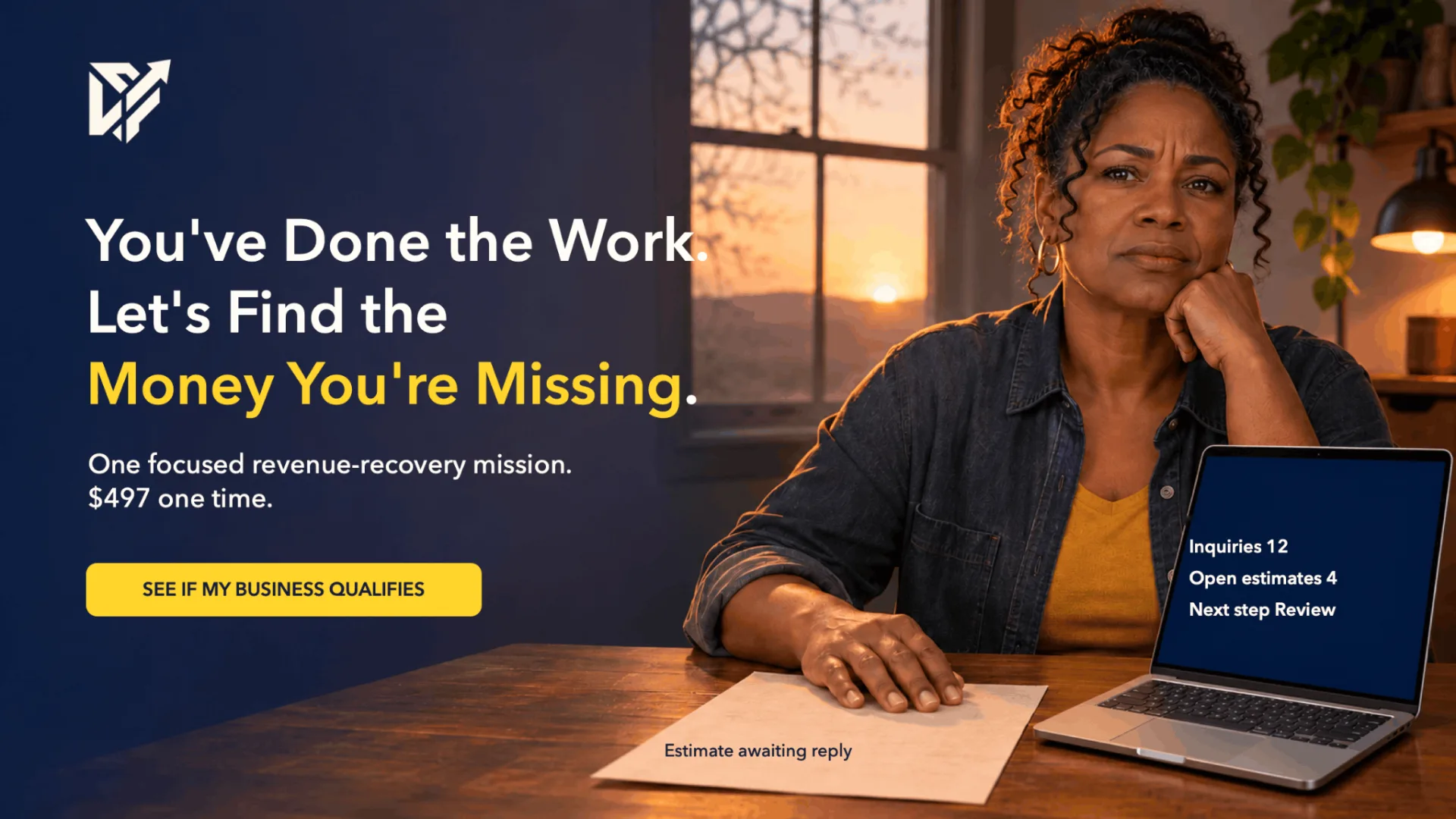
You may need a better way to understand what happened to the opportunities you already earned. Before spending more to attract strangers, find the place where a real customer relationship stopped moving.
Quotes, estimates, inquiries, appointments and unanswered questions. Did they receive the next step?
CATCH THE DEMANDPast customers may have a legitimate reason to come back—but only where the relationship and permissions support it.
WAKE USEFUL DEMANDSatisfied relationships can create repeat business or voluntary introductions. Trust must never be exploited.
PROTECT THE RELATIONSHIPThese are possible revenue opportunities, not a promise that recoverable money exists in any particular business.
Not a company-wide transformation. One appropriate opportunity, one authorized intervention, and an honest account of what happened.
Examine relevant records inside agreed access boundaries.
Define the audience, action, outcome and economics.
Prepare messages, the next step, and response handling.
People, channels, permissions and language are reviewed.
Observe responses, bookings, service and payments distinctly.
Receive a plain-English record of verified movement and unknowns.
This short self-check stays in your browser. It is not the official fit check and does not submit a lead. For the paid mission, begin with the form at the top.
No answer here proves a revenue loss. The goal is to identify a concrete next question.
The complete original Revenue Rescue sales copy is included below. Nothing has been cut or shortened for this website.
You've Already Done the Work. Let's Find the Money You're Missing.
You have customers who know your name.
People who have asked about your services. People who trusted you enough to request a price. People who bought from you before. People who meant to book, meant to call back, meant to make a decision.
And somewhere between interested and paid, some of those conversations went quiet.
You were taking care of the customers in front of you. Answering the phone. Doing the actual work. Handling problems. Sending invoices. Keeping your business alive.
You couldn't follow up on everything.
Nobody can.
But an unanswered estimate can turn into a forgotten estimate. A missed appointment can become a lost relationship. A customer who would have come back may never hear from you again.
The next sale you need might begin with someone who already knows your business.
That's the possibility behind Driftless Revenue Rescue™.
For $497, one time, we help you examine where revenue opportunities may be slipping through your existing business, choose one worth pursuing, prepare and activate one approved recovery effort, and measure what actually happens.
No required monthly subscription. No buying AI tokens. No promise that every lead will buy. Just one focused mission to find out what your business can recover.
Start with a free Revenue Rescue Fit Check. We'll look for a sensible place to begin before asking you to purchase.

There is a familiar moment in a struggling business. Sales feel slow. The owner opens a laptop and asks the same question again: How do I find more customers?
That question may be exactly right. But before you spend another dollar answering it, there is another question worth asking first.
What happened to the customers you already worked so hard to attract?
You paid for the ad. You posted the video. You knocked on the door. You attended the networking event. You answered the inquiry. You gave someone enough confidence to ask about your services. That attention cost something: money, time, effort, reputation, or all four.
Then the conversation stopped moving.
Perhaps a proposal waited three weeks for a response that never came. Perhaps a booking form quietly lost people at the last step. Perhaps an existing customer had another need, but nobody ever asked. Perhaps your office received calls during the busiest hour of the day, when everyone was delivering the very services that those calls were about.
Your business can keep buying more attention while those unfinished conversations accumulate. It can become exceptionally good at attracting people and painfully inconsistent at helping the right people take the next step.
That's The Leak Before the Faucet™. The faucet is what brings people in. The leak is where eligible opportunity stops before it becomes something that materially helps your business.
It may be a follow-up problem. It may be a weak offer. It may be slow responses, poor scheduling, insufficient capacity, unclear pricing, customer dissatisfaction, or unpaid work. Those are different leaks. Some need more marketing. Others need the exact opposite: fewer promises until the current ones are delivered and paid for.
You don't repair a leak by congratulating yourself on how much water you poured into the bucket.
You find the opening. You establish whether fixing it is possible and worth the effort. You repair one thing you can responsibly change. Then you look at the evidence.
Before you pay to attract another stranger, find out whether someone who already knows your business still has a legitimate reason to say yes.
Revenue Rescue is a way to investigate and act on one such opportunity. It does not assume the leak exists. It looks for it.
And if the evidence says your real problem is somewhere else, that matters just as much.
Revenue Rescue is our $497 one-time, bounded recovery mission. The free fit check is the first step to see whether that mission fits your business before you buy. You are not agreeing to a paid engagement by asking whether it makes sense.
REVIEW THE REVENUE RESCUE OFFER
Join Driftless for free. $0 to enter. No credit card required.
You do not need a polished business plan, a sales team, a perfect website, a certain revenue level, or an explanation that sounds impressive. You can arrive with a business that is already operating, a business idea you're still figuring out, or simply a problem that needs organizing.
Start where you are. Tell Driftless what you're trying to accomplish. Begin exploring the Free experience, get oriented around your objective, and use the assistance available within the Free Gate's permissions and capacity. The free account is not the same as purchasing a Revenue Rescue mission, and advanced or resource-intensive work may require a paid agreement. But joining to begin legitimate, governed work does not require a card or a paid subscription.
You don't have to make a purchase to take your first useful step.
JOIN DRIFTLESS FREE — NO CARD NEEDED
The two paths respect two different moments in your business. If you already know you want us to evaluate a focused recovery engagement, take the fit check. If you want help getting oriented without paying, join free. Neither path requires you to pretend you have everything figured out.
There is a part of owning a business that almost nobody sees.
They see your website. Your finished work. Your calendar. Your customers. Your posts. Maybe they see a busy owner and assume a busy business must be doing well.
They don't see the estimate you sent after dinner.
The customer who said, “Let me talk it over,” and never answered again.
The person who booked once, loved the service, and disappeared into everyday life.
The client who keeps asking for one more thing while the actual bill stays the same.
The unpaid invoice you meant to revisit once the week calmed down.
The week never calmed down.
Maybe you have employees who can help. Maybe you don't. Maybe every customer call, scheduling problem, follow-up message, and deposit still lands on you.
A business can have real demand and still leave revenue uncollected, unconverted, or simply unpursued. The reason matters. A missed follow-up needs a different solution from an underpriced service or a past-due invoice.
You deserve to know the difference.
Because when money is tight, another generic piece of business advice doesn't help much. You don't need somebody to tell you to “post more,” “be consistent,” or “grind harder.”
You need somebody to look at the business you actually have and ask a useful question:
Where is the nearest legitimate opportunity to earn or collect more money—and what would it take to act on it?
That is where Revenue Rescue begins.
Before you continue reading, look at your business as it actually operates. No special dashboard. No spreadsheet gymnastics. Think through these questions and notice where you hesitate.
If you answered “I don't know” more than once, that doesn't prove you're losing a certain amount of money. It tells you where better visibility may be valuable.
If one question made you think of a particular customer, conversation, or unpaid job, write it down. You have already moved from a vague concern about revenue to a more specific question.
If nothing on this list fits, good. Don't invent a leak because a sales page says there should be one. Revenue Rescue is for a genuine, bounded opportunity—not every business and not every problem.
Your first win may be clarity about what deserves your attention next. The paid mission goes further: if there is a suitable opportunity, it builds and operates one approved intervention and measures its result.
Think about the ordinary conversations that move through your business.
A homeowner asks a contractor for an estimate. The estimate is sent. The contractor gets buried in other jobs. Two weeks pass. Nobody checks whether the homeowner has questions.
A salon customer misses an appointment. The calendar moves on. Nobody offers an appropriate way to rebook.
A consultant finishes an engagement. The client has another problem the consultant could help solve. But no one asks what comes next.
A cleaning company serves a customer once. The customer might welcome recurring service, but no one makes the offer.
An agency has a list of qualified prospects who once requested information. Those prospects don't need to be treated like strangers. They need a relevant, respectful follow-up—if they are still eligible to be contacted.
These are illustrations, not promises about what exists in your business. Your records may tell a completely different story.
But the pattern is worth investigating.
Sometimes revenue is lost before anyone says no.
A business owner who is already stretched thin can spend money attracting fresh attention while existing opportunities receive none. More leads may help. Better pricing may help. Faster collections may help. Sometimes the right answer is to stop pursuing a particular group altogether.
We don't know which answer is yours until we examine the evidence.
And we're not going to pretend we do.
Not every customer who could buy from you is standing in the same place. That's why a single blast sent to everybody on a list can be both ineffective and unfair to the people receiving it.
The first market is the person already looking. This person asked for a quote, requested an appointment, started a conversation, or came to your website to compare options. They raised their hand. The useful move may be answering the question that kept them from deciding. It may be providing a clear appointment path, explaining an estimate, or politely asking whether they still need the service.
A person who requested information last Tuesday is not the same as someone who went silent three years ago. Their context, permissions, urgency, and likelihood of responding differ. Treat them accordingly.
The second market is the person who may not realize another useful step exists. An established customer might think your business does only the first service they bought. A former client may not know you offer a relevant follow-on engagement. A customer may continue doing something inconvenient because no one has shown them an appropriate alternative.
This is the waking market. The role of a message is to explain a genuine possibility, not manufacture a need or play on fear. Sometimes the useful message is an invitation. Sometimes it is a piece of information that helps someone make a better decision without buying anything at all.
The third market is trust. These are the relationships your business has earned. A satisfied customer might voluntarily recommend you. A respected partner may know someone with a fitting need. A past buyer may come back because they remember being treated well.
A trusted introduction is different from a cold advertisement. You should not exploit it. Referrals must be voluntary; incentives or endorsements must be truthful and disclosed where required. A referral or partner-activation campaign is not automatically included in every $497 mission. It is one potential source of opportunity to evaluate when the agreed scope and permissions support it.
The point is that these people do not need the same conversation.
The person asking for a price may need an answer. The person who bought once may need a relevant next offer. The satisfied customer who mentions your name to a friend may need nothing more than an easy, respectful way to make an introduction.
We investigate where the most plausible, eligible movement exists. Then one approved group becomes the focus of the mission.
This is more disciplined than treating everybody in your contact list as an identical prospect. It's more humane, too.
Every business has a journey between someone noticing it and that person becoming a satisfied, paying customer. The journey differs by industry, but the questions are familiar.
| A customer's current step | What the next useful movement might be | What may prevent it |
|---|---|---|
| Interested | A real conversation begins | No answer, unclear contact path, wrong timing |
| Conversation | Their actual problem is understood | Generic replies, no qualification, poor listening |
| Offer | They receive something worth evaluating | Unclear price, poor fit, missing details |
| Decision | They choose yes, no, or not yet | Unanswered objections, missing authority, no follow-up |
| Service | The promised work is delivered | Capacity, scheduling, quality, handoff failure |
| Payment | Earned money is properly invoiced and received | Billing friction, disputed work, unclear terms |
| Return | A satisfied customer chooses to buy again | No relevant offer, no reminder, changed needs |
| Referral | A customer voluntarily introduces someone | No simple introduction path, weak trust, no fit |
This is a teaching illustration, not a claim that every customer must travel every step or that every stalled step deserves further contact. A respectful no is a legitimate outcome. A person who opts out should not be pushed along a ladder they no longer want to climb.
The ladder matters because people often buy the wrong solution for the wrong step.
If your inquiries are unanswered, you may need a response process. If estimates don't convert, you may need better qualification or clearer offers. If buyers cancel after paying, your immediate problem may be service delivery, not sales. If people pay once and never return, that could reflect the nature of the service, changing needs, customer experience, or a missed appropriate next offer.
We don't just look for lost leads. We look for the moment useful movement stopped.
For a Revenue Rescue engagement, the fit check asks which part of that journey contains a sufficiently clear, safe, and actionable opportunity. The selected mission addresses one defined interruption. It does not claim to rebuild every stage of your business for $497.
A good decision about one step can save you from spending months optimizing the wrong one.
Revenue Rescue is designed for owners who have already built something real and want to find out whether the business is overlooking revenue it has a legitimate chance to earn.
We start with what you already have: the customers, inquiries, estimates, appointments, offers, and business records you authorize us to examine.
We look for patterns.
Where do conversations stop?
Where do interested people wait without a useful next step?
Which past customers could appropriately receive a new offer?
Are there open opportunities worth contacting again?
Is the problem really follow-up—or is the business working hard on offers that don't make enough money?
Then we choose one bounded opportunity and build an approved response around it.
Not a company-wide overhaul. Not an indefinite consulting arrangement. Not another complicated dashboard that becomes your problem to operate.
A defined mission. A defined audience. A defined action. A defined way to tell what happened.
And when the work is finished, you can see the difference between activity and an actual result.
$497. One-time Revenue Rescue mission.
Revenue Rescue follows The Customer Movement Method™, a practical way to connect a real customer problem with the next useful, authorized action and then examine the result.
You do not need to learn the framework to buy the service. You should, however, understand what makes the work different from a generic “we'll email your list” offer.
First, a person is not a lead count. A real customer has a history, a question, a decision to make, a preference, and sometimes a perfectly valid reason not to buy. A list of addresses is not a list of guaranteed sales.
Second, every message needs a job. If a person asked about booking, answer the booking question. If they requested a quote, help them understand the quote. If they have asked not to hear from you, honor the request. Sending a message merely because a system allows it doesn't create legitimate value.
Third, the next step must fit the person's readiness. Some people are ready to make a purchase. Others want to compare details. Some need time. Some need a reason to trust the business again. A single hard-sell message aimed at all of them risks losing the relationship.
Fourth, the promise survives the sale. It matters whether a customer can receive the service they were sold. It matters whether the business has capacity, whether the price covers costs, and whether the customer is satisfied. A new booking that cannot be fulfilled responsibly is not the kind of progress a small business can afford to chase.
Fifth, the evidence must match the claim. A click is a click. A reply is a reply. An accepted estimate is not money received. Collected revenue is not net profit. If we cannot verify a result, we should not promote it into a success story.
That is the purpose of the method: movement that matters, at a cost and risk that make sense, with the business owner still in control.
It is possible to use sophisticated systems without asking customers to study the machinery. The important part is that the machinery is accountable to the economic result and the human relationship.
One real person. One useful next step. One result we can examine.
The ordinary explanation for a cash shortage is often too broad: Business is slow. Sales are down. People aren't buying. Marketing isn't working.
Those descriptions may be true as feelings. They are not yet a diagnosis.
Consider a consultant with dozens of active relationships who cannot understand why so much work creates so little breathing room. More inquiries might make that situation worse. The binding issue could be unpaid revisions, customers whose scope has quietly expanded, project pricing that hasn't changed, late payments, or a calendar so full of low-margin work that higher-value buyers cannot get an appointment.
Consider a contractor with a full pipeline of written estimates. The problem might be follow-up. But it could also be that the estimates are consistently above a buyer's budget, arrive too late, exclude important details, or attract jobs the contractor should never have quoted.
Consider a salon with an uneven calendar. A rebooking effort might be valuable if former clients want to return. But if the business cannot serve existing bookings reliably, adding appointments could create cancellations, complaints, and less trust.
The work begins with an uncomfortable but useful distinction: the place where the pain appears may not be the place where the problem starts.
A revenue gap shows up in the bank account. The cause may be buried in the way inquiries are handled weeks earlier. A retention problem shows up in disappearing customers. The cause may be hidden in an onboarding promise nobody fulfilled.
Revenue Rescue is designed to narrow that investigation to one practical choice. The fit check establishes whether a bounded engagement is even appropriate. If one is, the approved mission identifies a target population, a specific next step, and a result that can be measured.
We need to know whether the customer is eligible to receive communication, whether there is a meaningful reason to contact them, whether a response can be handled, and whether serving an additional customer would likely help rather than harm the business.
Some situations require a different service. Regulated debt collection, major pricing reconstruction, legal disputes, full accounting, enterprise systems integration, or a company-wide turnaround cannot be smuggled into a $497 follow-up mission by calling everything revenue recovery.
The strongest intervention is not the loudest. It is the one that addresses the actual blockage.
That principle can spare a business owner from another month of activity without corresponding movement.
What would a useful change actually look like?
It might look like a set of pending estimates where every eligible customer now has a clear, respectful way to respond. It might look like a missed-appointment process that stops depending on somebody remembering to call. It might look like an offer that no longer asks the wrong customers to buy something that doesn't fit their needs. It might look like a business owner seeing, for the first time, that a high-volume customer segment consumes almost all the profit it generates.
Some of those discoveries can support a bounded campaign. Others may reveal a bigger issue that belongs in a different engagement. Knowing which is which is part of deciding whether to spend money at all.
The customer-facing purpose of Revenue Rescue is straightforward: after one approved mission, you should be able to answer a better set of questions than you could before.
What opportunity did we identify? Why was it suitable? Who could we contact? What did we offer? What happened after the contact? What did your customers actually do? What value, if any, reached your business? What should you do next?
That doesn't guarantee your answer will be “We made a sale.” Some legitimate experiments don't produce one. But a clearly bounded mission can be evaluated without inventing success, chasing vanity metrics, or requiring an endless subscription to find out what happened.
You don't need another report that makes your business look busy. You need a result you can make a decision from.
Maybe you'd finally know which open estimates deserve a call.
Maybe you'd discover that your best next opportunity is a customer who already bought from you.
Maybe you'd see that appointments are being booked but not completed.
Maybe you'd learn that the real constraint has nothing to do with leads. Your existing customers may be profitable only on paper. Your offers may be too cheap. Or the money may be earned but not collected.
That answer might be uncomfortable.
It would still be useful.
Because there is a cost to solving the wrong problem.
If you need pricing repair, buying more advertising can make a bad margin worse. If the problem is unpaid invoices, another marketing campaign won't collect them. If the customer relationship has no permissioned path for contact, an aggressive reactivation campaign is the wrong move.
Revenue Rescue is built around one decision that matters more than all the others: choosing the right recovery problem before doing the work.
And if there isn't a credible, appropriate opportunity for this offer, you should know that before paying for it.
That's why the first step is a free fit check.
These are invented situations illustrating possible diagnostics. They are not testimonials, customer case studies, or evidence of results produced by Driftless.
The owner spends the day doing service calls, then sends estimates after dinner. Some customers respond immediately. Others disappear. There is no consistent way to learn whether an estimate was accepted, rejected, or abandoned.
A possible Revenue Rescue mission could focus on a defined, permissioned set of recent open estimates. The work would be to clarify the next step, launch an approved follow-up, and measure actual responses and any subsequent verified economic movement. It would not presume every estimate is recoverable.
The calendar is packed. The work is real. But clients keep expanding requests without expanding what they pay. The owner doesn't need a hundred new leads; the first question is whether current services are priced and scoped to protect the business.
The fit check may find that a standard follow-up campaign is the wrong intervention. That is an important finding. It could point toward pricing, scope, or collections work that needs a different agreement rather than forcing this owner into a campaign that makes the problem worse.
A customer doesn't arrive. Another cancels. A third says they'll call back. The owner wants to know whether an appropriate rebooking process could preserve a useful relationship without making customers feel chased.
A mission might examine a narrow group of eligible missed appointments, with an approved message and clear rebooking route. The economic outcome depends on whether appointments are actually rescheduled, completed, and paid for—not on how many reminders are sent.
The agency spent months publishing content and attending events. People asked for proposals, but several conversations stalled when client projects consumed the team. The owner cannot tell which inquiries are still relevant.
The right move may be to review recent, qualified conversations and make a small, respectful follow-up offer. It may instead be to stop contacting old records with no reliable permission or current relevance. The records and rules decide.
Customers appreciate the work and sometimes buy again, but the business has no reliable understanding of repeat needs. A carefully chosen message might help eligible customers see a useful next service. In another industry, repeat purchase would be inappropriate because the service is naturally one-time.
The task is to understand the relationship rather than assume every former customer should become a recurring subscriber.
Different businesses. Different bottlenecks. The same principle: pick the next action the real situation can support.
You have probably seen the usual recommendations.
Buy another lead list.
Start another ad campaign.
Sign up for another tool.
Build a bigger funnel.
Hire somebody to handle follow-up.
Some of those investments can make sense. There are businesses where new demand truly is the constraint.
But there's a question worth answering first:
Are you making a serious effort to convert the demand you already earned?
If the answer is yes, excellent. Let's verify it.
If the answer is no, we should find out whether fixing that gap is worth the money.
You don't have to commit to an ongoing software subscription just to investigate one specific revenue-recovery opportunity.
And you shouldn't have to learn an entire operating system before someone addresses the business problem that made you seek help in the first place.
That's why Revenue Rescue is sold as a focused launch.
This question is easy to overlook when revenue feels urgent.
Imagine a business that has only two appointment slots next week. A campaign brings back ten interested customers. That sounds like a marketing success until those customers discover that the business cannot book them, cannot quote a realistic schedule, or cannot deliver the work on time.
The campaign may have manufactured a fresh complaint problem instead of improving the business.
That's why capacity matters. A potential buyer needs a credible next step the business can honor. If an offer will create work the company cannot safely fulfill, the correct action may be to limit the audience, change the timing, select another offer, or hold the mission.
The same is true of margin. A campaign may bring back someone who buys a service that costs more to deliver than the business receives. The owner can become busier and worse off.
A qualified Revenue Rescue intervention considers whether the desired sale would be useful once it becomes real. It does not attempt to guarantee profitability from incomplete books, but it should not ignore obvious delivery and economic constraints either.
Getting more people to say yes is valuable only if yes is a promise your business can keep.
This is where the wrong sales pitch can cost you real money.
A marketing company may try to sell you traffic.
A software company may try to sell you features.
A consultant may try to sell you a long engagement.
We want the first purchase to have a smaller, clearer purpose: find out whether one existing revenue opportunity can be acted on responsibly, and execute the agreed effort.
That could lead to a sale.
It could lead to appointments that create future opportunities.
It could reveal a defect in the way customers are handled.
Or it could reveal that your next dollar should be spent somewhere else entirely.
If the evidence points to underpricing, unprofitable work, or collection problems outside the selected mission, we should say so instead of pretending that sending more follow-ups will fix everything.
This is still your money. Protecting it is part of respecting the business you built.

You are purchasing one defined revenue-recovery launch, not a promise that a particular dollar amount will land in your bank account.
The mission is organized around six practical stages.
With your permission, we examine the relevant part of your existing business: perhaps unfinished estimates, past-customer relationships, missed appointments, qualified inquiries, or other records within the agreed scope.
We are looking for a real commercial opening, not inventing a dramatic number to impress you.
A name in a database is not revenue. An old inquiry is not a guaranteed buyer. An invoice is not collected cash.
We start by separating those things.
A scattered effort usually produces scattered evidence.
So we identify one eligible customer group, one approved offer or next step, and one outcome worth measuring.
For one owner, that might be a batch of quotes that never received follow-up. For another, it might be an appropriate invitation for prior customers to book again. For another, it could be a stalled appointment path that needs repairing.
The final mission depends on what the records, permissions, and economics justify.
We build the messages, contact sequence, response path, and relevant conversion materials needed for the approved mission.
Where email is the right channel, a bounded mission may use up to three approved messages to one defined audience. Other channels or workflows require their own approval and scope.
The point isn't to send more messages.
It's to make a useful, relevant offer and give the customer a clear way to respond.
Your customers are your relationships.
You should know whom the mission may contact, why those people are eligible, what they will be told, and what happens when they answer.
We don't treat access as permission to do anything we please.
The mission proceeds only inside the approvals, business rules, and communication permissions established for it.
We track the movement the mission is designed to create, with the agreed measurement window and available evidence.
Did people answer? Did someone book? Did an opportunity reopen? Was a proposal accepted? Was money actually collected?
Those are different outcomes, and they should be reported differently.
The initial mission design may include a 14-day measurement window following activation. Your exact scope and timing are established before work begins.
At closeout, you receive a plain-English account of the work, the evidence, the remaining unknowns, and the next economically sensible step.
If a customer replied, we'll say a customer replied.
If an appointment was booked, we'll say an appointment was booked.
If cash was actually received and can be reasonably attributed to the mission, we'll say that—with its supporting record.
If no recovery is verified, we won't relabel effort as success.
The purpose is to give you a real result to judge, even when the result is that an opportunity wasn't what it seemed.
A follow-up message is only useful when it belongs in the customer's actual conversation.
Think about a business owner who sends the same sentence to every contact: “Hey, just checking in. Do you want to buy?”
The person who asked a detailed question about the price hasn't had the question answered. The person who missed an appointment hasn't received a helpful rebooking option. The longtime customer who just completed a purchase may feel the business hasn't paid attention. The person who said no last month may receive an unwanted message that ignores the decision they already made.
The business owner counts four follow-ups. The customer experiences four different failures of relevance.
There is another way to think about it.
For the unanswered estimate, the next useful move may be, “I sent the estimate for your requested project. Is there a detail I can clarify before you decide?” The message should be accurate, appropriately timed, and permitted.
For the missed appointment, the next useful move may be, “We noticed the appointment didn't happen. If you'd still like help, here's how to choose another time.” The exact wording depends on the service, its rules, and the customer's preferences.
For the past customer, the next useful move may be explaining a genuinely relevant service or asking whether their needs have changed, not assuming that buying once means they consented to unlimited promotions.
For a person who cannot buy yet, the next step might be sharing useful information, scheduling a later conversation if requested, or simply leaving them alone. Respect is part of a working sales process.
The goal is to reduce friction where a customer genuinely wants to move, not pressure somebody across a boundary they've already set.
That's why Revenue Rescue begins with one eligible population and one defined customer movement. We want to know what the person is likely waiting on, what we may responsibly offer, and what our business must be prepared to do if the answer is yes.
You can send fewer messages and still do better work. The value of a message comes from what it helps somebody decide or accomplish, not from the number of times a send button gets pressed.
A message from your business is a small request for somebody else's attention. That attention should earn something.
The Customer Movement Method™ calls this the Value Bridge. Rather than opening every conversation with a demand for a purchase, we design the experience so a person can understand why the message matters, receive something useful, and choose an appropriate next step.
Stop means the right person recognizes that the message concerns something real. You don't have to shout. You can refer clearly to the estimate they requested, the appointment they couldn't make, or the previous work they authorized. Relevance is more effective than manufactured drama.
Hold means the message continues to deserve attention. It addresses the actual point of uncertainty. Was the price clear? Was the schedule possible? Is the requested service still available? Is there an important change to explain? The purpose is understanding, not a trick that keeps someone reading.
Reward means the reader gets value even before making a purchase. Maybe the message gives them the information they asked for, explains a choice, offers a useful booking option, or helps them decide that the service is not right for them. That is a legitimate outcome. A business that keeps its word while someone decides can protect trust more effectively than one that keeps changing the subject to the sale.
Advance means the next door is obvious and voluntary. Reply to the original conversation. Book the agreed service. Ask a question. Accept the proposal. Decline. Request no further contact. A clean path to no protects a relationship as surely as a clean path to yes.
Here is a hypothetical example of the difference.
Generic message: “Hey! We have amazing deals available. Book now before it's too late!”
Relevant message to a qualified person who requested an estimate: “You asked us about the kitchen repair last week. Your estimate is ready, and I'm available to answer questions about the scope or schedule. If you'd like to move forward, you can reply here or use the booking link we included. If your plans changed, no problem—just let us know.”
The second message makes fewer promises. It also does a much better job respecting why the conversation exists in the first place. It doesn't invent a deadline, pretend familiarity, or threaten the customer with a missed opportunity.
For your actual mission, the copy and contact path are prepared for review. Audience, timing, permitted channels, message count, contact eligibility, and response responsibilities belong in the approved scope.
Good recovery work gives someone a reason to continue a useful conversation. It never depends on taking away their freedom to end it.
The following numbers are hypothetical. They are not a Driftless customer result or a forecast.
Suppose a service business has 20 outstanding estimates.
Those estimates include people who may have hired someone else, decided not to proceed, or simply lost track of the conversation.
Now suppose one appropriate follow-up leads to a $900 job.
That doesn't mean $900 in profit. It doesn't even mean $900 in collected revenue until the customer pays. The business still has to deliver the work, cover its costs, and protect its margin.
But it shows why the distinction matters.
If the $900 job is completed and paid, the owner can evaluate whether the additional revenue and contribution justified the cost of reaching out.
If no one responds, that information matters too. Perhaps the offer is weak, the timing is wrong, the contacts aren't eligible, or the leads have already moved on.
A responsible recovery mission measures the outcome rather than claiming the full value of every quote on the list.
The number worth celebrating is not how much money was “sitting in the pipeline.” It's how much additional value the business can actually substantiate.
This example is invented for explanation. These numbers do not describe a Driftless customer, an observed conversion rate, or a forecast of what your business will earn.
Suppose a small service business receives 100 inquiries during a month. The owner is encouraged: traffic is up, the phone rings, the contact form fills out. On paper, it looks like marketing is working.
But follow the people instead of the traffic.
| Customer movement | Hypothetical count | What it means |
|---|---|---|
| Inquiries received | 100 | People made some kind of contact; not all will qualify |
| Real conversations | 30 | 70 never progressed to a meaningful exchange |
| Estimates delivered | 12 | 18 conversations did not become an offer |
| Purchases agreed | 4 | Eight estimates did not become accepted purchases |
| Payments verified | 3 | One purchase has not become a verified payment |
Where is the leak?
You cannot tell from this table alone. The seventy missing conversations may include spam, wrong-fit inquiries, people who never consented to contact, or leads who were answered but declined. The eight unaccepted estimates may be too expensive, too slow, too unclear, or simply unwanted. The unpaid purchase may be subject to ordinary terms rather than an overdue collection problem.
That's why diagnosis comes before intervention.
But notice the owner's available choices. They could pay to get another hundred inquiries, and perhaps some will become customers. They could investigate why only thirty conversations happened. They could learn whether the qualified estimates were delivered in time. They could repair the next step after an interested buyer asked a question. They could decide the current offer is underpriced or too costly to fulfill.
Each option consumes different resources and carries different risks. The right one is not determined by the biggest-looking number.
Now suppose the agreed mission is limited to one eligible population: a defined set of estimates that received no suitable follow-up. We establish who can be contacted and why, prepare a relevant message, approve it, activate it, and observe the responses.
Suppose two recipients reply. One says no. The other schedules a conversation. That is two responses and one scheduled conversation—not two sales. If the second person later accepts a job, that's a new step. If the job is delivered, invoiced, and paid, those are additional steps with their own records. If the sale might have happened anyway, attributable uplift remains uncertain unless the evidence supports a stronger conclusion.
The hypothetical makes one point: a business can be busy at the top of its funnel while its most useful next action lies somewhere in the middle.
CMM's teaching shorthand is:
RIGHT PEOPLE × RIGHT MOVEMENT × RIGHT NEXT STEP = REVENUE
This is a way to remember what deserves attention, not a mathematical guarantee. Actual realized revenue depends on price, buyer behavior, delivery, payment, and the facts of your business.
A hundred contacts can be almost worthless if nobody has a real reason to buy. A handful of relevant conversations can be meaningful. The truth comes from what happens next.
If you run a company with a staff, you may have people assigned to operations and sales.
But if you work alone, every part of the business has your name on it.
You deliver the service. You handle complaints. You quote new work. You chase paperwork. You pay the bills. You remember birthdays, customer preferences, renewal dates, and the details that make people trust you.
Then somebody tells you that you need to be better at follow-up.
You already know.
The problem isn't that you didn't care enough.
The problem is that your time had a limit.
Revenue Rescue is designed to focus attention on one potential source of income without making you build another permanent job around it.
You remain in control of the business relationship. We help define and operate the approved recovery step.
There is a difference between being busy with forty customers and having forty profitable customer relationships.
There is a difference between having booked work and having enough cash to live on.
There is a difference between being told your business has potential and being able to see the money that actually comes in.
We care about that last difference.
Imagine you own a service business. A promotion fills your calendar. Every appointment is booked. People compliment how busy you are. You get home later than ever, while your bank balance barely changes.
There are real reasons this can happen. The price may not cover labor and materials. Customers may require more work than the agreement describes. Discounts may eat the contribution. Refunds, cancellations, financing, transportation, or support may consume what looked like profit. Some of those costs are hidden in the owner's own unpaid time.
That's why Revenue Rescue should never celebrate an additional sale without respecting the economics of fulfilling it.
The first kind of success belongs to your customer. Did the person receive the service that was promised? Was it appropriate to their problem? Did the experience respect the agreement and the relationship? A business that sells what it cannot deliver creates future costs and broken trust.
The second kind of success belongs to the business. Did the work produce value after the costs of acquisition, delivery, fees, support, and other relevant expenses? Did the payment arrive? Did it improve the owner's actual position?
Both questions matter. And the answer may be incomplete when the business cannot supply reliable cost or payment records. We will not manufacture a profit claim out of a gross sales figure.
You may discover that your next revenue problem is not “How do I find more work?” but “Which work should I be taking, and what price makes it sustainable?”
A full pricing rebuild is outside the automatically included scope of Revenue Rescue. But identifying that mismatch before launching a poorly suited campaign can protect your money and your time.
More customers are only good news when you can serve them well and the relationship makes economic sense.
You have a collection of estimates or proposals that ended without a clear yes or no.
You have past customers who might have a legitimate reason to return, but you haven't had time to contact them appropriately.
You receive inquiries, yet some never reach an appointment or decision.
You have missed or canceled appointments with no consistent rebooking process.
You manage clients and stay busy, but you're unsure where the real profit is going.
You know there are follow-ups you meant to complete and want to stop relying on memory.
You feel pressure to spend more on marketing but can't confidently say what happened to the opportunities you already paid to attract.
You don't need to check every box.
You need one meaningful problem that fits a safe, measurable, economically sensible mission.
Some business relationships end naturally. The project is complete. The customer moves. The need disappears. That is normal, and it does not mean a sales process failed.
Other relationships have room to continue, but nobody knows whether the door is still open.
A satisfied homeowner may need the next stage of a project months later. A business client may have grown beyond the work you originally completed. A former customer may be willing to recommend your name when someone asks who helped them. They may even have referred you already and your business never learned about it.
This is the Trust Market in CMM: genuine relationships through which people learn about useful work from someone they already believe.
Trust can't be bought back with a louder message after you treat a customer's attention carelessly. It is built through delivered promises, accurate billing, respectful communication, and the ability to say “No, that service is not right for you” when that's the truth.
For the right business, one approved recovery opportunity may involve reintroducing a relevant service to eligible former customers. A voluntary referral opportunity may also be worth assessing. But neither is an excuse to pressure customers or turn their personal relationships into uncontrolled marketing channels.
Your customer's trust is a business asset only while you keep treating it like their choice.
This is why the mission asks not just whether you have contact information, but whether there is a legitimate reason and authority to use it.

DRIFTLESS REVENUE RESCUE™ — $497 ONE TIME
One approved recovery mission, built around one eligible opportunity in your existing business.
Your mission includes the agreed review and selection of a target opportunity, preparation of its recovery process, an approval step before activation, the authorized launch, outcome measurement, and a closeout summary.
The exact audience, message volume, channels, access, third-party expenses if any, launch schedule, measurement window, and service terms are documented before you commit.
There is no required subscription attached to this one-time offer.
You do not pay by AI token or by AI attempt.
You are not purchasing a promise of a minimum dollar recovery. You're purchasing a bounded effort with a defined way to evaluate its result.
If the fit check shows this isn't the right place to spend $497, the answer should be no—not an expensive attempt to make your business fit our offer.
Free first step. The one-time $497 purchase comes after a suitable mission and its terms are identified.
These two starting points are deliberately different. They exist so you can move forward without agreeing to a purchase you don't need.
| Driftless Free Gate | Revenue Rescue™ | |
|---|---|---|
| Price to begin | $0 | $497 one time, after fit and scope are agreed |
| Credit card to enter | Not required | Payment and agreement required for the paid mission |
| Best when | You want to start exploring, organizing an objective, and using available Free capabilities | You have a plausible existing revenue opportunity requiring a focused, approved intervention |
| Core relationship | Self-service Free operating experience within stated limits | One bounded service mission with defined scope, authority, and measurement |
| What is included | Available Free features and governed capacity | Agreed review, one selected recovery process, authorized activation, measurement and closeout |
| What it is not | Not a free unlimited Revenue Machine or full Revenue Constraint Scan | Not a guaranteed cash recovery or full business transformation |
| Subscription required? | No paid plan required to enter | No required recurring subscription |
The Free Gate can be your first introduction to Driftless. The Revenue Rescue mission is a separate purchase for a distinct problem. Some owners will choose only Free. Some will request a fit check and decide not to purchase. Others may buy one Revenue Rescue mission and never subscribe. Continued operating capacity is a separate decision.
We want you to know exactly which relationship you're choosing.
If you need to begin without paying: Join Driftless Free.
If you want to learn about the one-time revenue-recovery mission: Review the Revenue Rescue offer.
It buys focused attention on an economic problem that may already exist inside your business.
It buys a decision about which specific opportunity deserves action.
It buys the preparation and execution of one approved recovery workflow, rather than another list of tips for you to implement someday.
It buys measurement that separates contact attempts, customer responses, bookings, sales, collections, and unresolved outcomes.
It buys a closeout you can use to decide what to do next.
Perhaps the most useful thing it buys is a smaller decision.
You don't have to decide whether to move your entire business onto a new platform.
You don't have to decide whether to sign a twelve-month agreement.
You don't have to rebuild your entire sales operation before finding out whether the first recovery effort makes sense.
You can decide whether one contained mission is worth attempting.
Then judge the actual result.
Most business owners don't want to decode a marketing dashboard on Friday night. They want to know whether the work they paid for produced something they can use.
The original $497 mission already calls for a plain-English closeout summary. The following Money Movement Report™ is an illustrative way to make that summary more useful. The exact reporting format, data fields, and availability of a named report would need to be confirmed in the final agreement. This is a sample layout, not a claim that a separately branded report is already included or automated.
| What you would want answered | Illustrative closeout field | Why the distinction matters |
|---|---|---|
| What was the starting condition? | Eligible estimates lacking a confirmed disposition | Establishes what was actually known before action |
| What did we try to change? | Obtain a clear next step from approved, eligible recipients | Prevents moving the success definition later |
| Who could be contacted? | Approved audience and excluded records | Keeps consent and fit visible |
| What went out? | Message version, channel, dates, and execution receipts | Shows the intervention rather than merely claiming it ran |
| Who responded? | Replies and their actual categories | A reply is not yet a sale |
| What commercial movement occurred? | Bookings, accepted proposals, completed work, verified payments | Keeps separate events separate |
| What did the business keep? | Contribution when reliable costs and payment data exist | Revenue is not profit |
| What cannot be proven? | Uncertain attribution, missing payment evidence, insufficient observation window | Prevents manufactured certainty |
| What should happen next? | Continue, revise, stop, or explore a different constraint | Converts the closeout into a decision |
Suppose the record shows that messages were delivered to twenty-five eligible people; five replied; two requested an appointment; one appointment occurred; and no payment was verified during the measurement window. The owner may reasonably decide that the campaign created conversations but hasn't yet established economic success. We should not decorate that outcome with an invented dollar figure.
Suppose instead the records support a completed, paid purchase connected to the campaign. We can report the payment and the supporting path, and still be careful about whether the purchase would otherwise have happened. Associated with and caused by are different claims.
A report becomes valuable when it helps you make the next decision without having to trust an optimistic summary.
When the work is finished, you'll want to know what was approved, what happened, what your customers actually did, and what the evidence allows you to conclude. The closeout belongs to that purpose.
You should never have to guess whether “campaign success” means a sent message, a booked appointment, or money that reached your business.
A contact in a CRM has a name. Behind the name is a person. That person may have trusted you with a phone number to receive an appointment reminder, an email address to get a requested estimate, or private details needed to deliver a service.
Those are different permissions. Access to information does not make every use of that information appropriate.
Before a Revenue Rescue mission contacts anyone, the customer population, channel, message, permission basis, timing, exclusions, and response handling need to be reviewed and approved. Suppression requests and opt-outs matter. If the list cannot be used responsibly, we should choose a different action or decline the mission.
The other side of the relationship matters too. If a person replies yes, who takes the call? Who confirms the price? Who answers a question? Who delivers the work? Who is responsible if the appointment gets missed or the offer cannot be honored?
An outreach campaign that produces replies nobody handles has not repaired the customer's journey. It may have simply created a new place to disappoint them.
The business owner remains in control of the customer relationship. Revenue Rescue is an authorized, bounded effort; it is not blanket permission to operate every commercial decision in the company.
A responsible rescue protects the relationships that made the opportunity possible.
We won't count every person contacted as a win.
We won't call an opened email a sale.
We won't turn a promised appointment into money received.
We won't assume that a customer who buys would never have bought without the campaign.
We won't tell you that an old prospect is “worth” the amount of a quote they never accepted.
We won't use your customer information outside the access and permissions you approve.
And we won't promise that an algorithm can force somebody to buy.
Those shortcuts can make marketing reports look impressive while your bank balance stays exactly where it was.
You deserve a better accounting of the work.
Show the action. Show the response. Show the evidence. Make the next decision from what is real.
That's the standard we are building this offer around.
A message can generate more replies than another without producing more meaningful purchases. An offer can create a sale but disappoint the buyer. A heavily discounted campaign can look successful until delivery costs arrive.
A useful closeout asks which movement mattered and what we can responsibly infer from it.
If one group responded and another did not, we shouldn't immediately declare the winning message. Perhaps the groups were different in age, eligibility, urgency, prior experience, or purchasing capacity. Perhaps one was contacted at the right time. Perhaps the numbers were too small to support a strong conclusion.
We can still learn something from those observations. A question might deserve a better answer. A booking page might deserve a simpler path. A particular offer might attract too many wrong-fit inquiries. The evidence can guide a next hypothesis without pretending it has established a universal rule.
The purpose of measuring a mission is not to crown a winner from a handful of events. It is to make your next decision better than the one you could have made without the evidence.
Keep it.
A CRM can be useful for remembering people, storing conversations, and organizing sales work.
But a contact record alone doesn't make a customer buy. A reminder doesn't write the right message, establish the right permission, or explain whether a recovered sale was profitable.
Revenue Rescue is about choosing and operating one recovery effort, not selling you another place to store names.
Existing tools and records may be part of the approved workflow when access and compatibility permit. If a system isn't accessible or the data isn't usable, we'll have to account for that before committing to a mission.
The important question isn't which logo appears on your software screen.
It's whether the right work happens and whether you can verify its effect.
In fact, if you have five open estimates, know exactly whom to call, and have an hour available, you may not need Revenue Rescue at all.
Call them.
The offer makes more sense when the problem has become recurring, disorganized, or difficult to measure—and one focused intervention can relieve a genuine constraint.
Maybe you need a sensible audience selected from a messy list.
Maybe you need messages that fit the original conversation instead of a generic blast.
Maybe you need a reply path that doesn't strand people a second time.
Maybe you need an accountable launch and closeout because you have been starting these efforts and never finishing them.
If the work is small and obvious enough for you to handle well today, we'd rather tell you that than collect $497 for an unnecessary mission.
That's a good reason to ask harder questions.
Who was contacted?
Were they people who had a real reason to hear from the business?
What were they asked to do?
Could they reply easily?
Did somebody handle the reply?
Was an appointment completed or merely booked?
Was a purchase actually made?
How much did it cost to produce and fulfill that purchase?
What changed afterward?
A campaign that produced thirty replies and no profitable customers is a different story from a campaign that produced three replies and one profitable new engagement. Neither should be judged only by the number of messages sent.
Your experience with failed marketing shouldn't be dismissed. It should shape what we measure this time.
Then we tell you nobody bought through the mission, within the evidence and measurement window we have.
We can still report whether people responded, whether opportunities reopened, where the process stalled, and what remains unknown.
But we will not pretend those observations are cash.
This is a commercial intervention with uncertainty, not a guaranteed income product. People may ignore a message. They may have chosen another provider. The original opportunity may no longer exist. A customer may book and cancel. A sale may be unprofitable.
The $497 fee pays for the agreed mission, not a guaranteed recovery amount. Any refund, remedy, and service commitments must be stated in the written offer terms; none are implied here.
What we can commit to in the offer is clear scope, approval before outreach, documented execution, and an honest closeout of the available evidence.
Then a follow-up campaign may be the wrong move.
A business that is undercharging can become poorer by selling more.
Suppose every additional job creates more labor, more expenses, more stress, and almost no contribution after costs. A larger pipeline won't fix those economics.
That's one reason the fit check matters.
Revenue Rescue is a focused revenue-recovery launch. It isn't a replacement for a full pricing model, debt-collection service, financial audit, or company turnaround. If what you need falls outside that boundary, we'll identify the mismatch rather than quietly expanding the promise.
More sales are useful only when they make the business better off.
No. Not as an automatic part of this offer.
A healthy customer relationship is worth more than a careless marketing blast.
The approved mission has a defined audience and purpose. Eligibility, consent, suppression requests, communication rules, and channel permissions matter. You review the proposed outreach before activation.
And some records may need to be excluded entirely.
We would rather operate a small, appropriate mission than damage the trust it took you years to earn.
You should not have to become a software expert to understand the service you're buying.
Your part is to explain the business, provide approved access to the relevant records, review the proposed mission, and help confirm what happened when customer interactions or payments need your verification.
We define the work in ordinary business language.
You should be able to answer three questions at any point:
What are we trying to recover? What has been authorized? What has actually happened?
If the answer requires a lecture on AI architecture, we're doing a poor job of explaining your purchase.
You decide.
Maybe the mission demonstrates a useful follow-up process you want to continue operating.
Maybe it shows you a different, more urgent problem.
Maybe the result doesn't justify further spending.
You can take the closeout and make the next decision from the evidence.
Driftless also has ongoing software and business plans for owners who want broader operating capacity. Those are separate choices, not a condition of purchasing Revenue Rescue.
A recurring relationship should be earned by the value of continued work, not hidden inside the first checkout.
There is a difference between paying for a burst of activity and paying for work that leaves you better able to operate.
When the mission closes, its approved record should help answer what was attempted, what succeeded, what failed, and which problem appears most important next. That alone can make a follow-up decision more disciplined than guessing.
Depending on the mission's scope and results, the next logical improvement might be a reusable follow-up procedure, a clearer sales question, a more useful definition of a qualified estimate, or a reminder to avoid an unprofitable customer segment. Those items are potential next actions or separately scoped work, not automatically bundled deliverables simply because they sound attractive.
The Customer Movement Method™ asks a deeper question: if a business learns something useful, will the next similar customer benefit from that learning?
A business with no system for learning can make the same mistake every month and call each new marketing campaign a fresh start. A business that remembers its real results can become better at choosing the work worth doing.
One mission cannot prove every future campaign will work. It can, however, produce a record that deserves to inform the next decision.
You should leave knowing more about how your business earns—or fails to earn—money than you knew before the mission began.
Somebody who requested an estimate once had a reason to ask.
Somebody who paid you before already crossed a trust barrier that a cold audience hasn't crossed.
Somebody who missed an appointment may still need the service.
Somebody who told you “next month” may have meant it—or may have moved on.
Those possibilities are not equivalent to revenue. But they may be worth investigating before buying more attention elsewhere.
There are only so many hours in a day.
And if you're a small operator, you know exactly what happens when sales work competes with the work that keeps today's promises.
The service happens first. The follow-up slips to tomorrow. Tomorrow becomes Friday. Friday becomes next month.
Eventually, the conversation is hard to find.
You can't get those hours back.
But you can choose to stop treating follow-up as the part of business that happens only when there's time left over.
Revenue Rescue gives that problem a defined beginning, a defined intervention, and a documented ending.
Before purchasing a mission, start with a short qualification conversation or intake.
We'll establish the kind of business you run, the revenue problem you believe exists, the records available, and whether there's an appropriate, feasible recovery action to consider.
You don't need to prepare a perfect presentation.
You should be ready to explain what you sell, who buys it, what seems to be slipping through the cracks, and how the business currently tracks inquiries, customers, quotes, appointments, or payments.
If the next step requires sensitive access or customer outreach, that comes later, under explicit scope and permission.
The fit check is not a free full Revenue Constraint Scan, financial audit, or guarantee that recoverable money exists. It's a way to determine whether a bounded Revenue Rescue mission is an appropriate purchase.
If it is, you'll see the proposed mission and its terms before committing the $497.
If it isn't, you shouldn't be sold one.
Before we recommend a paid mission, the free Revenue Rescue Fit Check can begin with plain questions. You don't need an accounting degree, a marketing team, or the vocabulary of a software company to answer them.
1. What result are you actually trying to produce?
Some owners say they need more sales when the urgent need is cash in the account. Others have enough customers but need more profitable work. Others need appointments filled by people who show up and receive the service. Tell us what would make a real difference in your business and over what period. We should not assign an objective merely because the software happens to measure it.
2. Who is the customer who could make that result possible?
Perhaps it's a past buyer, a person with an unanswered estimate, or a current client with a legitimate additional need. A successful mission must target a real, appropriate population, not a vague fantasy about everybody who might buy something someday.
3. Who is already looking?
Which inquiries, booking attempts, quote requests, proposal discussions, or other active signals exist? How old are they? Do you have the right to follow up? Are they still relevant? This is where the first market—people already raising their hands—often becomes visible.
4. Who may need a better explanation?
There may be customers who don't understand an offer, don't realize a suitable service exists, or don't know the next step. Education can help when it is truthful and genuinely useful. It cannot manufacture a need that isn't present.
5. Who already trusts the business?
Think about satisfied customers, prior buyers, partners, and relationships worth preserving. A long customer list doesn't automatically authorize outreach, but the business's existing trust may matter more than a cold audience. Referral-oriented work requires a separately approved path when appropriate.
6. Where is the first meaningful stuck point?
Not every problem gets solved at once. The question is where one safe, affordable intervention has a credible chance of producing meaningful movement. That may mean following up on quotes, repairing a booking path, or deciding the real problem lies outside this offer.
7. What evidence would convince you that something changed?
Would a booked and completed appointment matter? A signed engagement? A payment received? A healthy contribution after the cost of delivery? Decide before running the mission. Otherwise the business can mistake effort for success after the fact.
These questions are not a substitute for a paid financial audit or a full platform diagnostic. They are a sensible way to decide whether Revenue Rescue belongs in the conversation.
You can start with what you know. If something is unknown, say that. The point is to become more precise, not to impress anyone with an answer.
If you prefer to explore without entering a paid-service conversation yet, join Driftless Free. There is no card required to enter the Free Gate.

Maybe you're reading this because you already know you have a revenue problem. Maybe the $497 mission sounds right, but this month you need to protect every dollar. Maybe you're starting from scratch and don't have a customer list to rescue yet.
We don't want the only message you take away to be “Come back when you can afford us.”
You can join Driftless for free.
The Free Gate is $0 forever to enter, and the published pricing terms say you do not need to provide a credit card merely to get started. You can enter Driftless, describe an objective, begin exploring your business reality, understand the experience, and start legitimate work within the Free Gate's available capabilities and limits. You aren't charged per token or per AI attempt merely for joining.
Start with the honest version of your situation.
“I have a cleaning business, but I don't know which customers are making me money.”
“I work alone. I have too much to do and I need to decide what matters first.”
“I have an idea for a business, but I haven't made a sale.”
“I know people are asking about my service. I just don't know where those conversations are going.”
“I'm trying to grow, but I need a plan that fits the time and resources I actually have.”
These are examples of objectives you can bring into the experience, not a promise that the Free Gate includes every analysis, integration, or execution capability needed to solve each one. The platform's governed Free experience determines which assistance and actions are available without payment.
You should not have to translate your everyday business problem into a complicated technical request before you can begin.
You can come in curious. You can come in overwhelmed. You can come in with a simple question. You can come in with a business that doesn't yet look like the one you hoped to build.
The next useful movement might be getting your goal written clearly. It might be discovering that a major missing piece is your pricing, your customers, or your follow-up process. It might be getting oriented enough to decide what you need to do first.
There is dignity in being able to begin without asking permission from your bank balance.
We do need to be clear about the boundary. A free Driftless account is not the $497 Revenue Rescue mission. It does not automatically include unlimited autonomous execution, third-party compute, messaging, enterprise features, or the governed Revenue Constraint Scan reserved for eligible paid arrangements. If your objective requires a paid service or external expense, that needs its own explicit terms and authority.
But the first decision is free: enter, describe where you are, and start discovering what legitimate help is available to you now.
JOIN DRIFTLESS FREE — NO CARD REQUIRED
Your business does not have to be big for the work to matter. And you do not have to buy Revenue Rescue to have a place to begin.
There are business owners who can make this purchase comfortably. For them, the question is whether one well-defined mission offers enough potential value to justify the fee.
There are also owners for whom $497 is groceries, a utility bill, a critical business expense, or breathing room they cannot safely surrender. Selling those people a speculative promise would contradict the purpose of this offer.
If the fee would put you under unacceptable pressure, start free. You can explore Driftless without a credit card, describe what you want to accomplish, and use the help available in the Free Gate. You can return to the Revenue Rescue fit check when it makes sense, if it ever does.
If there is a clear step you can take yourself today—answer five genuine inquiries, clarify three quotes, correct a broken booking link—do that. The paid mission should earn its place by addressing a problem you cannot or do not reasonably want to handle alone.
We don't need you to buy an inappropriate service to prove you're serious about building your business.
You are allowed to start small. You are allowed to ask questions first. And you're allowed to decide not to buy.
Usually, the strongest fit is a business with an existing customer base, inquiries, estimates, appointments, or other legitimate revenue opportunities to examine. If you have no such activity yet, generating first demand may be more important than recovering stalled demand. The fit check is designed to make that distinction.
The flagship mission is designed around an existing revenue opportunity, not an unlimited advertising campaign. Paid ads, extensive lead acquisition, and broader marketing programs are not automatically part of the $497 scope.
Yes, solo operators are a central audience for the offer. A mission still has to fit the available records, permissions, business capacity, and economics. You remain responsible for the customer service or delivery obligations you accept.
Service contractors, cleaners, salons, coaches, consultants, agencies, local service providers, and other businesses with established customer interactions may have eligible opportunities. Suitability depends on the specific records, offer, contact permissions, and mission constraints—not the label on the business.
Past-due payments may reveal a cash-flow constraint, but debt collection, legal demands, dispute resolution, and regulated collections activity are not included by implication. The fit check will determine whether an appropriate approved workflow fits the offered scope or whether another service is required.
No. The mission is designed to pursue and measure an opportunity, not guarantee that customers will buy or that a particular amount will be recovered. We believe you should know this before purchasing.
Data quality affects what can be done. We may need to reduce the audience, exclude questionable records, or conclude that the mission is not feasible. We won't treat missing consent or unusable contact data as a minor technical detail.
The number depends on the agreed audience and mission limits. The $497 offer is not unlimited mass messaging. Where the agreed plan uses email, a bounded sequence may include up to three approved messages. Exact limits are specified in the agreement.
There is no promised time to revenue. Access, approval, customer response, bookings, payment terms, and the type of service all affect timing. The mission's activation and measurement schedule will be set in its written scope.
We define the target outcome before activation, track the evidence available, and distinguish responses, appointments, sales, and collected revenue. If attribution cannot be established with reasonable support, that uncertainty stays visible in the closeout.
Where compatible and appropriately authorized, existing systems can supply records or support the workflow. The fit check identifies technical and data-access constraints before committing to a particular integration.
There is no required recurring subscription attached to Revenue Rescue. The one-time mission stands on its own; any subsequent software or service purchase is a separate decision.
No. The fit check is an initial qualification step. The $497 purchase covers the approved revenue-recovery mission under its written terms.
The $497 is the one-time mission price. Any third-party charges, paid sending services, or out-of-scope work must be identified and approved in the agreement rather than silently assumed to be included.
A candid description of your business, relevant records you have the authority to share, a decision-maker for approvals, and a way to verify customer or payment outcomes when needed. We won't ask you to authorize undefined activity.
You may need more advertising. But if an existing failure prevents qualified people from moving toward a useful purchase, increasing traffic can magnify that failure. Revenue Rescue helps determine whether one already-existing opportunity is worth acting on first. It doesn't claim new advertising is always wrong.
Not necessarily. Past opportunities often lack enough evidence to estimate a true counterfactual. A quote somebody never accepted is not money the business necessarily would have received. The mission identifies and measures one credible intervention, and the closeout distinguishes what was observed from what remains unknown.
The approved communication channel and disclosure requirements govern what is appropriate. No mission should impersonate a human who did not send a message or conceal required information. Messages should accurately represent the business and give recipients a legitimate way to respond or opt out.
The response path must be defined before activation. Depending on the mission, that may mean a documented business-hour reply, an authorized scheduling path, or another approved route. We should not advertise instant human response unless the business has actually arranged it.
The $497 flagship is designed around one agreed customer population, problem, and intervention. Multiple unrelated audiences or concurrent campaigns require separate scope and economic review; they are not included automatically.
Yes. The proposed one-time flagship carries no required monthly subscription. The final agreement defines its exact obligations. A recurring platform plan is a separate choice, not a hidden prerequisite.
Absolutely. The published Free Gate is $0 forever to enter, with no credit card required merely to begin. You can start exploring your objectives and the governed help available within that tier. It is a different service boundary from the $497 Revenue Rescue mission.
Yes. You don't have to decide everything now. Starting free does not commit you to buy the one-time engagement. If a focused revenue-recovery mission later makes economic sense, you can request the fit check and review its terms.
The public pricing page identifies the Free Gate as $0 to enter and says no credit card is required merely to begin. Free operating capacity is not unlimited. When an action requires a paid product, third-party spending, or a broader operating commitment, it should not be presented as part of the free entitlement.
No. It can define and execute an appropriate, approved recovery attempt and report its outcome. It cannot compel a customer to buy, eliminate competition, or guarantee payment.
You have probably worked through days when the business looked successful from the outside and felt frighteningly uncertain from the inside.
A full calendar doesn't always mean a healthy bank balance.
A lot of inquiries don't always mean a lot of sales.
A long customer list doesn't automatically mean stable income.
And being the person everybody depends on doesn't mean the business has learned how to take care of you.
You may have built something valuable.
You may also have a revenue problem that needs more than another motivational speech.
It deserves attention. A real diagnosis. A specific action. A decision based on evidence.
Maybe the next dollar comes from a new customer.
Maybe it comes from pricing your work properly.
Maybe it comes from a conversation you already started and never had the chance to finish.
Find out before you spend more money guessing.
You've already done the work. Let's find the money you're missing.
$497 one time. One approved mission. No required subscription.
We identify one suitable opportunity in your existing business, put an approved recovery effort to work, and show you what actually happened.
Start with the free fit check. We'll determine whether Revenue Rescue is the right next move for your business.
You built the business. The next decision should help it pay you back.
You may have started your business to spend more time with your family. Or to have more control over your schedule. Or to build something you own. Or because you knew how to help people and wanted a fair chance to earn a living doing it.
You probably didn't picture yourself wondering whether the customer who asked for a quote ever received it, whether your calendar was full of work that barely paid, or whether the next advertising bill was going to solve anything.
But here you are. Running a business is a thousand small promises competing for the same limited hours.
You've already built relationships that deserve careful handling. You've already done real work that deserves honest pricing. You've already carried risks other people don't see.
That does not mean every contact is a hidden sale. It does mean your business deserves a serious look before you spend more money guessing.
If there is one appropriate revenue opportunity to pursue, we want to help you identify it, act with your approval, and show what actually changed. That's Revenue Rescue.
If this isn't the month to spend $497, we still want you to be able to begin. Join Driftless Free. No card. No shame about starting small. Describe the result you're working toward and take the next legitimate step available to you.
There is no single starting line for a business owner. The right next move depends on what is true now.
For a focused revenue-recovery mission: See if your business qualifies.
For a free place to begin right now: Join Driftless Free — no credit card required.
Your next step doesn't have to be enormous. It has to be one worth taking.
Revenue Rescue is a bounded service, not an income guarantee. The $497 fee covers the mission defined in the approved written agreement. Outcomes depend on customer behavior, business conditions, available data, necessary permissions, and execution. The final scope, timing, third-party expenses, and any refund or remedy terms must be specified before purchase.
You built it for a reason. Before you spend another dollar guessing, find out whether one focused recovery mission fits the business you've already built.
START WITH THE FREE FIT CHECK THE FORM COMES FIRST. CHECKOUT IS A SEPARATE, OPTIONAL STEP.